Short answer: Choose Outset if you are a UX or insights team that wants AI-moderated interviews and usability sessions on one platform, with screen sharing on prototypes, live sites and mobile apps, and you are comfortable with a custom annual contract. Choose Conveo if you are a consumer brand or agency testing concepts, ads and packaging, and you want video analysis that reads tone and non-verbal cues, billed by the interview minute. Choose Koji if voice and text are enough and you want to start this week on published, per-interview prices: 1 credit per qualified text interview, 3 per voice interview, €1 per credit, and 10 free credits.
Both Outset and Conveo replace the old "book a moderator, wait three weeks, code the transcripts" loop with an AI that interviews and analyses for you. They differ on who they are built for, what they analyse, and how you pay.
Why this comparison comes up now
Two things happened in the last year. AI-moderated interviews went mainstream, and the vendors raised enough money to sell hard.
Maze's 2026 Future of User Research report, based on nearly 500 responses, found that 69% of researchers use AI in at least some projects, up 19 points in a year (Maze). A year earlier, 58% of teams used AI tools in research, up from 44% in 2024 (Maze). Budgets followed. Outset raised a $30 million Series B led by Radical Ventures in December 2025, with Microsoft's venture fund M12 taking part, for about $51 million in total. Conveo raised a $50 million Series A in September 2026 (Axios).
The market around them is also consolidating. At the end of September 2026, Salesforce signed an agreement to buy Listen Labs, another close rival, in a deal reported at about $2 billion (SiliconANGLE), and User Interviews, one of Outset's recruitment partners, now sits under UserTesting's new parent company, Auros. Buyers who were comparing four or five independent AI interview vendors a year ago are now asking which ones will still look the same in 2027. Outset and Conveo are two of the best-funded independents left.
Outset vs Conveo at a glance
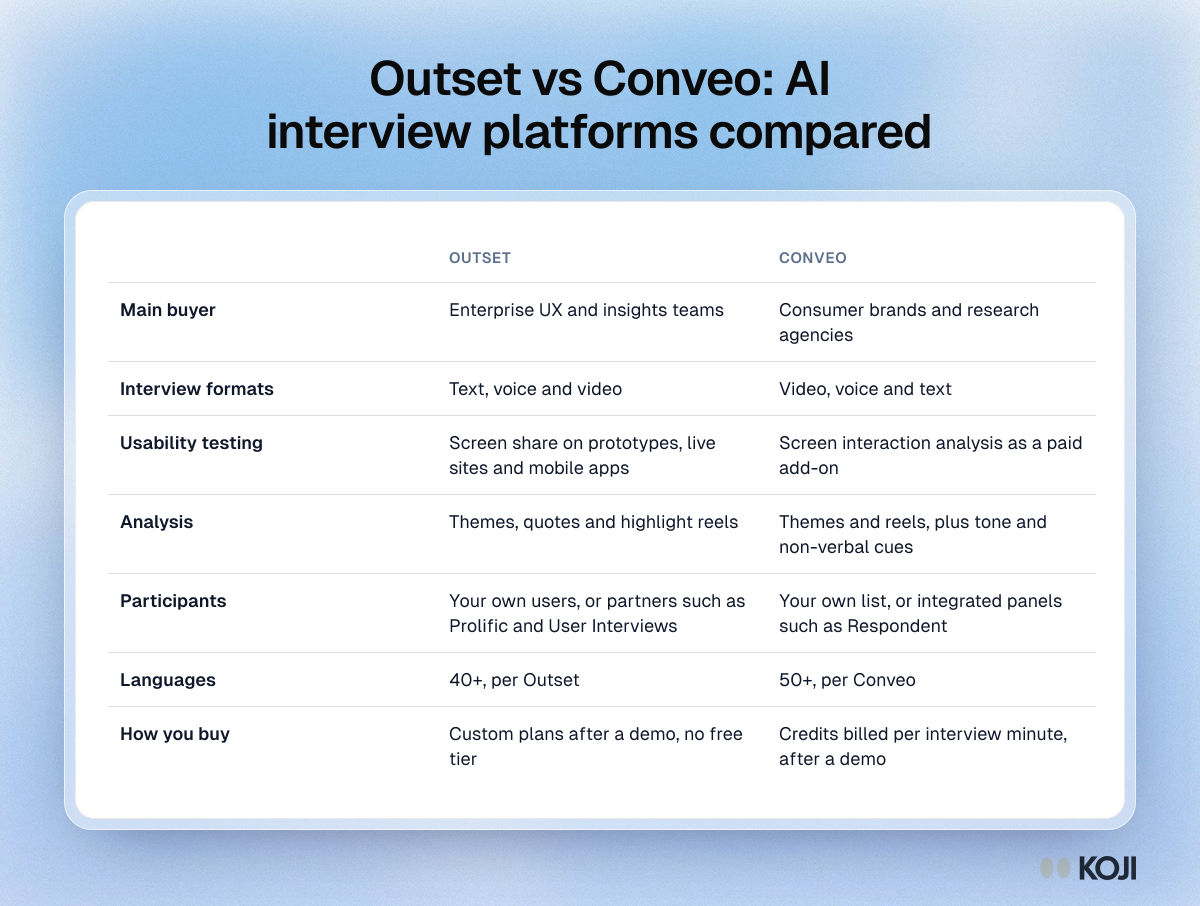
| Outset | Conveo | |
|---|---|---|
| Main buyer | Enterprise UX and insights teams | Consumer brands and research agencies |
| Interview formats | Text, voice and video | Video, voice and text |
| Usability testing | Screen share on prototypes, live sites and mobile apps | Screen interaction analysis as a paid add-on |
| Analysis | Themes, quotes and highlight reels | Themes and reels, plus tone and non-verbal cues |
| Participants | Your own users, or partners such as Prolific and User Interviews | Your own list, or integrated panels such as Respondent |
| Languages | 40+, per Outset | 50+, per Conveo |
| How you buy | Custom plans after a demo, no free tier | Credits billed per interview minute, after a demo |
What Outset does best
Outset was built around one job: let a research team run many more interviews than its people could moderate. Its AI moderator holds conversations by text, voice or video, asks follow-up questions, and can switch into a usability task where the participant shares a screen on a prototype, a live website or a mobile app. Outset says it works in more than 40 languages.
That usability layer is its clearest edge over Conveo. A product designer can ask why someone chose a plan and, in the same session, watch them try to change it. Outset turns the results into summaries, themes, quotes and highlight reels for stakeholders. On security it states SOC 2 Type II, ISO 42001, GDPR and HIPAA, which shortens procurement at large companies.
Outset has no panel of its own. You interview your own users or recruit through partners such as Prolific and User Interviews, which keeps recruitment flexible but adds a second vendor to the bill.
Pricing: Outset's pricing page lists no figures. It describes a standard subscription, a plan with added research support, and enterprise terms. Buyer reports put the entry point at around $20,000 a year, sometimes described as per seat, with panel recruitment on top. We cover the details in Outset pricing.
What Conveo does best
Conveo started from video. Its AI moderator runs video, voice and text interviews with dynamic follow-ups, and its analysis goes past the transcript to tone, facial expression and behaviour. Each theme gets a highlight reel, and each finding links back to the source clip. Conveo says it supports more than 50 languages and works with more than 400 enterprises, including Google, Unilever and AB InBev.
That makes it strongest where emotion is the data: concept tests, ad tests, packaging and brand work, where a stakeholder wants to see a face react rather than read a quote. Participants can join by CSV invite, QR code or WhatsApp, or come from integrated B2C and B2B panels.
Pricing: Conveo bills prepaid credits per interview minute, with an uplift for advanced video analysis such as screen interaction or diary studies. Its agency pricing page shows an example of 1,500 minutes at $5.00 a minute, and Software Advice lists an enterprise starting price of US$45,000. We worked through a full study budget in Conveo pricing.
Where they differ, and why it matters
Usability testing vs emotional response
If your question is "can people complete this task?", Outset's screen sharing on prototypes and apps gives you behaviour you can watch. If your question is "how do people feel about this ad?", Conveo's non-verbal analysis gives you reactions you can show. Both can do some of the other, but each is tuned for one.
Seats vs minutes
Outset's reported model is a subscription, scoped to your team and support needs. Conveo charges by the minute. A seat-style contract rewards teams that run research all year with the same few people. A per-minute model rewards teams with irregular, project-shaped work, but the bill depends on how long participants talk, which is hard to forecast.
Who recruits
Neither runs its own panel in the way Listen Labs does. Outset leans on partners such as Prolific and User Interviews; Conveo integrates several panels, including Respondent. Either way, budget recruitment and incentives as separate lines.
How fast you can start
Neither offers a self-serve signup or a published free trial. Both start with a demo. Outset's own site describes a customer whose focus groups had cost $80,000 and taken five weeks, which shows the comparison both vendors sell against: agency research, not other software.
Who should choose which
Pick Outset if:

Photo by Theme Photos on Unsplash
- Your research team runs usability work alongside interviews and wants one tool for both.
- You need SOC 2, ISO 42001 or HIPAA paperwork for procurement.
- Your research runs all year with a steady team, so a subscription is easy to justify.
Pick Conveo if:
- You are a consumer brand or agency testing creative, concepts or packaging.
- Stakeholders want video reels and emotional reads, not only quotes.
- Your work comes in projects, and a per-minute bill maps cleanly to client budgets.
Pick neither if you need answers from your own customers this week, without a procurement cycle. That is where the buying model matters more than the feature list.
The buying model is the real decision
For many teams, Outset vs Conveo is the wrong first question. The bigger choice is how you want to pay for AI interviews at all:
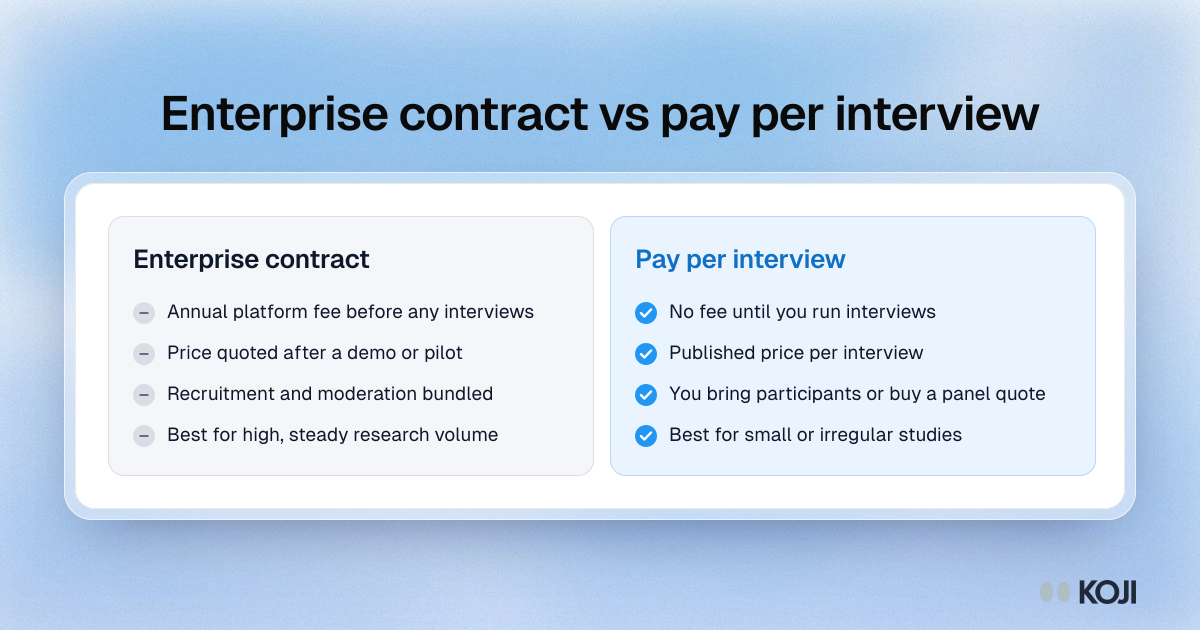
- Enterprise contract: an annual platform fee before any interviews, a price quoted after a demo or pilot, recruitment and moderation bundled, best for high and steady research volume.
- Pay per interview: no fee until you run interviews, a published price per interview, you bring participants or buy a panel quote, best for small or irregular studies.
Outset and Conveo both sit on the left. Lyssna's 2025 synthesis survey of 300 practitioners found that 60.3% say time-consuming manual work is their biggest frustration. AI moderation fixes much of that, but a long sales cycle puts some of the delay back.
The self-serve alternative: Koji
Koji is an AI-native research platform you run yourself. You type what you want to learn, an assistant drafts the research brief, and an AI interviewer holds the conversations by voice or text in 28 languages, or by phone.
- Published, per-interview prices. A qualified text interview uses 1 credit and a voice interview uses 3. Credits cost €1. Sign up with 10 free credits and no card, buy packs as you go, or choose Insights at €29 a month (29 credits) or Interviews at €79 a month (79 credits).
- You only pay for usable interviews. Each interview gets a quality score from 1 to 5, and only those scoring 3 or more use credits or enter the report.
- Numbers and reasons in one study. Six question types, from open ended to ranking and yes/no, each with AI follow-ups you control.
- Recruit your way. Share a link, send personal invite links from a CSV on the Interviews and Enterprise plans, or recruit from Koji's panel on a paid plan and see the cost before launch. Screening questions filter out people who do not fit.
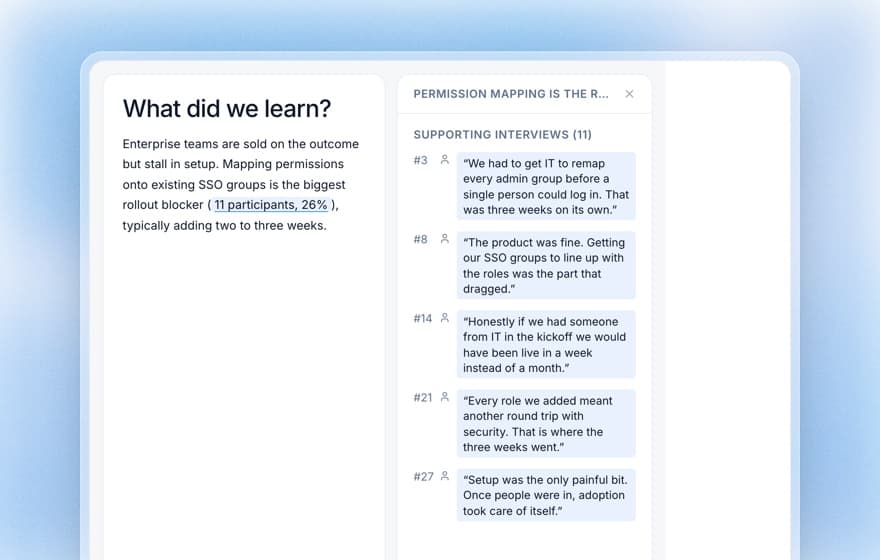
- Findings you can check. Reports show themes, findings, recommended actions and personas, and every finding links to the quotes behind it.
- Run research from your AI assistant. Koji's MCP connector lets you create studies and read reports from Claude and other AI tools.
Where Outset and Conveo are ahead: Koji does not record webcam video or screen shares. If you need usability sessions on a prototype, Outset is the better fit. If you need facial-expression analysis and video reels, choose Conveo.
Start with one real question
The quickest way to compare AI interview platforms is to run the same study on two of them. With Koji you can do it today: type your question, let the assistant draft the brief, preview the interview for free, and send it to ten customers. Then take the transcripts and report into your Outset or Conveo demo and see which answers you still need.
Start free with Koji. 10 credits, no card, and you only pay for interviews that pass the quality bar.
More reading: Koji vs Outset, Koji vs Conveo, Listen Labs vs Outset and Listen Labs vs Conveo.
Sources: Outset pricing page and Series B announcement (December 2025); Conveo billing documentation and agency pricing page; Software Advice listing for Conveo; Axios (September 2026); SiliconANGLE (October 2026); Maze, Future of User Research Report 2026 and 2025; Lyssna, Research Synthesis Report 2025. Pricing figures are buyer reports or vendor examples, not quotes.