Koji Learn · For founders

The founder's research playbook

Every decision from idea to scale, in the order you'll face them, with the research that answers each one: who to talk to, what to ask, how many people you need and how to decide.

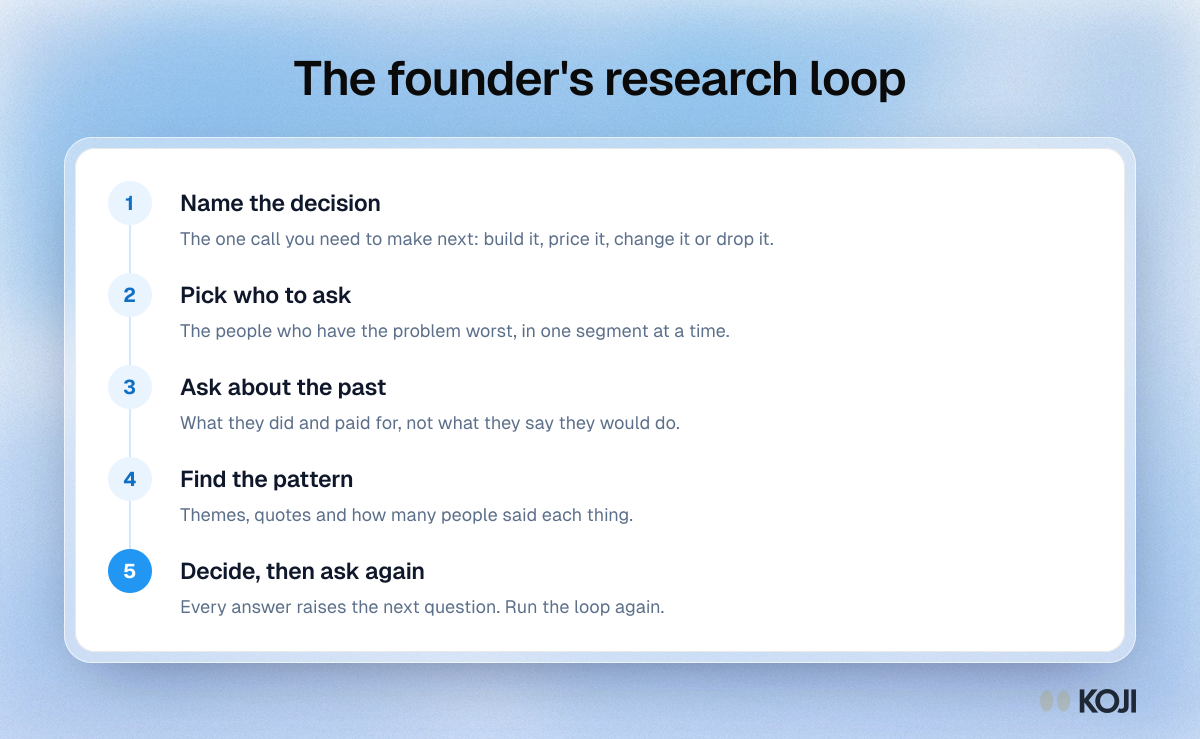
One loop, every stage

The questions change as the company grows. The way to answer them doesn't: name the decision, ask the right people about what they actually did, find the pattern, decide, and ask again.

The founder's research loop in five steps: name the decision, pick who to ask, ask about the past, find the pattern, decide and ask again
The loop behind every stage of the founder's research playbook.
Two women talking at an outdoor cafe table

Stage 1

Before you build

Prove the problem is real, find the people who have it worst, and test the idea before you write code.

  1. Is this problem real, and painful enough to pay for?

    Interview 20 to 30 people who should have the problem about the last time it happened, not about your idea.

  2. Where do I find people to talk to?

    Go where people already talk about the problem: communities, forums, events and your network's network.

  3. Who exactly is my customer?

    Compare who feels the problem most and who already pays to work around it. That group is your first customer.

    Start hereIdeal Customer Profile
  4. Will they want what I plan to build?

    Show the idea only after the problem interviews, and look for commitment, like a signup or a deposit, not compliments.

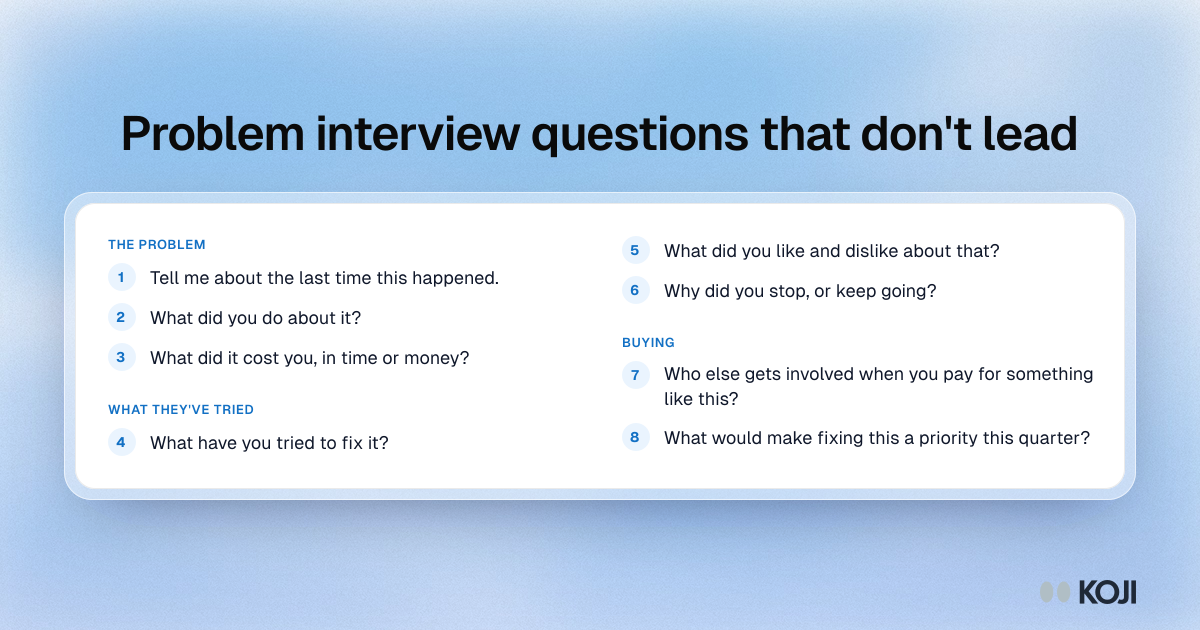
Eight problem interview questions in three groups: the problem, what they've tried, and buying. Each asks about past behaviour, not opinions about the future
Questions about what people did, not what they would do, in the spirit of The Mom Test by Rob Fitzpatrick.
A founder interviewing a customer across an office desk

Stage 2

Finding product-market fit

Test what you show people, set a price, learn why new users stall, and find out whether you have fit.

  1. Does my landing page, demo or concept land?

    Show it to people who fit your customer, ask what they expect it to do, and note where they get confused.

    Start hereConcept Testing
  2. What should I charge?

    Ask recent buyers what they'd pay and why, find the range where it starts to feel expensive, then test it with a real offer.

  3. Why do new users stall before they get value?

    Interview people who signed up in the last two weeks, those who stuck and those who stalled, about their first session.

    Method references

  4. Do we have product-market fit?

    Ask active users how they'd feel if they could no longer use the product. 40% "very disappointed" is the usual bar.

  5. How should we describe what we do?

    Ask your happiest customers what they compared you with and how they'd describe you to a friend, then use their words.

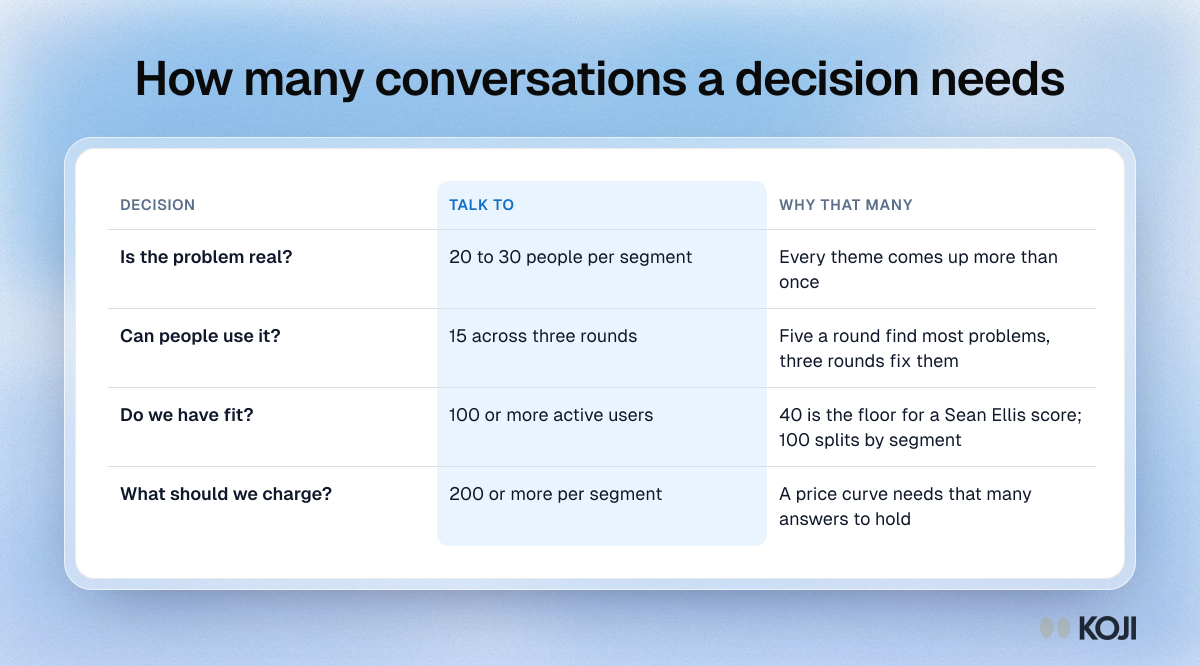
Table of how many people to talk to: 20 to 30 per segment to validate a problem, 15 across three usability rounds, 100 or more active users for a product-market fit score and 200 or more per segment for a price curve
Sources: NN/g on usability and quantitative studies, saturation studies of qualitative interviews, and Superhuman's product-market fit engine. Counts are per segment and sit above the published minimums.
Four people in a meeting around a table

Stage 3

Scaling what works

Keep customers, learn why deals are won and lost, move into new segments, and build a research habit that outlasts the founders.

  1. Why do customers leave?

    Interview customers who left in the last 90 days, and similar ones who stayed, about the moment things changed.

    Start hereChurned Customer Interviews
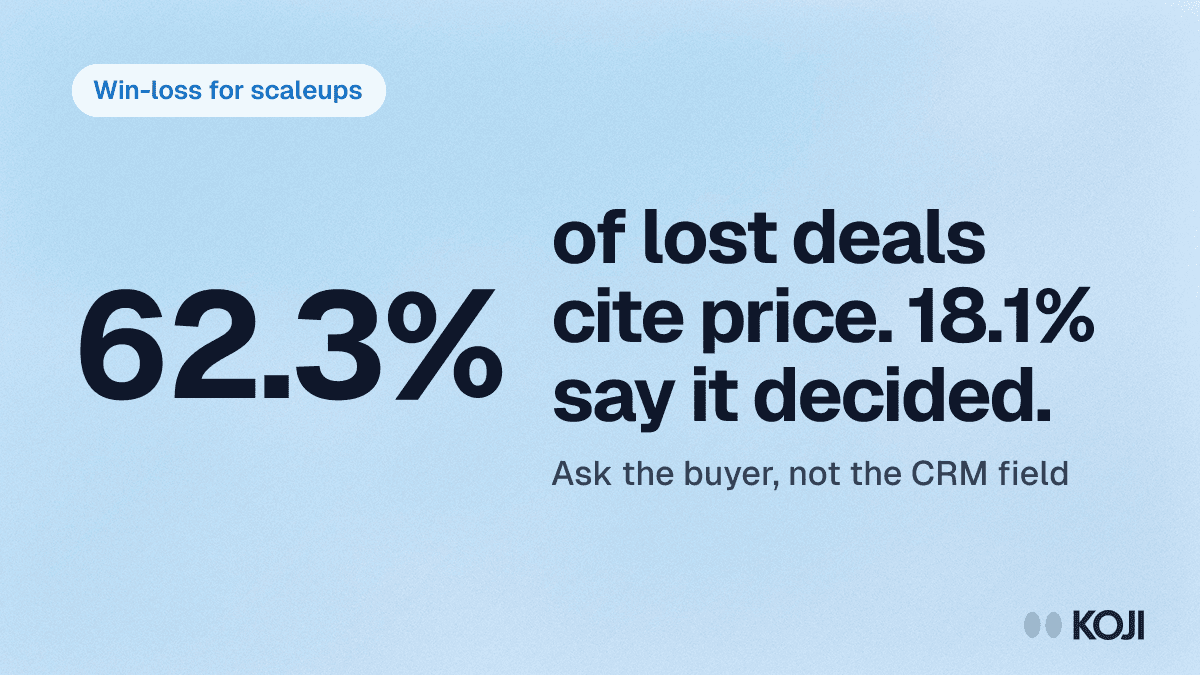
  2. Why do we win and lose deals?

    Talk to buyers within weeks of their decision, wins and losses alike, about how they decided rather than about features.

    Method references

  3. How should our pricing change as we move upmarket?

    Interview recent buyers, lost deals and people who left your pricing page before you change what you publish.

  4. Where is our next segment or market?

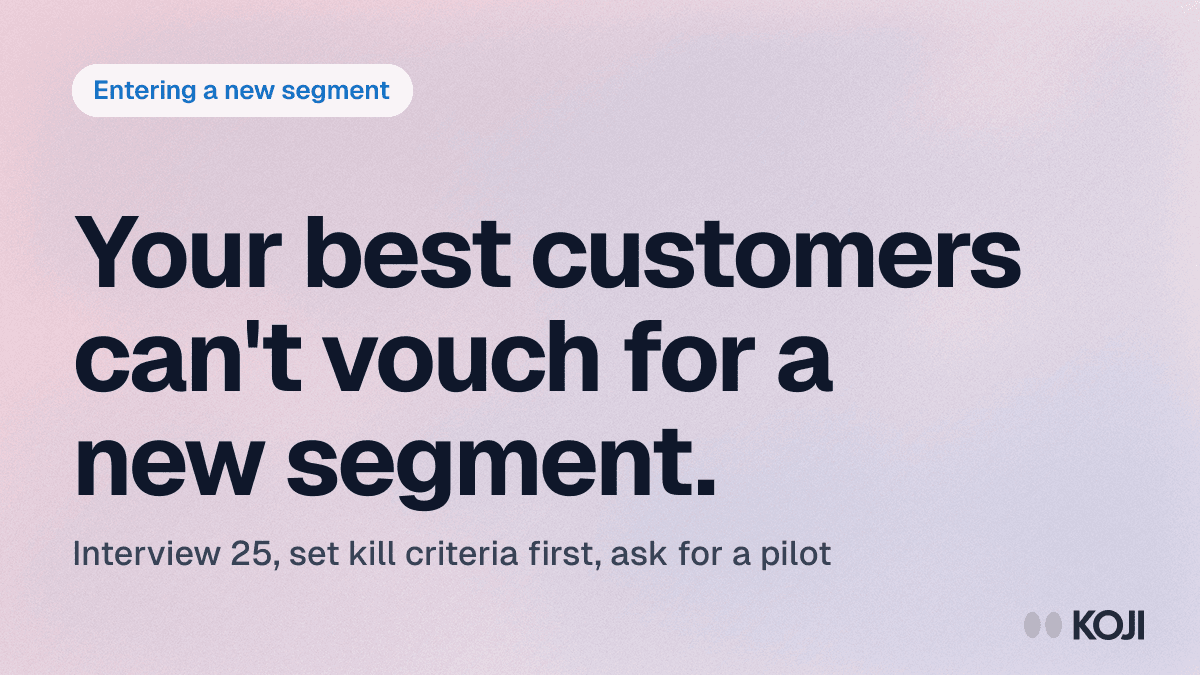
    Interview 20 to 30 people in the new segment before you build for it, and compare them with the customers you have.

  5. When do we hire our first researcher?

    When interviews happen every week and nobody owns them, it's time for someone whose job is research.

    Start hereThe Solo Researcher's Toolkit
Two women having a conversation at a desk

Stage 4

Running a small business

Learn why customers choose you, leave you or never come back, and which price and offer work, on a small budget.

  1. Why do customers leave or not come back?

    Call customers who haven't come back and ask what they did instead the next time they needed you.

  2. What should we charge?

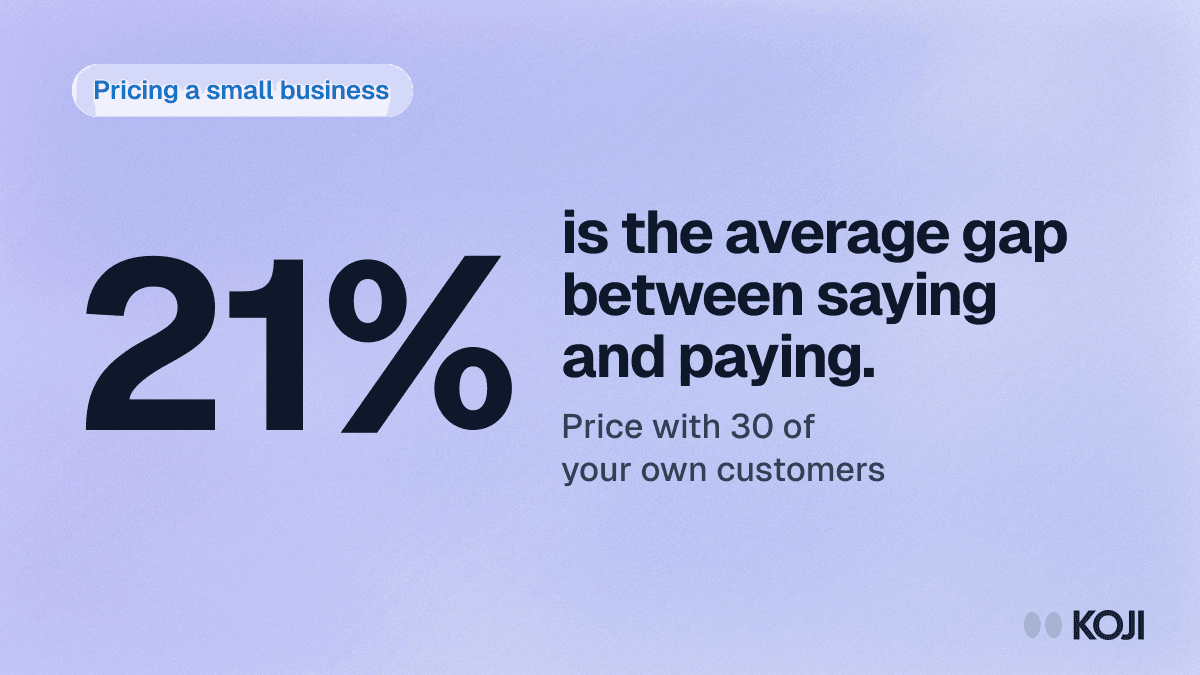
    Ask recent customers what they'd expect to pay and at what price they'd go elsewhere.

  3. Which offer or message works best?

    Show two versions of the offer to people like your customers and ask which they'd pick and why.

    Start hereConcept Testing
  4. How do I get customers to talk to me?

    Ask at checkout, on the receipt or by text, and offer a small thank-you for ten minutes of their time.

More founder playbooks

A young woman with headphones talking outdoors

Run your next customer conversations with Koji

AI interviews by voice, text or phone, with your own customers or a panel, and a report you can take to your team.

See the Koji journey for your stage

Photos by Vitaly Gariev on Unsplash.