Reference table
What four reviews found about clickers
Audience response systems and polling: effects on learning, engagement and exam scores
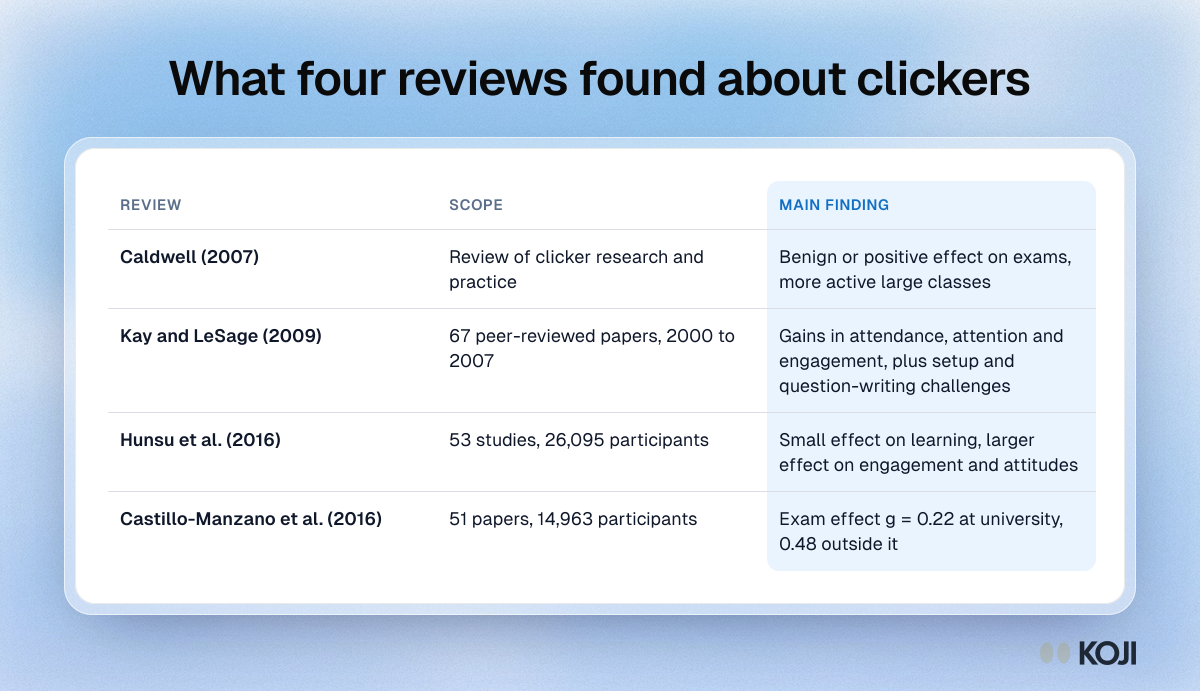
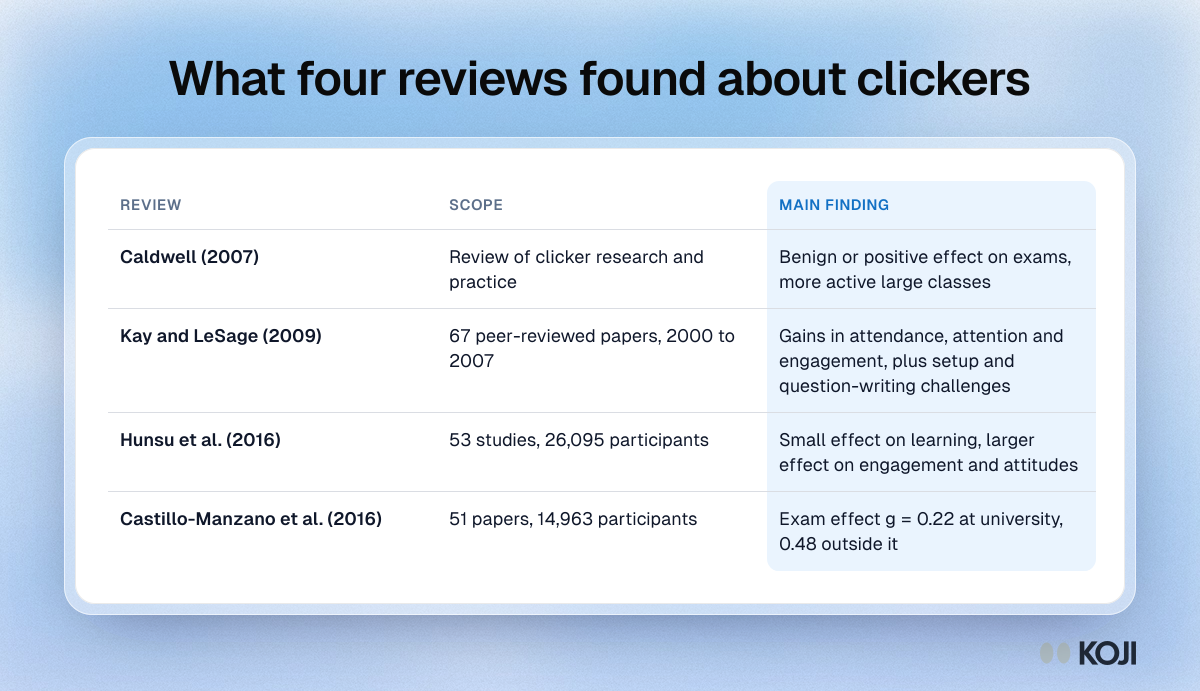
A table of four reviews of clickers and audience response systems in education: Caldwell (2007), Kay and LeSage (2009), the Hunsu, Adesope and Bayly (2016) meta-analysis and Castillo-Manzano and colleagues (2016). It shows each review's scope and main finding. It is meant for programme leads deciding how to evaluate in-class polling. Koji course evaluation interviews can ask students what the questions asked them to do, which the reviews point to as the factor that matters.
What's in this reference table
| Review | Scope | Main finding |
|---|---|---|
| Caldwell (2007) | Review of clicker research and practice | Benign or positive effect on exams, more active large classes |
| Kay and LeSage (2009) | 67 peer-reviewed papers, 2000 to 2007 | Gains in attendance, attention and engagement, plus setup and question-writing challenges |
| Hunsu et al. (2016) | 53 studies, 26,095 participants | Small effect on learning, larger effect on engagement and attitudes |
| Castillo-Manzano et al. (2016) | 51 papers, 14,963 participants | Exam effect g = 0.22 at university, 0.48 outside it |
Use this image
Free to use in your docs, decks and posts under CC BY 4.0, as long as you credit Koji with a link to this page. To embed it, paste this into your page:
html
<a href="https://www.koji.so/visuals/clicker-audience-response-system-reviews-compared"><img src="https://www.koji.so/visuals/clicker-audience-response-system-reviews-compared/clicker-audience-response-system-reviews-compared.png" alt="Table comparing four reviews of clickers and audience response systems: small effects on learning, larger effects on engagement and attitudes." width="1200" height="691" /></a>
<p>Source: <a href="https://www.koji.so/visuals/clicker-audience-response-system-reviews-compared">What four reviews found about clickers</a>, Koji</p>