Reference table
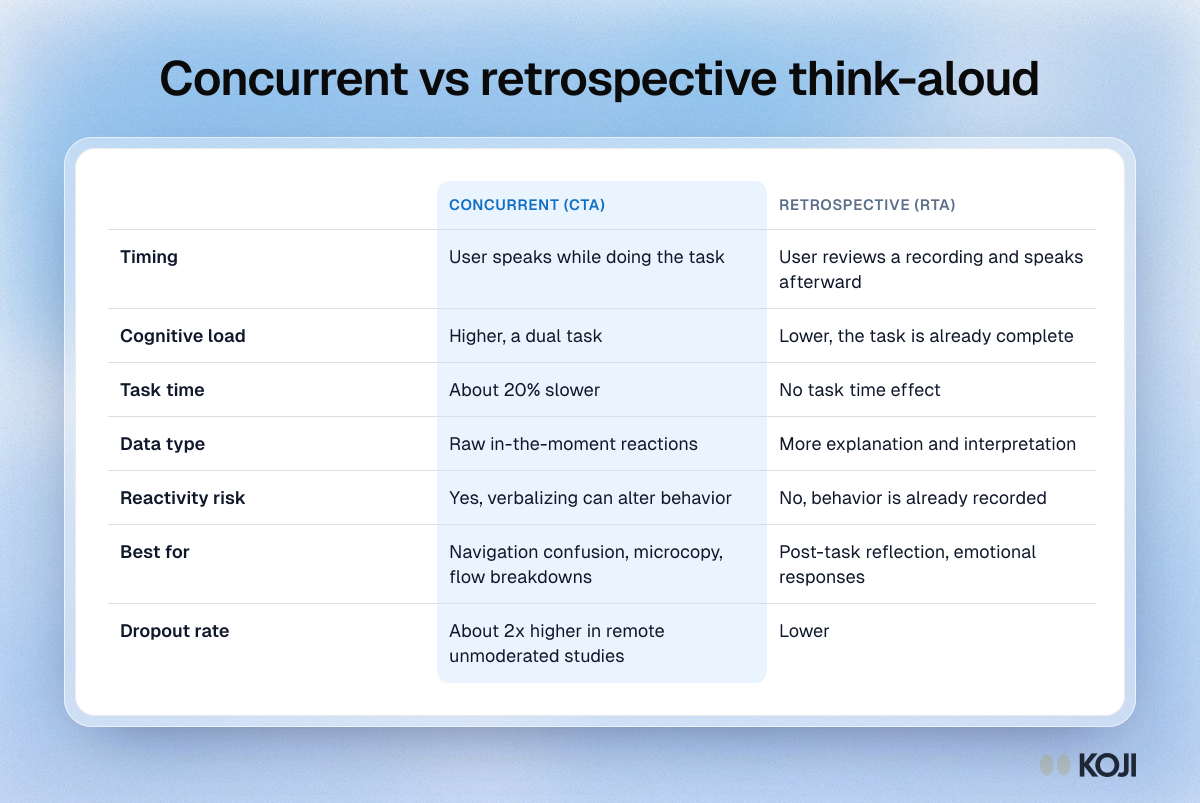
Concurrent vs retrospective think-aloud
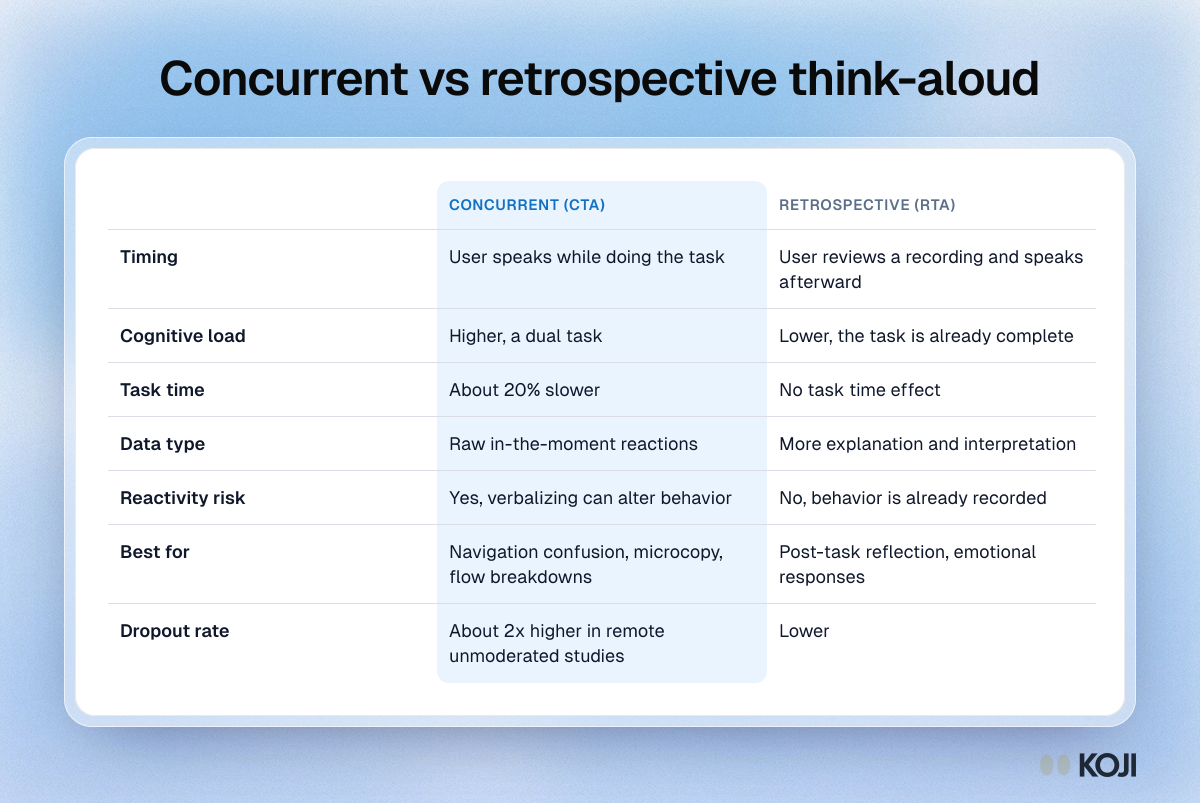
Concurrent think-aloud has participants speak while they work, which captures raw reactions but slows the task and can change behavior. Retrospective think-aloud has them narrate a recording afterward, which gives more explanation and no task-time effect. Use this comparison to choose the variant before planning a usability session.
Where this appears
What's in this reference table
| Concurrent (CTA) | Retrospective (RTA) | |
|---|---|---|
| Timing | User speaks while doing the task | User reviews a recording and speaks afterward |
| Cognitive load | Higher, a dual task | Lower, the task is already complete |
| Task time | About 20% slower | No task time effect |
| Data type | Raw in-the-moment reactions | More explanation and interpretation |
| Reactivity risk | Yes, verbalizing can alter behavior | No, behavior is already recorded |
| Best for | Navigation confusion, microcopy, flow breakdowns | Post-task reflection, emotional responses |
| Dropout rate | About 2x higher in remote unmoderated studies | Lower |
Use this image
Free to use in your docs, decks and posts under CC BY 4.0, as long as you credit Koji with a link to this page. To embed it, paste this into your page:
html
<a href="https://www.koji.so/visuals/concurrent-vs-retrospective-think-aloud"><img src="https://www.koji.so/visuals/concurrent-vs-retrospective-think-aloud/concurrent-vs-retrospective-think-aloud.png" alt="Table comparing concurrent and retrospective think-aloud across timing, cognitive load, task time, data type, reactivity risk, best use and dropout rate." width="1200" height="803" /></a>
<p>Source: <a href="https://www.koji.so/visuals/concurrent-vs-retrospective-think-aloud">Concurrent vs retrospective think-aloud</a>, Koji</p>