Process
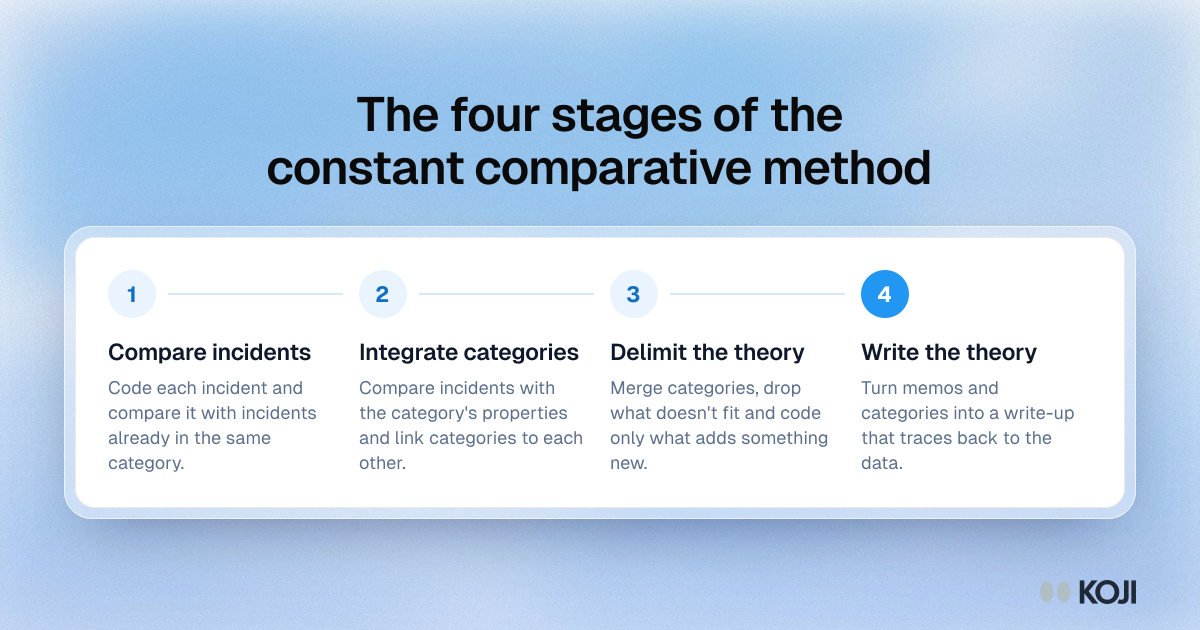
The four stages of the constant comparative method
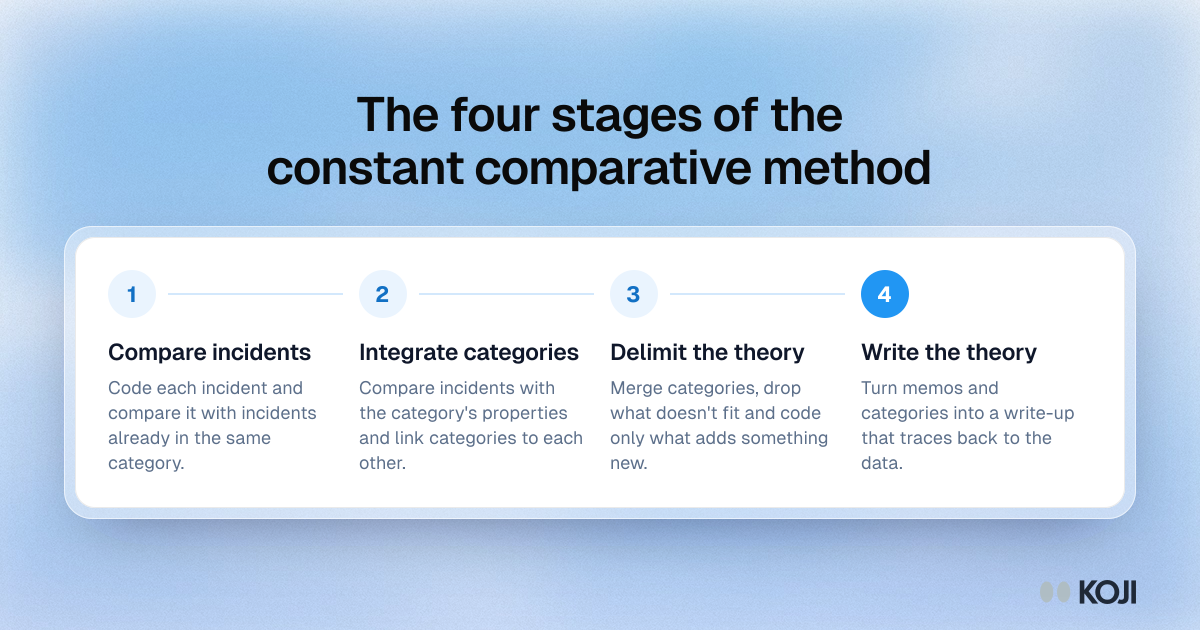
The four stages of the constant comparative method, the core analysis technique of grounded theory set out by Barney Glaser and Anselm Strauss. Each new piece of data is compared with what has already been coded, while data collection is still going on. Use it to plan qualitative analysis that builds categories from the data instead of sorting it into fixed boxes. Koji supports constant comparison by coding each interview as soon as it ends and grouping related answers across interviews.
Where this appears
What's in this process
- Compare incidents: Code each incident and compare it with incidents already in the same category.
- Integrate categories: Compare incidents with the category's properties and link categories to each other.
- Delimit the theory: Merge categories, drop what doesn't fit and code only what adds something new.
- Write the theory: Turn memos and categories into a write-up that traces back to the data.
Use this image
Free to use in your docs, decks and posts under CC BY 4.0, as long as you credit Koji with a link to this page. To embed it, paste this into your page:
html
<a href="https://www.koji.so/visuals/constant-comparative-method-four-stages"><img src="https://www.koji.so/visuals/constant-comparative-method-four-stages/constant-comparative-method-four-stages.png" alt="Process showing the four stages of the constant comparative method: compare incidents, integrate categories, delimit the theory and write the theory." width="1200" height="630" /></a>
<p>Source: <a href="https://www.koji.so/visuals/constant-comparative-method-four-stages">The four stages of the constant comparative method</a>, Koji</p>