Reference table
Is this score good? Three ways to answer
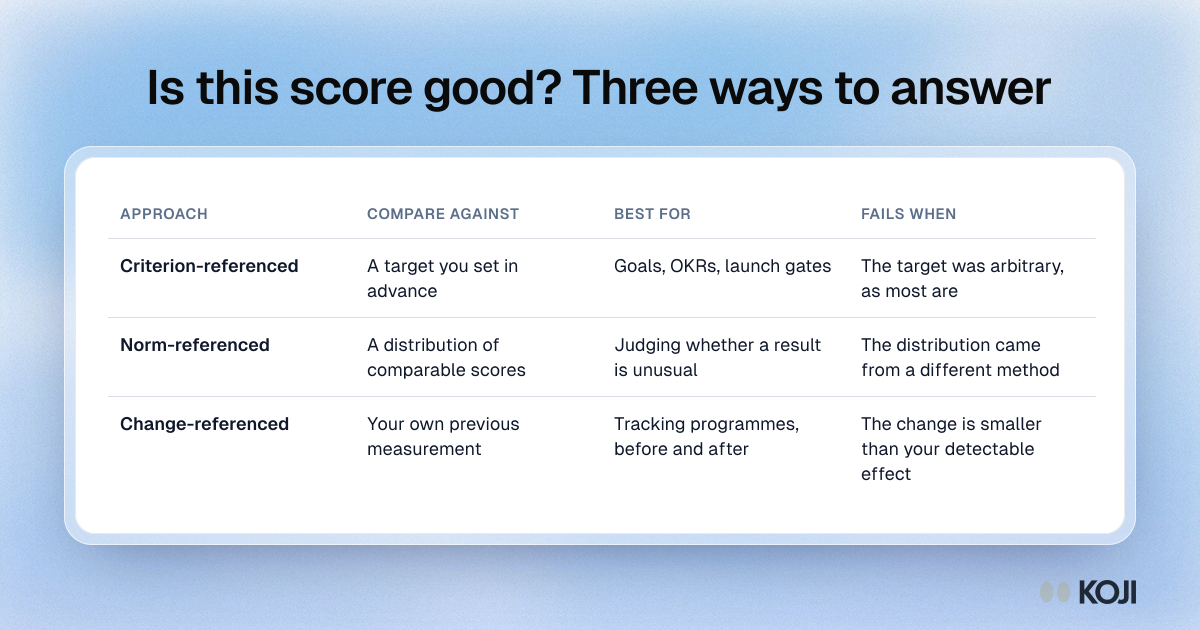
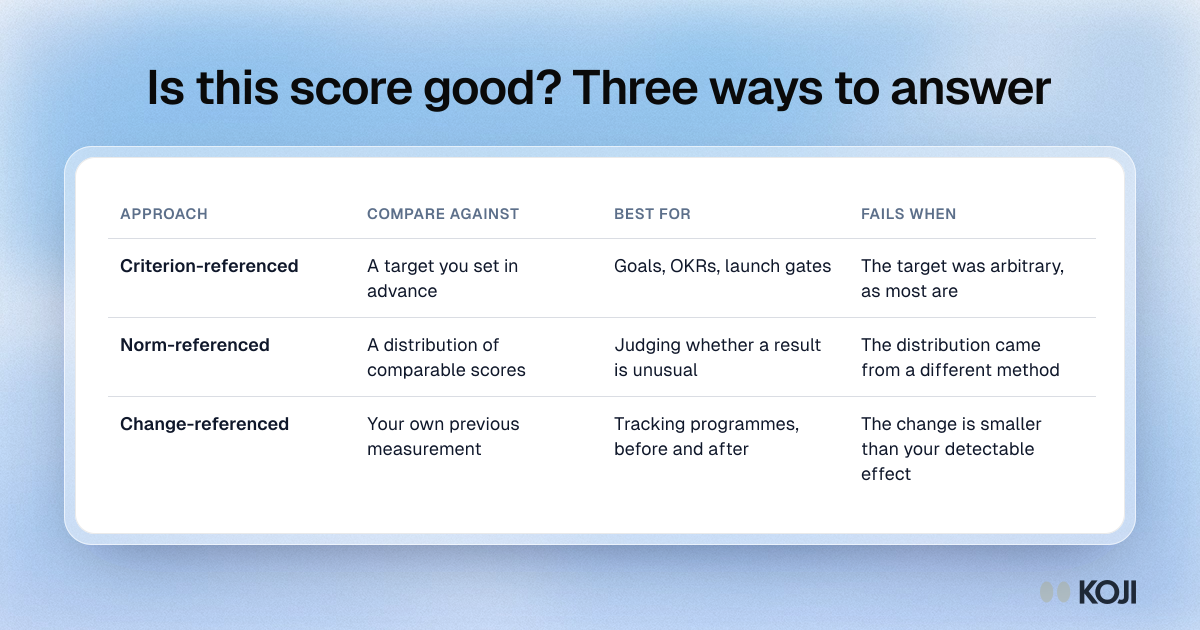
A comparison of three legitimate ways to judge whether a survey or research score is good: against a target set in advance, against a distribution of comparable scores, or against your own previous result. Each row says what it is best for and when it breaks down. Use it before quoting a benchmark next to your number. Koji's structured questions keep wording and scale fixed across waves, which is what makes norm-referencing against your own history valid.
Where this appears
What's in this reference table
| Approach | Compare against | Best for | Fails when |
|---|---|---|---|
| Criterion-referenced | A target you set in advance | Goals, OKRs, launch gates | The target was arbitrary, as most are |
| Norm-referenced | A distribution of comparable scores | Judging whether a result is unusual | The distribution came from a different method |
| Change-referenced | Your own previous measurement | Tracking programmes, before and after | The change is smaller than your detectable effect |
Use this image
Free to use in your docs, decks and posts under CC BY 4.0, as long as you credit Koji with a link to this page. To embed it, paste this into your page:
html
<a href="https://www.koji.so/visuals/criterion-norm-change-referenced-score-comparison"><img src="https://www.koji.so/visuals/criterion-norm-change-referenced-score-comparison/criterion-norm-change-referenced-score-comparison.png" alt="Table comparing criterion, norm and change-referenced ways to judge a score: what each compares against, its best use and when it fails." width="1200" height="630" /></a>
<p>Source: <a href="https://www.koji.so/visuals/criterion-norm-change-referenced-score-comparison">Is this score good? Three ways to answer</a>, Koji</p>