Process
How to do discourse analysis on interview transcripts
A six-step method for UX and customer researchers
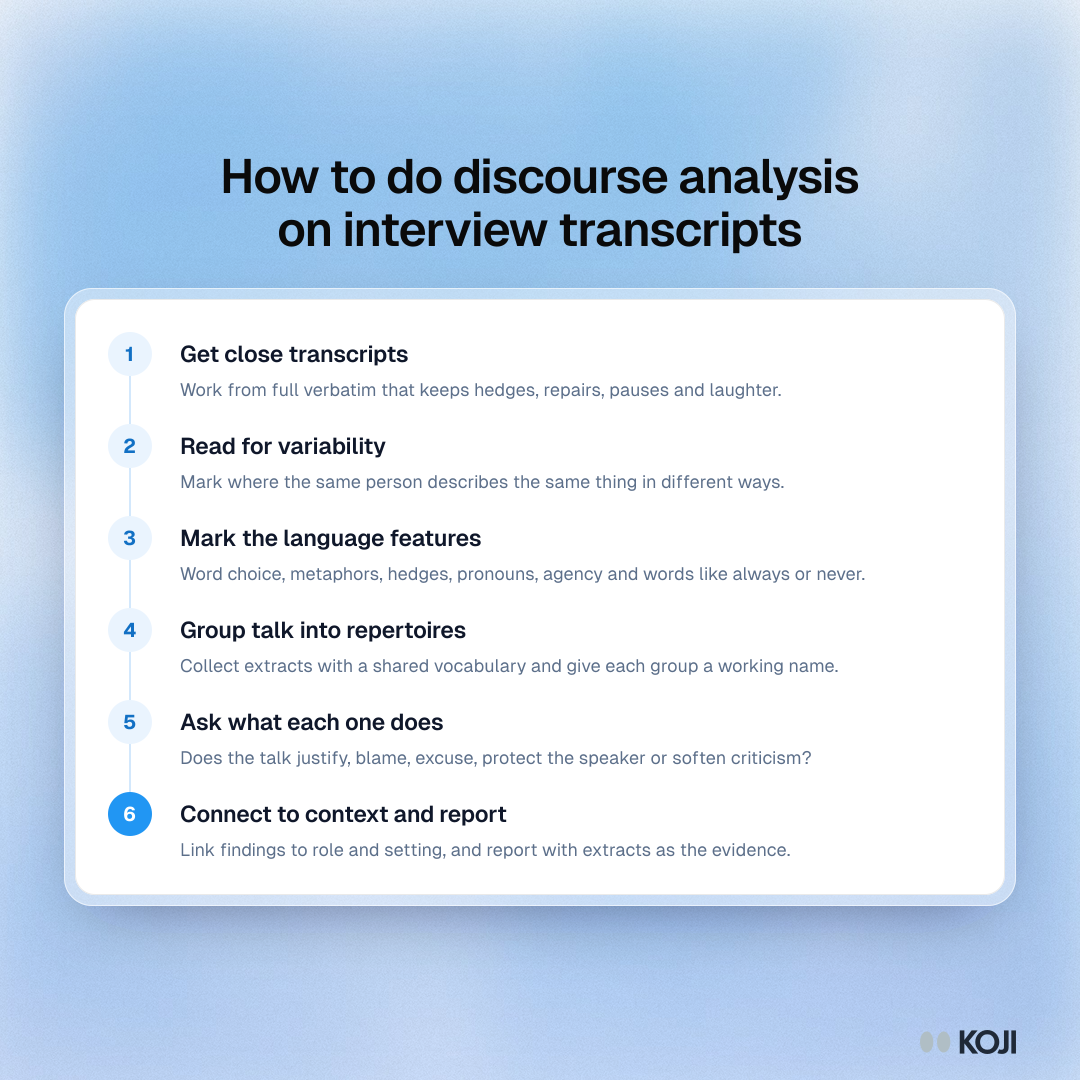
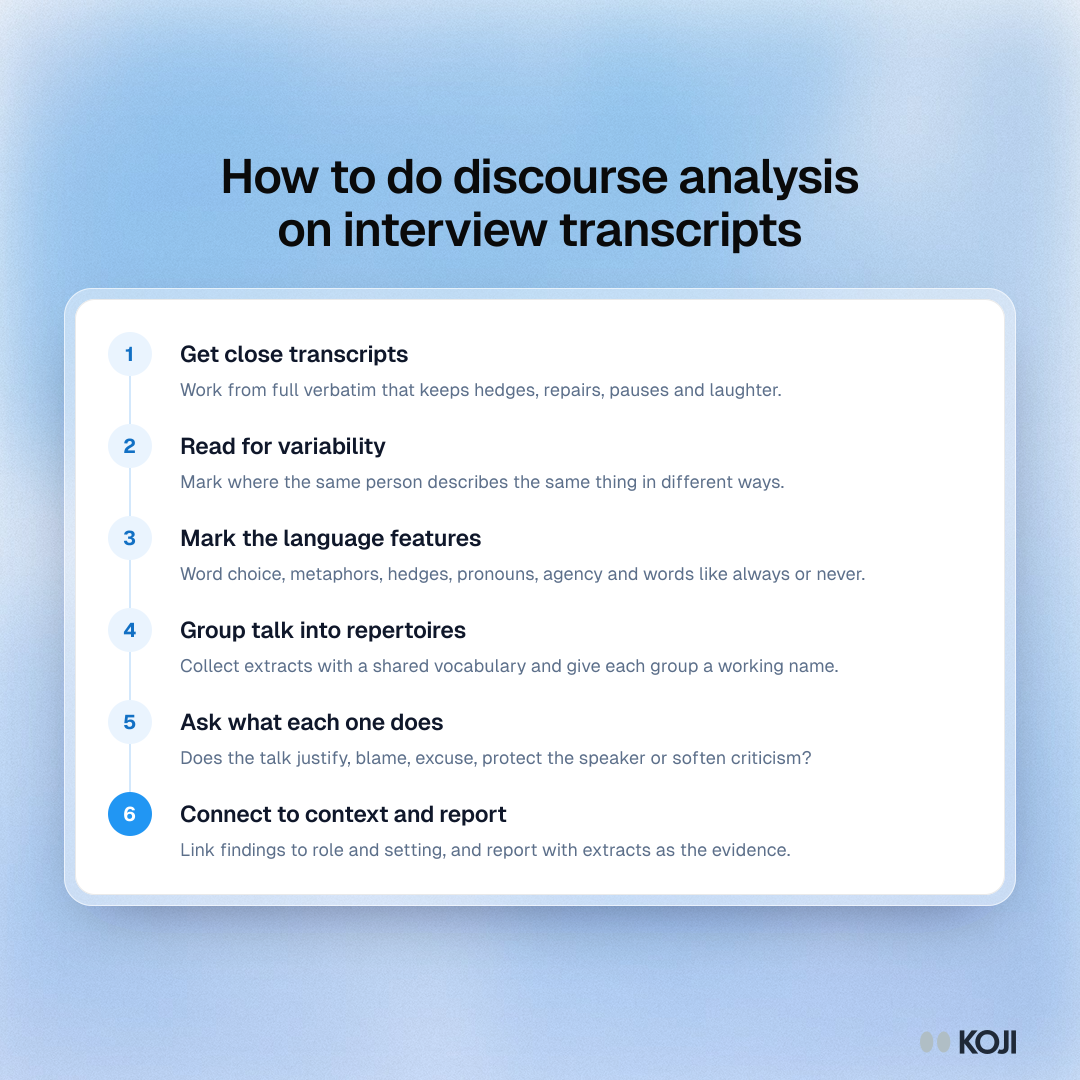
A six-step process for applying discourse analysis to customer and user interviews: get close transcripts, read for variability, mark language features, group talk into interpretative repertoires, ask what each one does, then connect it to context and report with extracts. It suits researchers who want to understand how people justify, blame or frame decisions, not only what they said. Koji supplies verbatim transcripts and quotes from AI-moderated interviews to start from.
Where this appears
What's in this process
- Get close transcripts: Work from full verbatim that keeps hedges, repairs, pauses and laughter.
- Read for variability: Mark where the same person describes the same thing in different ways.
- Mark the language features: Word choice, metaphors, hedges, pronouns, agency and words like always or never.
- Group talk into repertoires: Collect extracts with a shared vocabulary and give each group a working name.
- Ask what each one does: Does the talk justify, blame, excuse, protect the speaker or soften criticism?
- Connect to context and report: Link findings to role and setting, and report with extracts as the evidence.
Use this image
Free to use in your docs, decks and posts under CC BY 4.0, as long as you credit Koji with a link to this page. To embed it, paste this into your page:
html
<a href="https://www.koji.so/visuals/discourse-analysis-steps-interview-transcripts"><img src="https://www.koji.so/visuals/discourse-analysis-steps-interview-transcripts/discourse-analysis-steps-interview-transcripts.png" alt="Process for doing discourse analysis on interview transcripts in six steps, from close transcription to reporting with extracts" width="1080" height="1080" /></a>
<p>Source: <a href="https://www.koji.so/visuals/discourse-analysis-steps-interview-transcripts">How to do discourse analysis on interview transcripts</a>, Koji</p>