Discourse Analysis for User Research: Reading How People Talk, Not Just What They Say
A practical guide to discourse analysis for UX and customer researchers: the main approaches, how it differs from thematic and content analysis, a step-by-step method for interview transcripts, and common mistakes.
Short answer: Discourse analysis studies how people use language to describe, explain and justify things, and what that language does. Where thematic analysis asks "what did people say?", discourse analysis asks "how did they say it, and why that way?" In user research, that means looking at word choice, metaphors, hedges, who people blame or credit, and the different ways the same person talks about the same product. Use it when language itself is the research question: positioning and messaging, trust and blame after an incident, how teams justify buying or dropping a tool, or why survey scores and interview stories don't match. It needs close, verbatim transcripts and a small number of rich interviews, not hundreds of short answers.
This guide explains what discourse analysis is, the main approaches, how it compares with thematic and content analysis, a six-step method for interview data, a worked example and the mistakes to avoid.
What discourse analysis is
Discourse analysis is a family of qualitative methods that treat talk and text as action, not as a window onto what people "really" think. When a customer says "we sort of outgrew it", they are not only reporting a fact. They are giving an account that protects their team's judgement, avoids blaming anyone and makes leaving sound natural.
Two ideas sit underneath most versions of the method:
- Language constructs. People choose among many possible descriptions of the same event. The one they pick shapes how the event is understood.
- Language does things. Accounts blame, excuse, justify, persuade, build identity and manage how the speaker comes across.
The evidence that word choice changes meaning is strong. In Loftus and Palmer's 1974 study in the Journal of Verbal Learning and Verbal Behavior, people who watched the same film of a car crash estimated an average speed of 40.8 mph when asked how fast the cars were going when they "smashed" into each other, and 34.0 mph when the verb was "hit". A week later, 16 of 50 people in the "smashed" group (32%) said they had seen broken glass, compared with 7 of 50 (14%) in the "hit" group. There was no broken glass in the film. If one verb can shift memory that much, the words participants choose in an interview are worth reading closely.
The main approaches
You don't need to pick a school to start, but it helps to know what each one looks for.
Discursive psychology and interpretative repertoires
Jonathan Potter and Margaret Wetherell's Discourse and Social Psychology (1987) set out an approach that looks at how everyday talk builds versions of the world. Their key tool is the interpretative repertoire, which they describe as "recurrently used systems of terms used for characterizing and evaluating actions, events and other phenomena."
In product research, repertoires show up quickly. A team might describe the same analytics tool in a "control" repertoire ("it keeps everyone honest", "we finally have one source of truth") and in a "surveillance" repertoire ("it's watching what we do", "management checks it"). Neither is the true view. Both are available, and people switch between them depending on what they are trying to do in the conversation. Discursive psychology also pays attention to variability: when the same person describes something in two different ways, that inconsistency is data, not noise.
Critical discourse analysis
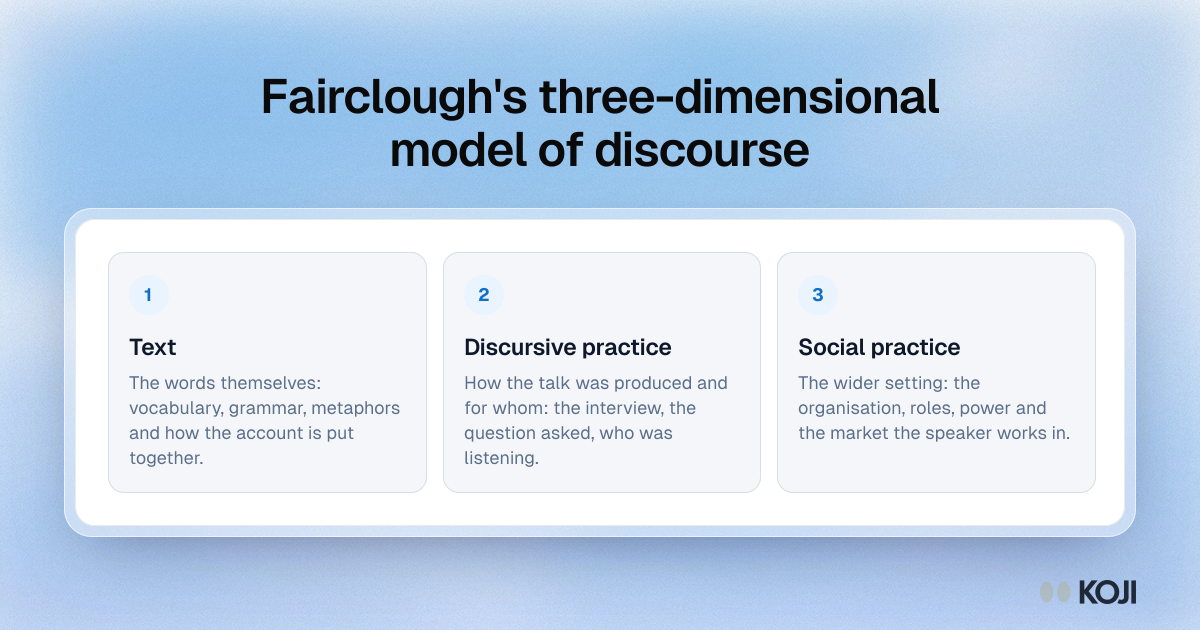
Norman Fairclough's critical discourse analysis (CDA), set out in Discourse and Social Change (1992), links language to power. His three-dimensional model reads any piece of talk at three levels: the text itself (vocabulary, grammar, structure), the discursive practice (how the text was produced and who it was for) and the social practice (the wider organisational or cultural context). CDA fits research on workplace tools, procurement, compliance and any setting where some voices carry more weight than others.
Metaphor analysis
George Lakoff and Mark Johnson argued in Metaphors We Live By (1980) that "the essence of metaphor is understanding and experiencing one kind of thing in terms of another." Customers do this all the time. A tool that is "a black box", "a second brain" or "a tax we pay every month" is being understood through three very different frames. Mapping these metaphors across interviews is one of the fastest ways into discourse analysis for product teams, and it feeds straight into positioning work.
Framing
Framing research shows that logically identical descriptions lead to different choices. In Tversky and Kahneman's 1981 study in Science, 72% of participants chose the safe programme when outcomes were described as lives saved, but only 22% chose the same programme when it was described as deaths. In interviews, listen for how people frame their own decisions (gains or losses, risks or opportunities) and how your questions frame them back.
Discourse analysis vs thematic and content analysis
The three methods can use the same transcripts but ask different questions.
| Content analysis | Thematic analysis | Discourse analysis | |
|---|---|---|---|
| Main question | How often does X appear? | What patterns of meaning are there? | How is this built, and what does it do? |
| Unit | Words, codes, categories | Themes across the dataset | Extracts of talk in context |
| Transcript needed | Clean verbatim | Clean verbatim | Full verbatim, often with pauses and overlaps |
| Typical sample | Large | Moderate | Small and rich |
| Output | Counts and categories | Themes with quotes | Repertoires, positions and functions, shown through extracts |
Thematic analysis treats language mostly as a route to what people mean. Discourse analysis treats language as the thing being studied. Many teams use both: thematic analysis to map what came up, then discourse analysis on a few themes where the wording seemed to matter. See thematic analysis vs content analysis for the other comparison.
How to do discourse analysis on interview data
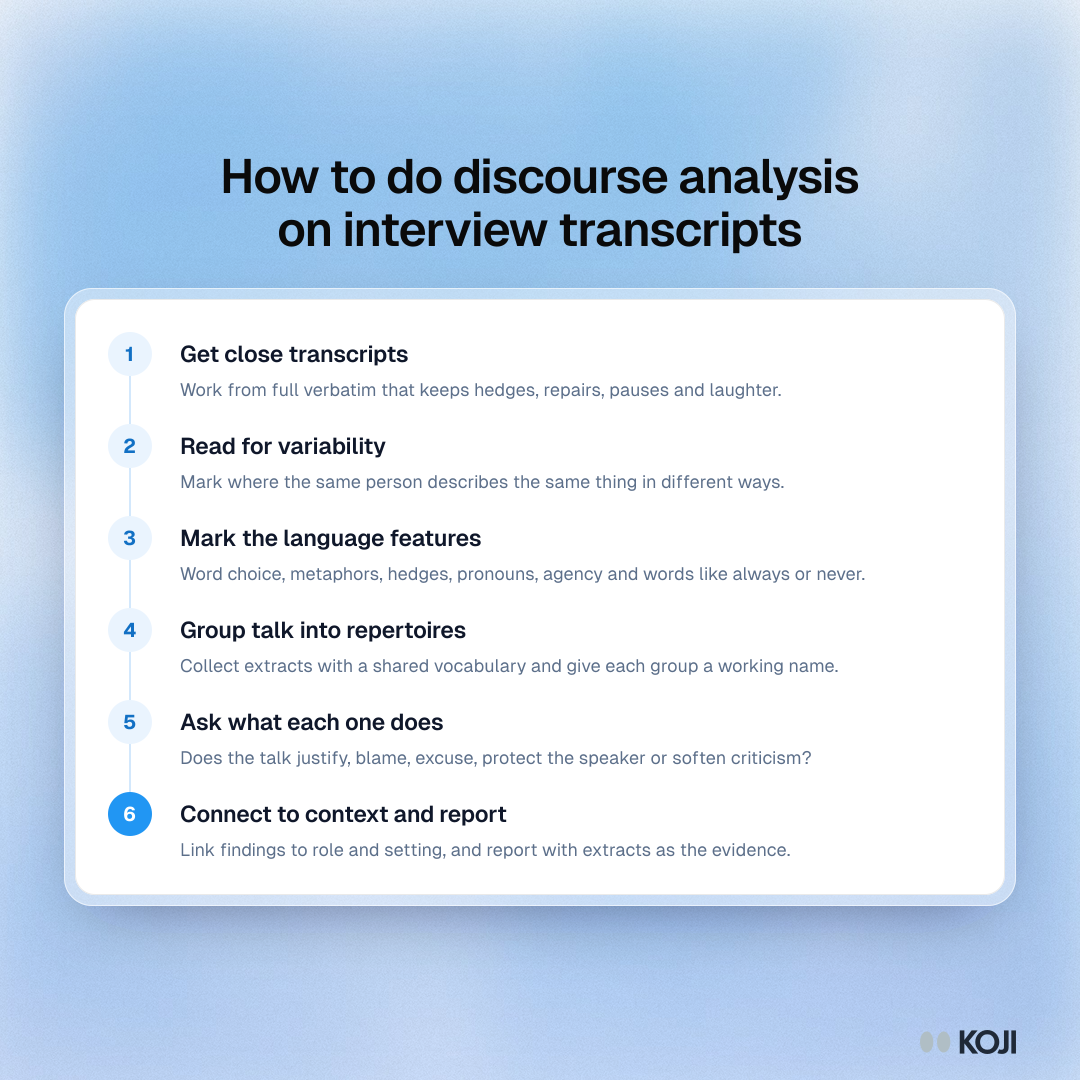
1. Get close transcripts
Work from full verbatim transcripts that keep hedges, repairs, pauses and laughter. A clean transcript removes much of what you need. See verbatim vs clean verbatim transcription.
2. Read for variability
Read each interview through before you code anything. Mark places where the same person describes the same thing in different ways, or contradicts themselves. "It's really easy to use" early on and "nobody on my team can figure it out" later is not a mistake to tidy away. Ask what each version is doing.
3. Mark the language features
Go through again and mark:
- Word choice and labels: "users" or "people", "the system" or "our tool", "switch" or "escape"
- Metaphors: what is the product being compared to?
- Hedges and intensifiers: "kind of", "I guess", "honestly", "literally"
- Pronouns and positioning: when does "we" become "they"? Who is the expert, who is the victim, who is to blame?
- Agency: "the data got lost" (no one did it) versus "IT lost the data"
- Extreme case formulations: "always", "never", "everyone"
4. Group recurring language into repertoires
Collect extracts that use a similar vocabulary and way of evaluating things. Give each group a working name, such as "tool as safety net" or "tool as overhead". Look for at least two or three competing repertoires around the same topic.
5. Ask what each one does
For each repertoire and each strong extract, ask what the talk achieves. Is it justifying a decision, protecting the speaker's competence, softening criticism for the interviewer, or making a problem sound like someone else's? This is the heart of the method.
6. Connect to context and report with extracts
Link what you found to the setting: the person's role, their organisation, the interview itself and the market. Then report with extracts, each introduced and followed by your reading of it. In discourse analysis, the extract is the evidence. A count of how many people used a repertoire can help, but it is not the finding.
A short worked example
Three participants describe cancelling a project management tool:
- P03: "We kind of outgrew it, honestly. It was great when we were five people."
- P07: "Leadership moved us to something else. Not my call."
- P11: "It just didn't stick. People went back to spreadsheets."
A thematic reading might code all three as "churn: team change". A discourse reading notices three different accounts. P03 uses a growth repertoire that makes leaving a sign of success and keeps praise for the product. P07 removes their own agency and places the decision with leadership. P11 uses agentless phrasing ("it didn't stick") that blames no one. For a retention team, these suggest three different conversations: one about scaling, one with economic buyers, and one about habit and adoption.
Interviewing for discourse analysis
Discourse analysis depends on the interview as much as on the analysis. A few habits help:

Photo by Christina @ wocintechchat.com M on Unsplash
- Ask for accounts, not opinions. "Tell me about the last time you..." produces richer language than "Do you like...?"
- Use the participant's words back. If they say "babysitting the tool", ask about babysitting. Don't swap in your term.
- Don't fill pauses. A pause before an answer is often where the hedge or repair appears.
- Notice your own framing. Your question is part of the discourse. "What frustrated you?" invites a complaint repertoire.
- Record and transcribe fully. Notes alone lose the wording.
Common mistakes
Treating it as fancy thematic analysis. If your output is a list of topics with quotes, you have done thematic analysis. Discourse analysis explains how talk works.
Reading intent into every word. Not every "kind of" is strategic. Base claims on patterns across several extracts, and show the extracts.
Ignoring the interviewer. The interviewer's questions shape the talk. Include them in the extracts you analyse.
Analysing translations. Work in the original language where possible, and treat translated extracts with care.
Too much data. A dozen rich interviews analysed closely beat a hundred analysed lightly.
How Koji helps
Discourse analysis is slow by hand: recruiting, running long interviews, transcribing in full and pulling extracts. Survey tools rarely help, because short typed answers with no follow-up don't give you much talk to analyse. Koji speeds up the parts around the close reading, which stays your job.
- Conversational interviews at scale. Koji runs AI-moderated interviews by voice or text, with follow-up probing on open questions, so participants give accounts in their own words rather than one-line answers.
- Verbatim transcripts. Voice interviews are transcribed automatically and kept as transcribed, without a filler-stripping pass, so hedges and repairs stay in. Each message is labelled by speaker and timestamped, and the interviewer's questions are in the transcript too.
- Quotes tied to the exact words. Koji's analysis attaches each finding to a verbatim quote from the participant, kept in the original language, fillers included. That gives you a fast first pass of candidate extracts.
- Themes first, then close reading. Koji's report groups what came up into themes and findings, with the supporting quotes one click away. Use it as your thematic map, then pick the themes where wording seems to matter for discourse analysis.
- Export for your own analysis. Download a transcript as CSV, or export a whole study as CSV or JSON, and bring it into your coding tool for the detailed work.
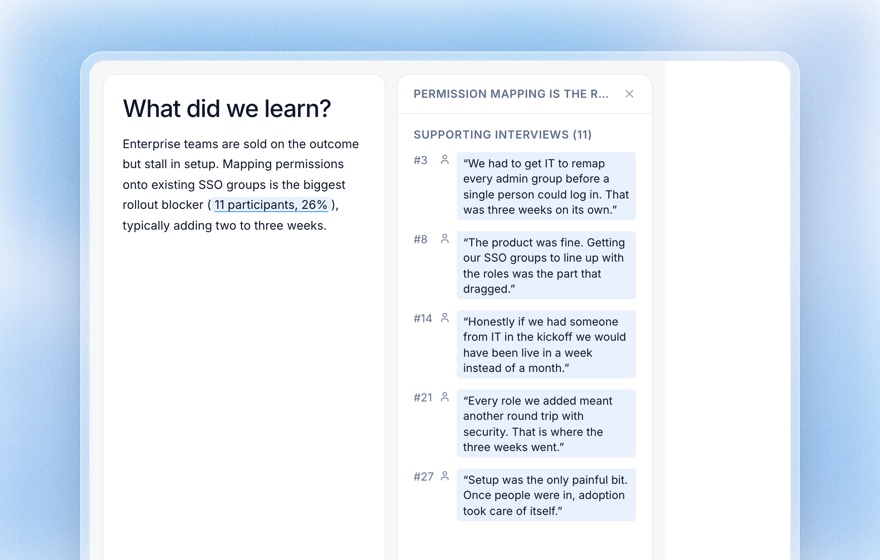
Koji's analysis is thematic. It tells you what came up and how often, and it keeps the words. Reading how those words are used is the discourse analyst's part.
Related Resources
- Thematic Analysis Guide
- Thematic Analysis vs Content Analysis
- Narrative Analysis Guide
- Conversational Implicature in Interview Answers
- Structured Questions Guide
- Verbatim vs Clean Verbatim Transcription
FAQ
What is discourse analysis in simple terms? It is the study of how people use language to build accounts of the world and what those accounts achieve, such as justifying a decision or shifting blame.
How is discourse analysis different from thematic analysis? Thematic analysis finds patterns of meaning in what people said. Discourse analysis studies how they said it and what the wording does in context.
Is discourse analysis useful for UX and product research? Yes, when language is part of the question: positioning and messaging, trust, blame after incidents, buying and cancellation decisions, and gaps between what people say and do.
How many interviews do you need for discourse analysis? Fewer than for thematic analysis. A small number of rich, fully transcribed interviews analysed closely is typical.
What transcript do you need for discourse analysis? Full verbatim, keeping hedges, repairs, pauses and laughter. Conversation-analytic work often adds Jefferson notation for timing and overlaps.
What is an interpretative repertoire? A recurring set of terms and ways of evaluating something that people draw on when they talk about it. Potter and Wetherell introduced the idea into social psychology in 1987.
Sources
- Potter, J., & Wetherell, M. (1987). Discourse and Social Psychology: Beyond Attitudes and Behaviour. Sage.
- Fairclough, N. (1992). Discourse and Social Change. Polity Press.
- Lakoff, G., & Johnson, M. (1980). Metaphors We Live By. University of Chicago Press.
- Loftus, E. F., & Palmer, J. C. (1974). Reconstruction of automobile destruction: An example of the interaction between language and memory. Journal of Verbal Learning and Verbal Behavior, 13(5), 585–589.
- Tversky, A., & Kahneman, D. (1981). The framing of decisions and the psychology of choice. Science, 211(4481), 453–458.
Related Articles
What Participants Mean But Never Say: Implicature in Interview Answers (2026)
Participants routinely convey more than their words state. Learn to read conversational implicature, run the cancellation test, and stop coding interviews literally.
Narrative Analysis: A Complete Guide for Qualitative Research
Learn what narrative analysis is, how it differs from thematic analysis, the four main approaches (thematic, structural, dialogic, visual), a step-by-step process, and how to do it at scale with AI.
Structured Questions in AI Interviews
Mix quantitative data collection — scales, ratings, multiple choice, ranking — with AI-powered conversational follow-up in a single interview.
The Complete Guide to Thematic Analysis
Learn how to systematically analyze qualitative data using Braun and Clarke's six-phase thematic analysis framework.
Thematic Analysis vs Content Analysis: Which Qualitative Method Should You Use? (2026)
A clear comparison of thematic analysis and content analysis — what each method is, how they differ on quantification and depth, when to use which, whether to combine them, and how AI-assisted analysis speeds both.
Verbatim vs Clean Verbatim Transcription for Research Interviews
What full verbatim, clean verbatim and intelligent verbatim transcription keep and remove, which style fits thematic, discourse and conversation analysis, and how to edit quotes without changing meaning.