Narrative Analysis: A Complete Guide for Qualitative Research
Learn what narrative analysis is, how it differs from thematic analysis, the four main approaches (thematic, structural, dialogic, visual), a step-by-step process, and how to do it at scale with AI.
Narrative analysis is a qualitative research method that interprets the stories people tell about their experiences — treating each account as a meaningful whole rather than chopping it into coded fragments. Where thematic analysis asks "what topics recur across everyone?", narrative analysis asks "how does this person construct their story, and what does that reveal about how they make sense of the world?"
It is the right method when sequence, context, and meaning matter as much as content — onboarding journeys, churn stories, buying decisions, and any "walk me through what happened" question where the order and framing of events carry the insight.
What narrative analysis is
According to Catherine Kohler Riessman, whose 2008 book Narrative Methods for the Human Sciences is the standard reference, narrative analysis interprets the stories individuals tell to understand how they create meaning from personal experience. The unit of analysis is the story itself — beginning, middle, and end — not isolated quotes.
"Nature and the world do not tell stories, individuals do." — Catherine Kohler Riessman
This view rests on a simple but profound idea from cognitive psychologist Jerome Bruner: narrative is not just one way humans communicate — it is how we think.
"We organize our experience and our memory of human happenings mainly in the form of narrative." — Jerome Bruner, 1991
For researchers, that means a customer's story about why they cancelled is not noise to be filtered into a theme. The sequence, the turning points, and the way they cast themselves as hero or victim are the data.
Why narrative analysis matters now
The volume of story-shaped data has exploded. Interview transcripts, support chats, reviews, and open-ended survey responses are all narratives — and they dominate the data landscape:
- According to IDC and Gartner, roughly 80-90% of enterprise data is unstructured — text, audio, and conversation rather than neat rows and columns (IDC via industry analysis).
- That unstructured data is growing at an estimated 55-65% per year, far outpacing structured data.
- Yet IDC estimates only about 10% of it is ever stored and analyzed — meaning the overwhelming majority of customer stories never inform a decision.
Narrative analysis is one of the most powerful tools for converting that raw story data into understanding — but historically it has been one of the slowest, which is exactly why so little of the data gets used.
Narrative analysis vs. thematic analysis
This is the distinction researchers most often need clarified:
- Thematic analysis fragments data across participants to find recurring patterns. It answers "what are the common themes?" It is comparative and aggregative.
- Narrative analysis keeps each account intact to understand how an individual structures meaning. It answers "how does this story work, and why is it told this way?" It is holistic and interpretive.
They are complementary, not competing. Many studies run thematic analysis for breadth and narrative analysis on a handful of rich cases for depth.
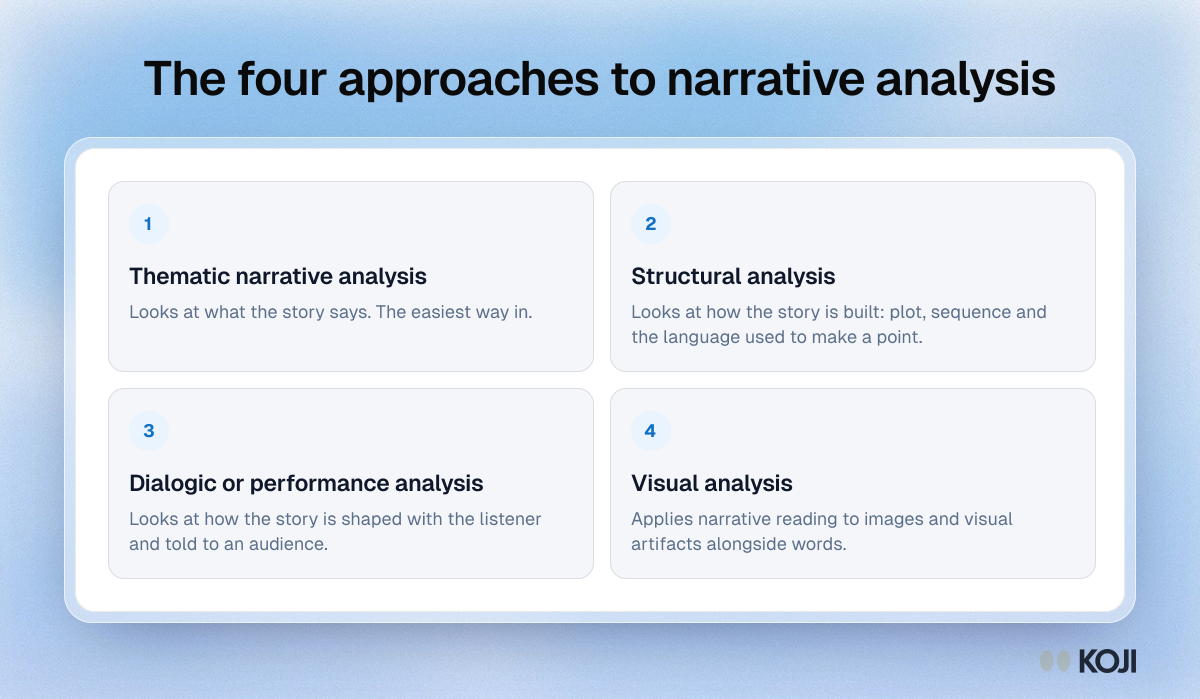
The four main approaches (Riessman)
Riessman identifies four analytic lenses:
- Thematic narrative analysis — focuses on the content of the story: what is told. The most accessible entry point.
- Structural analysis — focuses on how the story is organized: its plot, sequence, and the linguistic devices used to make a point.
- Dialogic/performance analysis — focuses on the interaction: how the story is co-produced with the listener and performed for an audience.
- Visual analysis — applies narrative interpretation to images and visual artifacts alongside words.
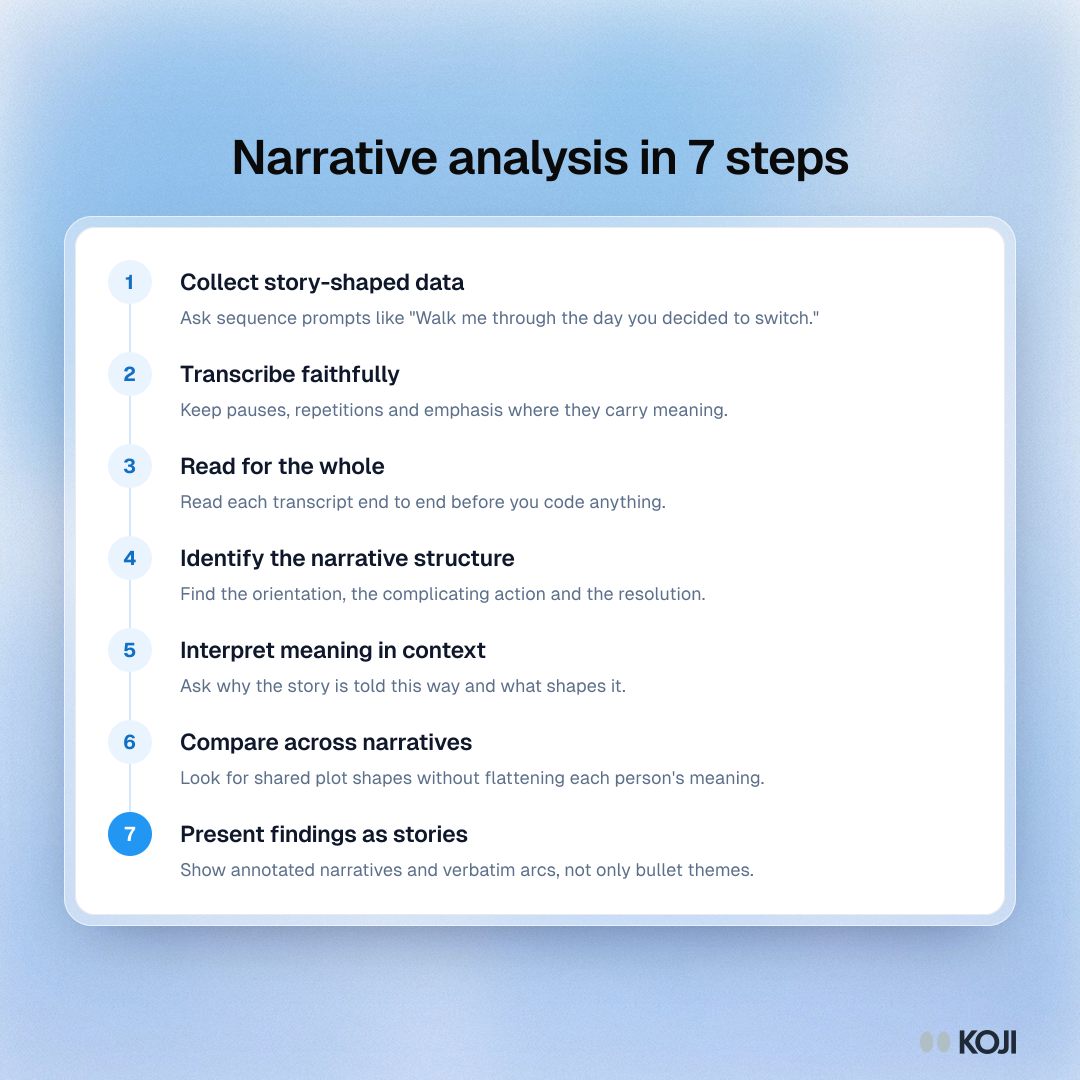
A step-by-step narrative analysis process
- Collect rich, story-shaped data. Use open-ended, sequence-oriented prompts: "Walk me through the day you decided to switch." Depth interviews and conversational surveys produce the best narratives.
- Transcribe faithfully. Preserve pauses, repetitions, and emphasis where they carry meaning — how something is said is part of the analysis.
- Read for the whole. Read each transcript end to end before coding anything. Resist the urge to fragment.
- Identify the narrative structure. Locate the orientation (setup), complicating action (the turning point), and resolution. Note how the narrator positions themselves and others.
- Interpret meaning in context. Ask why the story is told this way — what cultural, social, or personal forces shape it.
- Compare across narratives. Look for shared plot shapes (for example, recurring "hero defeated by friction" arcs in churn stories) without flattening individual meaning.
- Represent findings as stories. Present insight through annotated narratives and verbatim arcs, not just bullet-point themes.
The bottleneck: narrative analysis does not scale by hand
Done manually, narrative analysis is intensely time-consuming. Faithful transcription, whole-text reading, structural mapping, and interpretation can consume many hours per participant — which is why most teams analyze a handful of stories and leave the other 90% of their unstructured data untouched. The depth is real, but so is the cost.
The modern approach: narrative analysis at scale with AI
Koji is built to capture and analyze narratives without the manual bottleneck — so you can apply narrative thinking to every conversation, not just a curated few.
- Capture better narratives automatically. Koji's AI-moderated interviews conduct natural, sequence-oriented conversations in voice or text and probe in real time — "what happened next?", "why did that matter?" — eliciting the turning points that make a story analyzable. Running 24/7, they gather hundreds of narratives instead of a dozen.
- Preserve the whole story, then find the arcs. Koji transcribes every interview and applies automatic thematic analysis and sentiment analysis across the full set, surfacing shared plot shapes — common turning points, recurring resolutions — while keeping each individual account intact for deeper reading.
- Blend narrative depth with quantitative anchors. Koji's structured questions — six types: open_ended, scale, single_choice, multiple_choice, ranking, and yes_no — let you attach a measurable anchor to each story (for example, an effort rating at the moment a churn story turns), then have the AI probe the reasoning. You get the arc and the number.
- Move from raw stories to decisions in real time. Because synthesis is automated, the 90% of customer narratives that normally go unanalyzed can finally inform a decision — no PhD in qualitative methods required. Teams using AI-assisted analysis routinely cut time-to-insight dramatically.
Narrative analysis has always been the richest way to understand customers. Koji makes it fast enough to use on everyone.
Common pitfalls
- Fragmenting too early. Coding before reading the whole story turns narrative analysis into ordinary thematic coding.
- Ignoring the how. Content matters, but so do sequence, framing, and performance. Strip those and you lose the method's power.
- Over-generalizing from few cases. Narrative depth is not statistical representativeness — be explicit about scope, or pair it with broader analysis.
A worked example: the churn narrative
Imagine ten customers each tell the story of why they cancelled. Thematic analysis might tag them all "price." Narrative analysis reads each arc and finds something richer: an orientation (everything was fine), a complicating action (a botched migration, an unanswered ticket, a teammate who left), and a resolution (started evaluating alternatives, then cancelled). The "price" mention turns out to be the justification customers reach for at the very end — not the turning point that actually started the exit. That distinction changes what you fix: not the pricing page, but the migration experience that set the story in motion. A pile of decontextualized quotes would never have surfaced the sequence.

Photo by National Cancer Institute on Unsplash
Where narrative analysis shines in product and UX research
- Onboarding and activation: the sequence of first-run moments is inherently a story with turning points.
- Churn and win-back: understanding the path to cancellation reveals the intervenable moment, not just the stated reason.
- Buying decisions: B2B purchases unfold as multi-character narratives across a buying committee.
- Journey mapping: narratives supply the lived, first-person texture that an abstracted journey map flattens out.
In each case, the order and framing of events — not just the topics mentioned — carry the actionable insight.
Tips for keeping narrative analysis rigorous
Because interpretation is central, narrative analysis invites bias if done loosely. Keep it disciplined: ground every interpretation in specific lines of transcript; have a second researcher read the key narratives independently and compare readings; preserve disconfirming stories rather than smoothing them away; and be explicit about your own position and how it might shape what you hear. Triangulating narrative findings against thematic analysis or quantitative anchors strengthens the confidence you can place in your conclusions.
Frequently asked questions
Is narrative analysis qualitative or quantitative? It is a qualitative method, though it pairs well with quantitative anchors from structured questions.
What kind of data does it need? Story-shaped data with sequence and context — depth interviews, conversational surveys, diaries, and open-ended responses.
Related Resources
- Discourse Analysis for User Research
- Thematic Analysis Guide — find recurring patterns across participants
- Structured Questions in AI Interviews — anchor narratives with quantitative measures
- Coding Qualitative Data — the building blocks of qualitative analysis
- Grounded Theory — build theory up from qualitative data
- Research Synthesis Guide — turn analysis into shareable insight
- How to Analyze Qualitative Data — choose the right analysis method for your study
Related Articles
How to Code Qualitative Data: A Step-by-Step Guide
Learn the complete process of qualitative coding — from building a codebook to identifying themes — and how AI tools like Koji automate the most time-consuming parts.
Content Analysis: The Complete Guide to Analyzing Text and Interview Data
A comprehensive guide to content analysis as a research method — covering conventional, directed, and summative approaches, step-by-step coding, inter-rater reliability, and how AI automates the most time-consuming parts.
Customer Quotes: How to Extract, Tag, and Use the Voice of Your Customer
Customer quotes are the most persuasive evidence in product, marketing, and research. This guide covers how to extract them, what makes a quote useful, and how Koji surfaces them automatically.
Discourse Analysis for User Research: Reading How People Talk, Not Just What They Say
A practical guide to discourse analysis for UX and customer researchers: the main approaches, how it differs from thematic and content analysis, a step-by-step method for interview transcripts, and common mistakes.
Grounded Theory in Qualitative Research: A Practical Guide
A practical guide to grounded theory methodology — how to collect, code, and analyze qualitative data to develop theory from the ground up, and how AI-powered tools accelerate the iterative analysis process.
How to Analyze Qualitative Data: From Raw Interviews to Actionable Insights
A step-by-step guide to qualitative data analysis — from reviewing raw transcripts to synthesizing themes, generating insights, and presenting findings that teams act on.
Open, Axial, and Selective Coding: The Complete Guide to Qualitative Coding Phases
A complete guide to the three coding phases of grounded theory — open, axial, and selective coding. Examples, decision points, and how AI-native research with Koji compresses weeks of coding into minutes.
Research Synthesis: How to Combine Multiple Studies Into Clear Insights
A practical guide to synthesizing findings across multiple research studies — using thematic synthesis, triangulation, and structured data aggregation to build compounding organizational knowledge.
Structured Questions in AI Interviews
Mix quantitative data collection — scales, ratings, multiple choice, ranking — with AI-powered conversational follow-up in a single interview.
The Complete Guide to Thematic Analysis
Learn how to systematically analyze qualitative data using Braun and Clarke's six-phase thematic analysis framework.