Framework Analysis: The Complete Guide to the Matrix Method for Qualitative Data (2026)
A step-by-step guide to framework analysis (the Framework Method) for qualitative research — the five stages, the charting matrix, when to use it, and how AI speeds it up.
Framework analysis (also called the Framework Method) is a structured, matrix-based approach to analyzing qualitative data, in which you organize coded interview data into a grid of cases (rows) and themes (columns) so you can compare across participants and within themes systematically. Developed by Jane Ritchie and Liz Spencer at the UK's National Centre for Social Research, it is prized in applied and policy research because it is transparent, auditable, and well-suited to teams working toward concrete recommendations on a deadline. The traditional bottleneck is the manual coding and charting — and that is exactly the step modern AI research platforms like Koji automate, turning days of spreadsheet wrangling into a structured matrix you can read the same day.
This guide walks through what framework analysis is, when to choose it over other methods, its five stages, the all-important charting matrix, and how to run it faster without losing rigor.
What Is Framework Analysis?
Framework analysis is a method for managing and analyzing qualitative data — most often interview transcripts — by indexing it against a structured analytical framework and then summarizing it into a matrix. Each row is a case (a participant or interview) and each column is a code or theme. Every cell holds a condensed summary of what that participant said about that theme, with a pointer back to the source quote.
The result is a bird's-eye view of your entire dataset. You can read down a column to see how all participants discussed one theme, or across a row to understand one participant holistically. This dual readability is what makes framework analysis so powerful for spotting patterns, outliers, and relationships between themes.
Unlike purely inductive methods, framework analysis comfortably accommodates both pre-defined themes (from your research questions or interview guide) and themes that emerge from the data. That makes it a pragmatic middle ground between rigidly deductive and fully emergent approaches.
Framework Analysis vs. Other Qualitative Methods
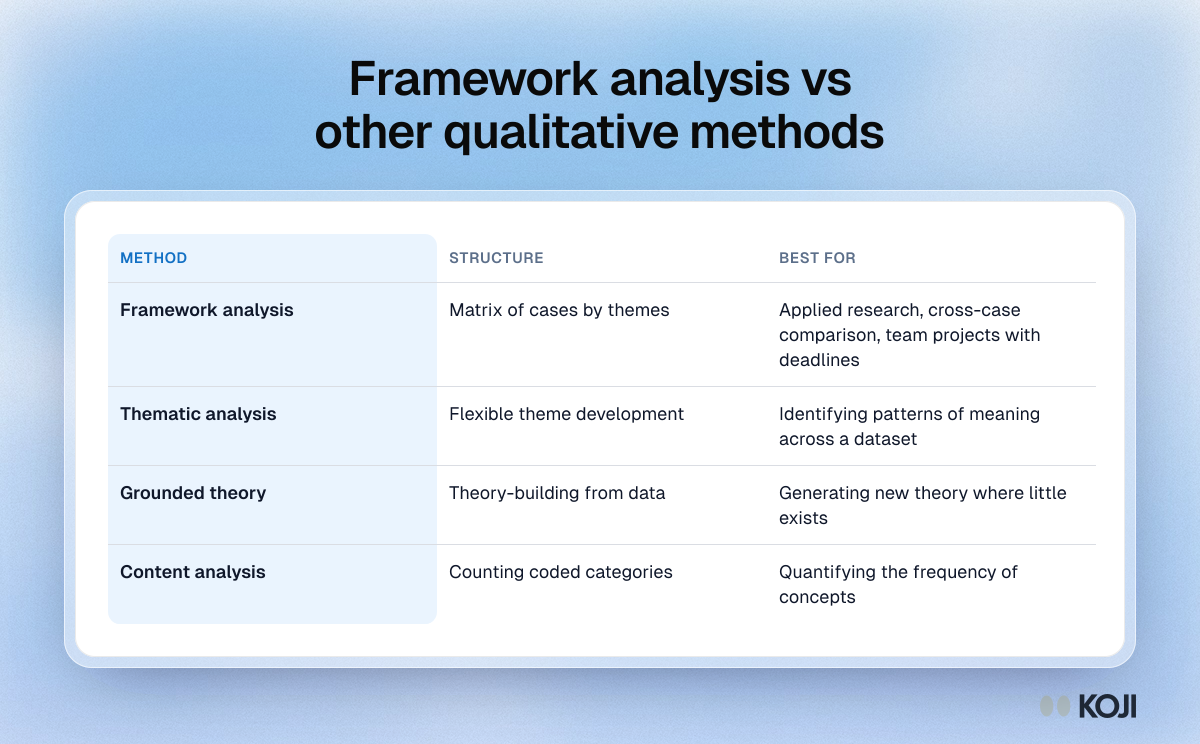
| Method | Structure | Best for |
|---|---|---|
| Framework Analysis | Matrix of cases × themes | Applied research, cross-case comparison, team projects with deadlines |
| Thematic Analysis | Flexible theme development | Identifying patterns of meaning across a dataset |
| Grounded Theory | Theory-building from data | Generating new theory where little exists |
| Content Analysis | Counting coded categories | Quantifying the frequency of concepts |
Choose framework analysis when you have a clear set of research questions, multiple participants you need to compare, and a need to show stakeholders exactly how you reached each conclusion. Its visible audit trail — from raw quote to matrix cell to finding — is its signature advantage.
The Five Stages of Framework Analysis
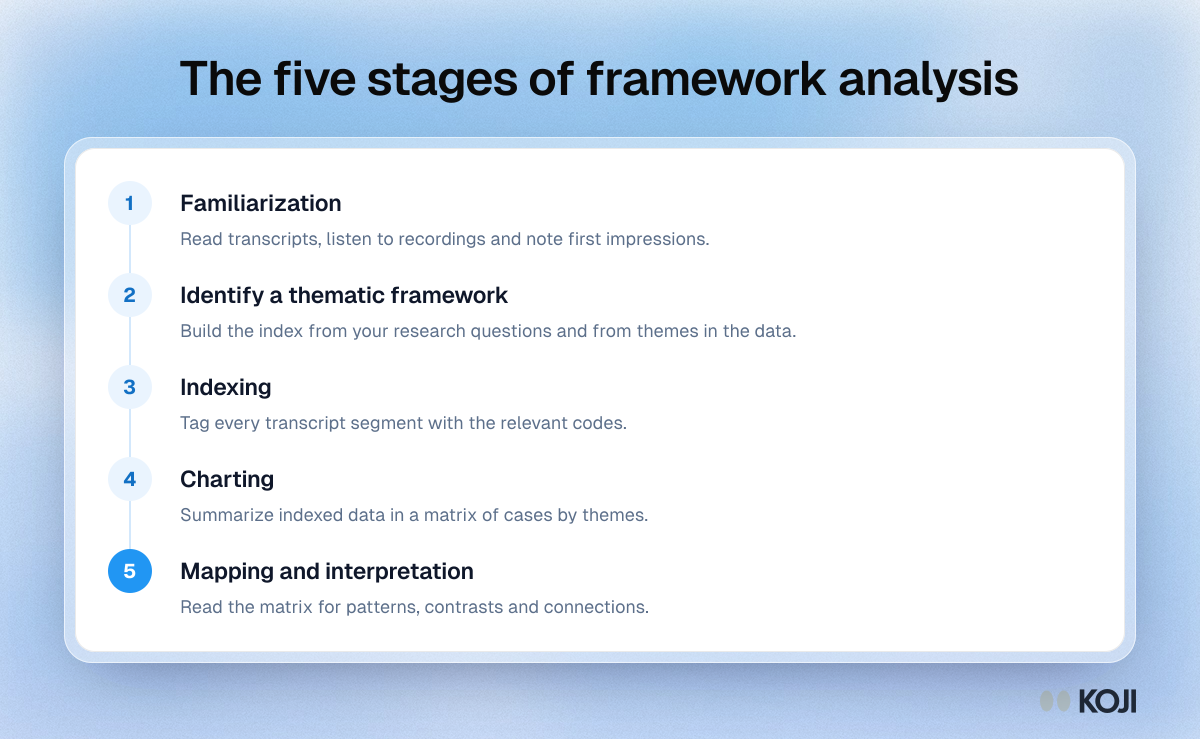
Stage 1: Familiarization
Immerse yourself in the data. Read transcripts, listen to recordings, and note initial observations. With Koji, every interview is transcribed automatically and summarized in real time, so familiarization starts the moment an interview finishes rather than after a transcription vendor returns files.
Stage 2: Identifying a Thematic Framework
Develop the set of codes and themes you will index against. These come from two sources: your research questions and interview guide (a priori themes) and recurring ideas that surface during familiarization (emergent themes). The output is a working "index" — your column headers.
A major head start here: if you designed your study in Koji using structured questions, your thematic framework is partly built for you. Koji's six question types — open_ended, scale, single_choice, multiple_choice, ranking, and yes_no — map cleanly onto framework columns, and the open_ended responses (with AI follow-up probing) supply the rich text each cell summarizes.
Stage 3: Indexing (Coding)
Apply the framework to every transcript, tagging segments with the relevant codes. This is the most labor-intensive stage by hand. Koji's automatic analysis codes responses against themes as interviews arrive, dramatically shrinking the manual indexing burden while keeping every tag traceable to its source quote.
Stage 4: Charting
Summarize the indexed data into the framework matrix — cases down the side, themes across the top, condensed summaries in each cell. Charting is the heart of the method. You are distilling, not copying: each cell captures the essence of what a participant said about a theme, abstracted enough to compare but specific enough to stay faithful to the data.
Stage 5: Mapping and Interpretation
Read the completed matrix to find patterns, contrasts, and connections. Compare themes across cases, look for typologies, and build the explanations that become your findings and recommendations. This is where the matrix pays off: relationships that are invisible in a pile of transcripts jump out of a well-built grid.
The Charting Matrix: A Worked Example
Imagine a study on why B2B customers churn, with five interviews. A simplified framework matrix might look like this:
| Case | Theme: Onboarding | Theme: Pricing | Theme: Support |
|---|---|---|---|
| P1 | Felt lost in week 1; no guide | Acceptable for value | Slow email replies frustrated them |
| P2 | Smooth, used template | Too expensive after raise | Rarely needed it |
| P3 | Abandoned setup midway | Fine | Chat resolved issues fast |
Reading down the Onboarding column instantly reveals that onboarding friction is a recurring churn driver. Reading across P3 shows a customer who churned despite good support — a pricing-and-onboarding story, not a support story. These cross-cutting insights are framework analysis at its best.
How AI Accelerates Framework Analysis Without Losing Rigor
Framework analysis is rigorous but historically slow, because charting a matrix by hand across dozens of transcripts can take a researcher weeks. The method's transparency is a strength; its labor cost is the reason teams often abandon it under deadline pressure.
This is where an AI-native platform changes the equation. With Koji:
- Transcription and coding are automatic, so Stages 1–3 compress from weeks to hours.
- Structured questions pre-build your framework, giving you column headers and quantifiable cells (a
scalerating, asingle_choiceselection) alongside qualitative summaries. - The real-time report functions as a living matrix — themes, representative quotes, and aggregated structured answers are organized for cross-case reading the moment interviews complete.
- Sentiment scoring adds an emotional dimension to each cell automatically (see sentiment analysis in interviews).
The researcher still owns the interpretation in Stages 4 and 5 — judgment, abstraction, and the building of explanations remain human work. But the mechanical burden that used to make framework analysis impractical at scale is gone. Compared with manually coding exports from a survey tool like Typeform or Qualtrics, Koji delivers the structured, traceable foundation framework analysis demands without the spreadsheet marathon.
Best Practices
- Keep an audit trail. Always link matrix cells back to source quotes. The method's credibility rests on traceability.
- Don't over-summarize. A cell should be condensed but still defensible against the original transcript.
- Involve the team. Framework analysis is built for collaboration — have multiple analysts review the framework and a sample of indexing for consistency.
- Let themes evolve. If a strong emergent theme appears mid-analysis, add a column and revisit earlier cases.

Framework analysis remains one of the most defensible, stakeholder-friendly ways to analyze qualitative data. Pair its structured rigor with Koji's automated collection and analysis, and you get audit-ready insight at a speed that finally matches the pace of product decisions.
Related Resources
- Structured Questions Guide — how Koji's six question types pre-build your framework matrix.
- Thematic Analysis Guide — the flexible alternative for pattern-finding.
- Open, Axial, and Selective Coding — the grounded-theory coding approach.
- Content Analysis Guide — when you need to quantify coded categories.
- Sentiment Analysis in Interviews — add an emotional dimension to each matrix cell.
- Affinity Mapping — a collaborative complement for synthesizing themes.
Related Articles
Affinity Mapping: Organize Qualitative Data Into Themes
Learn how to use affinity mapping to group qualitative research data into meaningful clusters and uncover actionable patterns.
Content Analysis: The Complete Guide to Analyzing Text and Interview Data
A comprehensive guide to content analysis as a research method — covering conventional, directed, and summative approaches, step-by-step coding, inter-rater reliability, and how AI automates the most time-consuming parts.
Open, Axial, and Selective Coding: The Complete Guide to Qualitative Coding Phases
A complete guide to the three coding phases of grounded theory — open, axial, and selective coding. Examples, decision points, and how AI-native research with Koji compresses weeks of coding into minutes.
Rapid Qualitative Analysis: How to Get From Interviews to Findings in Days
Rapid qualitative analysis replaces line-by-line coding with summary templates and a participant-by-topic matrix. How the Hamilton method works, what the evidence says, and how to run one.
Sentiment Analysis in Qualitative Research: Understanding Emotional Patterns
Learn how to identify and interpret emotional patterns in qualitative interview data — and why emotional insights predict behavior better than stated opinions.
Structured Questions in AI Interviews
Mix quantitative data collection — scales, ratings, multiple choice, ranking — with AI-powered conversational follow-up in a single interview.
Template Analysis: Nigel King's Flexible Approach to Thematic Coding
Template analysis builds a hierarchical coding template from part of your data, often with a few a priori themes, and revises it until it fits. The six steps, an example template and how it compares.
The Complete Guide to Thematic Analysis
Learn how to systematically analyze qualitative data using Braun and Clarke's six-phase thematic analysis framework.