Verbatim vs Clean Verbatim Transcription for Research Interviews
What full verbatim, clean verbatim and intelligent verbatim transcription keep and remove, which style fits thematic, discourse and conversation analysis, and how to edit quotes without changing meaning.
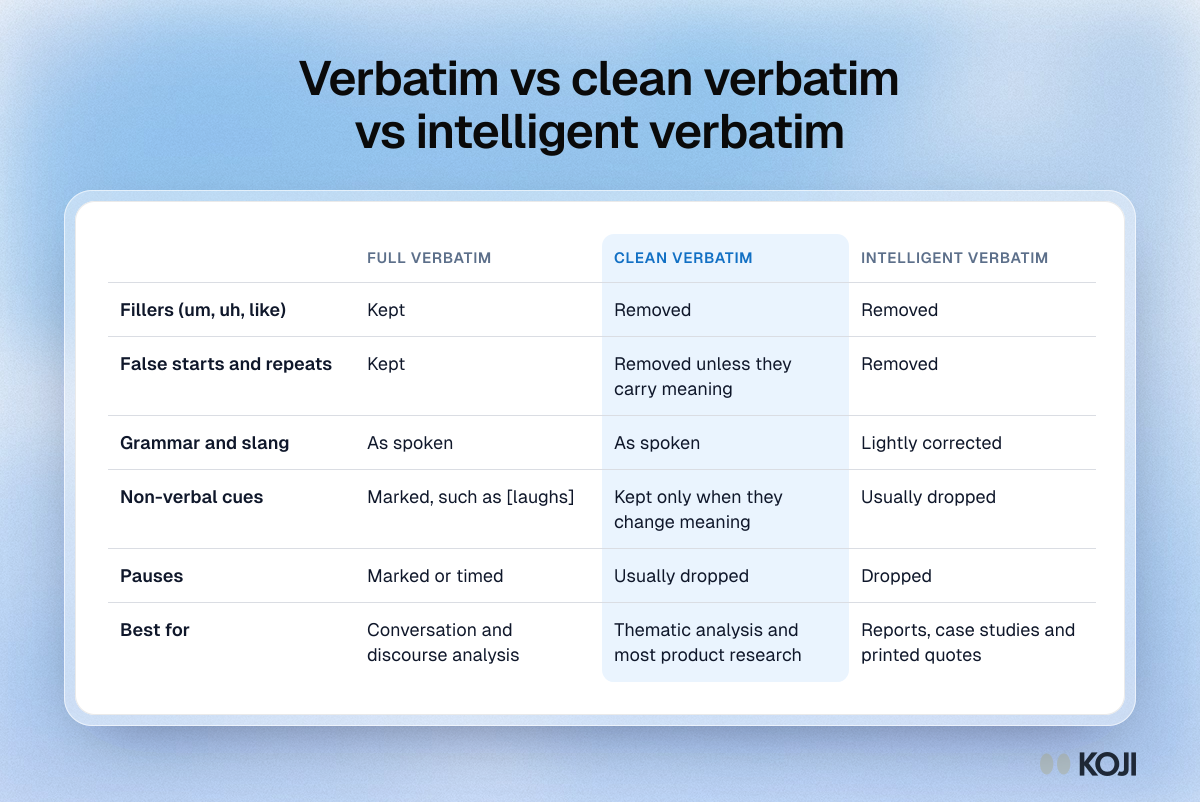
Short answer: Full verbatim transcription keeps everything a person said, including "um", false starts, repeats, laughter and pauses. Clean verbatim keeps the speaker's words, grammar and slang but removes the fillers and stumbles that carry no meaning. Intelligent (or edited) verbatim goes further and tidies grammar and tangents so the text reads well. For most product and UX research analysed with thematic analysis, clean verbatim is enough. Use full verbatim when how people talk is the data: conversation analysis, discourse analysis, or studies of hesitation and uncertainty. Whatever you choose, keep an untouched master copy, decide before fieldwork, and write the choice down.
This guide explains each transcription style, what each one keeps and drops, which style fits which kind of analysis, how to edit quotes for reports without changing what someone meant, and how Koji handles transcripts.
Why the transcription style matters
A transcript is not a neutral copy of an interview. It is a set of decisions about what to keep. Oliver, Serovich and Mason (2005) put it plainly in Social Forces: "While often seen as a behind-the-scenes task, we suggest that transcription is a powerful act of representation." They describe two broad traditions. Naturalised transcription records every utterance in as much detail as possible. Denaturalised transcription smooths out speech features, such as stutters and pauses, so the text reads like written language.
Neither is wrong. They answer different questions. If you want to know which onboarding steps confuse people, the "ums" rarely change the answer. If you want to know whether people are unsure about a pricing change, the hesitation before "yeah, I'd probably pay that" might be the most important thing in the interview.
The choice also costs time. The University of Manchester's toolkit on transcribing qualitative data, hosted by the UK National Centre for Research Methods (Burke, Jenkins and Higham, 2010), estimates about four to seven hours of work for every hour of recording, which puts 40 one-hour interviews at 160 to 240 hours. That rule of thumb assumes a thematic analysis. The toolkit notes that conversation analysis takes longer, because every pause and overlap has to be marked.
The three transcription styles
Full verbatim (true verbatim)
Full verbatim records the interview as it sounded. It keeps:
- Fillers: "um", "uh", "like", "you know"
- False starts and self-corrections: "We used, well, I used it for..."
- Repetitions and stutters: "I-I-I didn't"
- Non-verbal sounds in brackets: [laughs], [sighs], [crosstalk]
- Pauses, marked as (pause) or timed in seconds, such as (2.0)
- Unclear passages, with a timestamp: [inaudible 00:12:31]
- Non-standard grammar and slang exactly as spoken
Disfluency is a normal part of speech, so a full verbatim transcript of a fluent speaker still looks messy. Bortfeld and colleagues (2001), in Language and Speech, found that rates rose when speakers had a harder planning job, such as describing abstract shapes rather than photographs. That is the reason fillers can be data: they cluster where thinking gets hard.
Clean verbatim
Clean verbatim keeps every meaningful word but removes:
- Fillers and hesitation sounds
- Stutters and repeated words with no meaning
- False starts that the speaker abandoned
- Most non-verbal cues, unless they change the meaning
It does not fix grammar, swap in more formal words or cut content. "We was going to switch but the price thing put us off" stays as it is. A non-verbal cue stays when it matters: [laughs] after "oh, the export is great" tells the reader the participant is being sarcastic.
Intelligent (edited) verbatim
Intelligent verbatim edits for reading. It corrects grammar, cuts tangents and tightens long sentences. It is useful for executive summaries, case studies and anything a customer will see in print. It is the furthest from what was said, so treat it as a writing step, not a transcription step, and never analyse from it.
Here is the same answer in all three styles:
- Full verbatim: "Um, so we, we tried, like, the export? And it was (1.5) I mean it was fine but [laughs] nobody, nobody actually opened the file."
- Clean verbatim: "So we tried the export? And it was, I mean it was fine but [laughs] nobody actually opened the file."
- Intelligent verbatim: "We tried the export. It worked, but nobody opened the file."
Look at what the edited version loses: the pause, the laugh and the "I mean". Those three things are what tell you the export is not really fine.
Which style to use for which analysis
Match the transcript to the analysis you plan to run.
Thematic analysis and most product research. Clean verbatim is usually enough. You are looking for patterns of meaning across people, and fillers rarely change a code. Keep non-verbal cues that change meaning and mark long pauses before important answers. See the thematic analysis guide.
Content analysis and word counts. Clean verbatim, applied the same way to every transcript. If one transcriber keeps "like" and another removes it, word counts stop being comparable.
Conversation analysis and discourse analysis. Full verbatim, often with Jefferson notation, a system developed by Gail Jefferson for marking timing and delivery. Common marks include (0.5) for a timed pause in seconds, (.) for a very short pause, square brackets for overlapping talk, colons for a stretched sound ("so::") and an equals sign for talk that follows with no gap. You need this level of detail when the question is how people build an answer, not only what the answer is. See discourse analysis for user research.
Studies of uncertainty, trust or emotion. Full verbatim for the passages that matter, at least. Hedges, repairs and pauses are evidence of doubt. The speech disfluency guide covers how to read them.
Quotes for stakeholders. Clean verbatim, or lightly edited, but always taken from a fuller master copy so anyone can check the original.
Multilingual studies. Transcribe in the original language first, in the same style for every language, then translate. Translating a clean transcript loses hesitation twice.
Automatic transcription and its errors
Many teams now start from automatic speech recognition (ASR) rather than typing. That saves most of the hours above, but it adds a different problem: the machine decides what was said. ASR output usually sits somewhere between full and clean verbatim. Many systems drop some fillers and smooth some repeats, and they don't tell you which.
Accuracy is also uneven. Koenecke and colleagues (2020), in PNAS, tested five commercial speech recognition systems and found an average word error rate of 0.35 for Black speakers compared with 0.19 for white speakers. If one group's words are misheard nearly twice as often, their quotes are more likely to be garbled or left out of a report. Check a sample of each transcript against the audio, especially for accents, jargon and product names, and fix errors before you code.
Agreeing conventions with your team
When more than one person transcribes or codes, write a one-page convention sheet before the first interview. It should say:

Photo by Vitaly Gariev on Unsplash
- Which style you are using, and why.
- Which fillers and cues to keep, with examples.
- How to mark pauses, overlaps and unclear passages.
- How to label speakers (for example "Interviewer" and "P07", never real names).
- What to remove for privacy, such as names, employers and locations, and what to put in their place.
- Where the master copy lives and who can edit it.
Have two people transcribe the same five minutes and compare. Most disagreements show up straight away, usually over fillers that might carry meaning ("like" as a filler versus "like" as a comparison).
Editing quotes without changing meaning
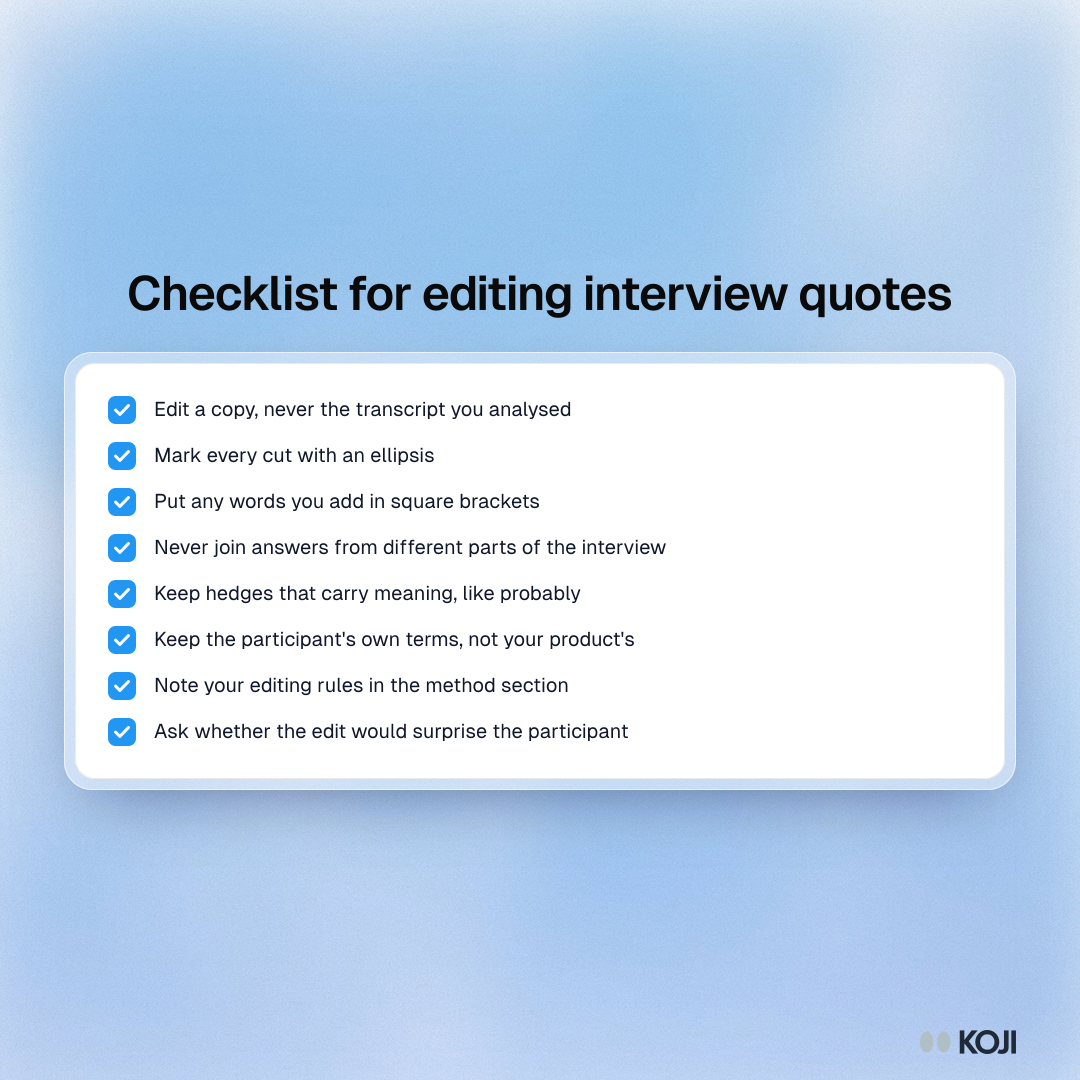
Most quotes in a report are cleaned up a little. That is fine if you follow a few rules.
- Keep the master copy. Edit a copy for the report, never the transcript you analysed.
- Mark every cut. Use an ellipsis (...) where you removed words.
- Mark every addition. Put words you added for clarity in square brackets: "It [the export] was fine."
- Never join separate answers. Two sentences from different parts of the interview are two quotes.
- Keep the hedges that carry meaning. "I'd probably pay" and "I'd pay" are different findings.
- Keep the participant's own words. Don't swap their term for your product's term.
- Say what you did. One line in the method section ("quotes are lightly edited for readability; cuts are marked") is enough.
If a cleaned quote would surprise the participant, you have edited too much.
Common mistakes
Choosing the style after the interviews. If you don't decide early, you end up re-transcribing or analysing a style that can't answer your question. Decide in the research plan.
Analysing from an edited transcript. Intelligent verbatim is for readers. Code from the fullest version you have.
Mixing styles across transcripts. Comparisons between segments break when one set is clean and another is full verbatim.
Trusting ASR blindly. Spot-check against the audio, and check more for accented speech and specialist terms.
Removing laughter and pauses everywhere. Some of them are the finding. Keep the ones that change meaning, even in clean verbatim.
How Koji helps
Transcribing and checking interviews by hand is slow, and survey tools skip the problem by collecting short typed answers with no follow-up. Koji runs AI-moderated interviews by voice or text, so every interview arrives already transcribed, and it keeps the participant's words intact for analysis.
- Transcripts with no extra step. Voice interviews are transcribed automatically, turn by turn, and text interviews are stored as typed. Each interview's transcript shows who said what (participant or AI interviewer) with a timestamp on every message.
- No silent clean-up. Koji doesn't apply a filler-stripping or "clean verbatim" pass to transcripts. What the participant said, as transcribed, is what you see.
- Quotes that stay verbatim. When Koji analyses an interview, every finding, pain point and notable quote is tied to the participant's exact words, copied as they appear in the transcript, fillers and repetitions included. A finding whose quote can't be matched to what the participant said is dropped. Quotes stay in the participant's original language.
- A full copy you control. Download any single transcript as a CSV with timestamp, speaker and message columns, or export all interviews in a study as CSV or JSON for your own coding tool.
- Evidence behind every finding. In the report, you can open a finding to see the supporting quotes and go back to the full transcript, which makes checking context quick.
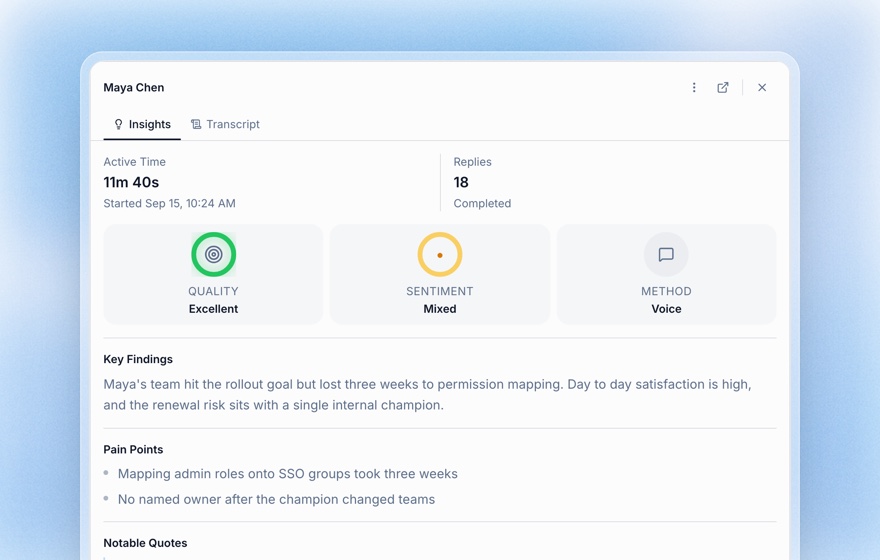
Koji's transcripts give you a fast, consistent starting point. If your study needs Jefferson-level detail, such as timed pauses and overlaps, export the transcript and add that layer yourself for the passages you are analysing.
Related Resources
- Speech Disfluency in Interview Transcripts
- Verbatim Analysis Guide
- Thematic Analysis Guide
- AI Transcription for Research Interviews
- Structured Questions Guide
- In Vivo Coding
FAQ
What is the difference between verbatim and clean verbatim transcription? Full verbatim keeps everything, including fillers, false starts, repetitions, pauses and non-verbal sounds. Clean verbatim keeps every meaningful word and the speaker's grammar but removes fillers and stumbles that carry no meaning.
Is clean verbatim acceptable for qualitative research? Yes, for most thematic and content analysis. It is not enough for conversation analysis, discourse analysis or studies where hesitation and uncertainty are part of the question.
What is intelligent verbatim? An edited transcript that also corrects grammar and removes tangents so it reads well. Use it for reports and case studies, not for analysis.
Should I remove "um" and "uh" from interview quotes? In reports, usually yes, with cuts marked by an ellipsis. Keep them when the hesitation is part of the point, for example before an answer about price.
How long does it take to transcribe a one-hour interview? By hand, about four to seven hours per recorded hour for a thematic analysis, according to the University of Manchester toolkit hosted by NCRM. Conversation analysis takes longer.
Are automatic transcripts verbatim? Not reliably. Speech recognition may drop fillers or mishear words, and error rates differ between speakers. Check a sample against the audio before analysis.
Sources
- Oliver, D. G., Serovich, J. M., & Mason, T. L. (2005). Constraints and opportunities with interview transcription: Towards reflection in qualitative research. Social Forces, 84(2), 1273–1289.
- Burke, H., Jenkins, L., & Higham, V. (2010). Transcribing your own qualitative data. Realities Toolkit 08, University of Manchester. NCRM ePrints.
- Bortfeld, H., Leon, S. D., Bloom, J. E., Schober, M. F., & Brennan, S. E. (2001). Disfluency rates in conversation: Effects of age, relationship, topic, role, and gender. Language and Speech, 44(2), 123–147.
- Koenecke, A., et al. (2020). Racial disparities in automated speech recognition. PNAS, 117(14), 7684–7689.
- Jefferson, G. (2004). Glossary of transcript symbols with an introduction. In G. H. Lerner (Ed.), Conversation Analysis: Studies from the First Generation. John Benjamins.
Related Articles
AI Transcription for Research Interviews: Speed Up Analysis by 10x
Learn how AI transcription transforms research interviews — from audio to analysis in minutes. Covers accuracy, speaker identification, theme extraction, quality scoring, and how Koji automates the entire pipeline.
In Vivo Coding: How to Code Qualitative Data in Participants' Own Words
What in vivo coding is, how to do it step by step, how it compares with descriptive and other first cycle methods, and the mistakes that weaken it.
Um, Uh, and the False Start: What Transcript Cleanup Deletes (2026)
Filled pauses are not noise. See what um and uh signal, why listeners benefit from them, and why your transcription tool removes them by default.
Structured Questions in AI Interviews
Mix quantitative data collection — scales, ratings, multiple choice, ranking — with AI-powered conversational follow-up in a single interview.
The Complete Guide to Thematic Analysis
Learn how to systematically analyze qualitative data using Braun and Clarke's six-phase thematic analysis framework.
Verbatim Analysis: How to Code and Analyze Open-Ended Responses at Scale (2026)
Verbatim coding turns messy open-ended answers into countable themes — but manual coding is slow, expensive, and bias-prone. Learn the code-frame workflow, the manual vs AI tradeoff, and how Koji auto-codes verbatims and captures the depth a survey verbatim never could.