Framework
Fairclough's three-dimensional model of discourse
Read any piece of talk at the level of text, practice and context
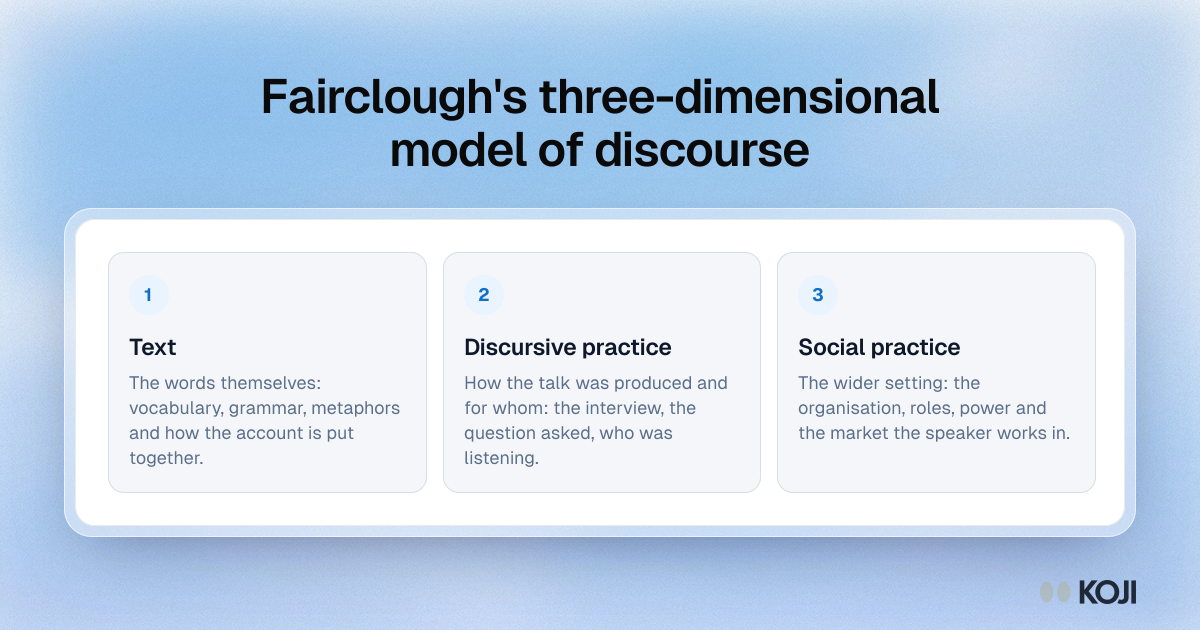
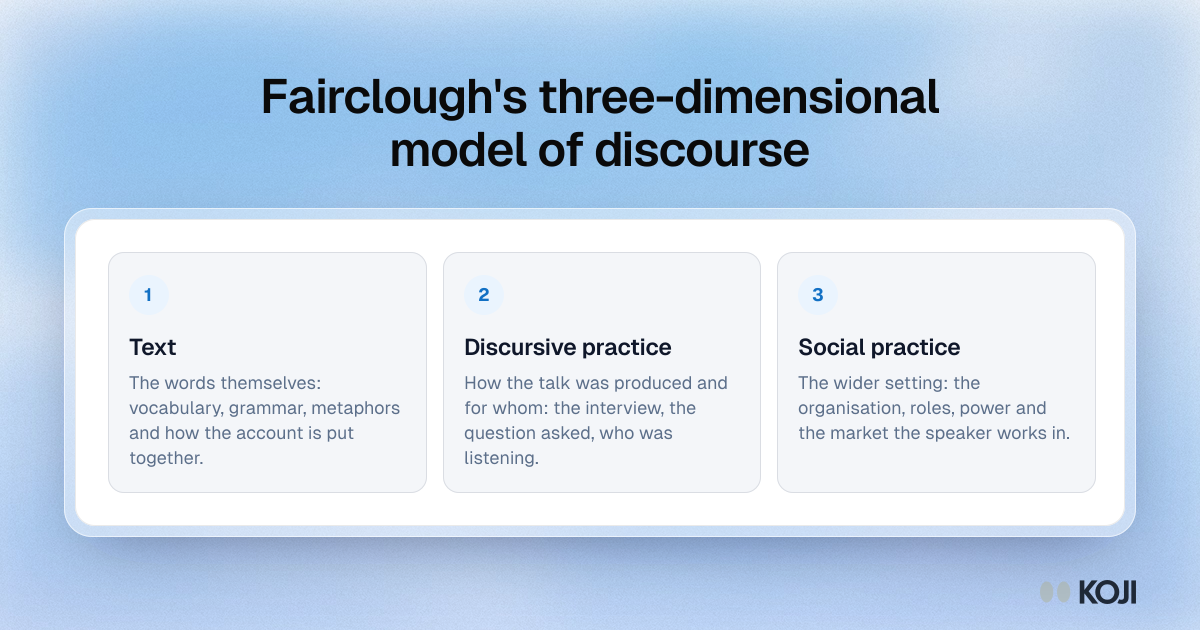
Norman Fairclough's three-dimensional model is the core of critical discourse analysis. It asks you to read talk as text (vocabulary, grammar, metaphor), as discursive practice (how and for whom it was produced) and as social practice (the organisational and cultural setting). User researchers can use it to read interview extracts about workplace tools, buying decisions and anything shaped by power. Koji keeps interview transcripts and quotes verbatim, which gives you the text level to start from.
Where this appears
What's in this framework
- Text: The words themselves: vocabulary, grammar, metaphors and how the account is put together.
- Discursive practice: How the talk was produced and for whom: the interview, the question asked, who was listening.
- Social practice: The wider setting: the organisation, roles, power and the market the speaker works in.
Use this image
Free to use in your docs, decks and posts under CC BY 4.0, as long as you credit Koji with a link to this page. To embed it, paste this into your page:
html
<a href="https://www.koji.so/visuals/fairclough-three-dimensional-model-discourse-analysis"><img src="https://www.koji.so/visuals/fairclough-three-dimensional-model-discourse-analysis/fairclough-three-dimensional-model-discourse-analysis.png" alt="Framework showing Fairclough's three dimensions of discourse: text, discursive practice and social practice, with what to look for at each level" width="1200" height="630" /></a>
<p>Source: <a href="https://www.koji.so/visuals/fairclough-three-dimensional-model-discourse-analysis">Fairclough's three-dimensional model of discourse</a>, Koji</p>