Process
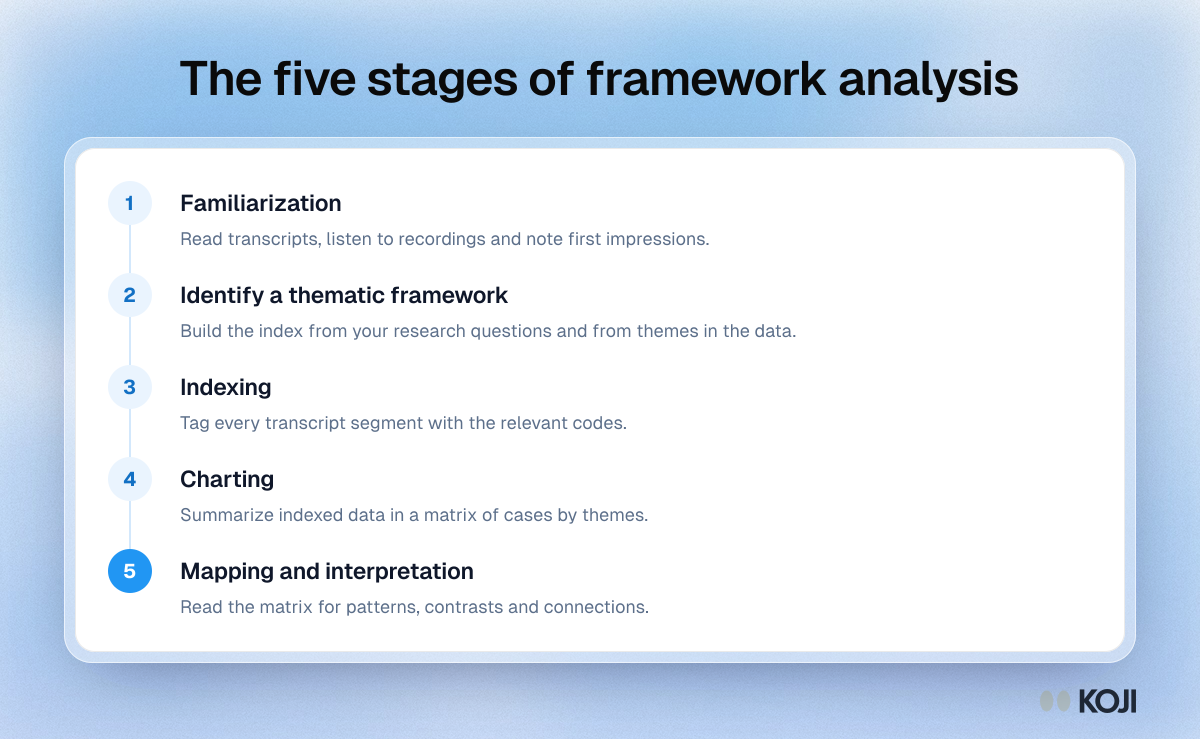
The five stages of framework analysis
Ritchie and Spencer's Framework Method, step by step
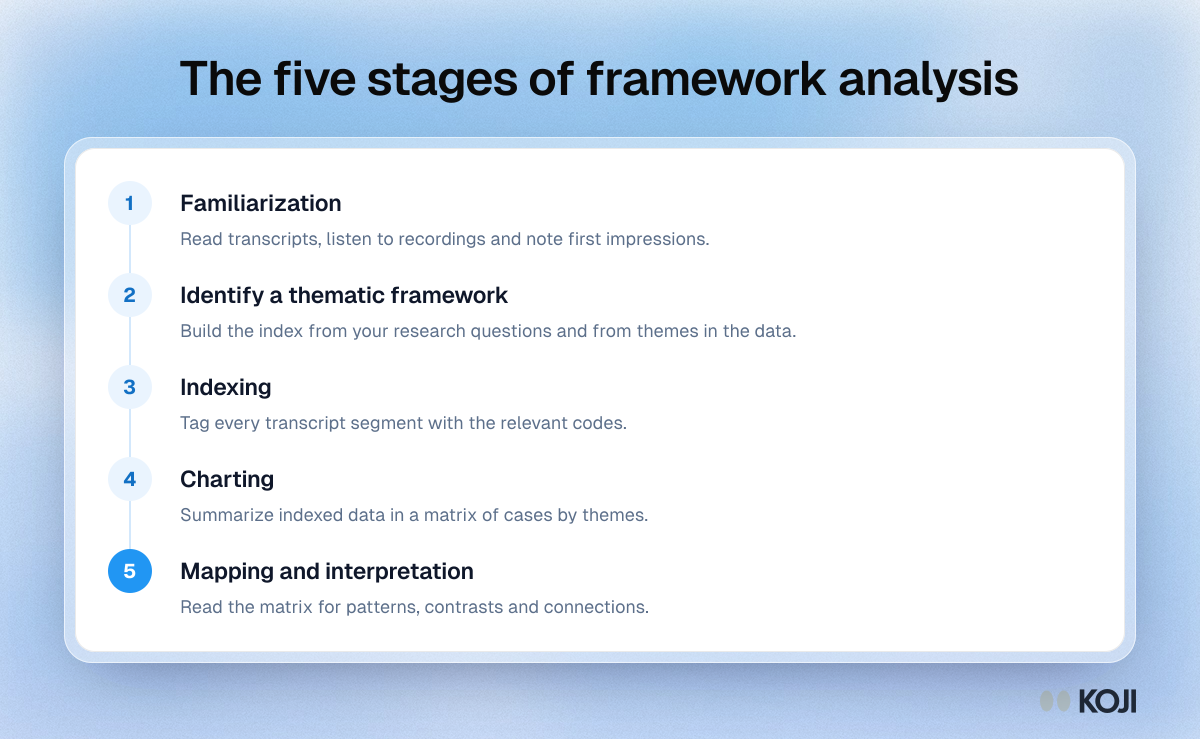
The five stages of framework analysis, the matrix method for qualitative data. You move from reading the data, to building a set of themes, to tagging every transcript, to summarizing it in a grid of cases and themes, to reading that grid for findings. Use it to plan an analysis with a team and a deadline. Koji automates transcription and much of the coding, so the stages that take days by hand shrink to hours.
Where this appears
What's in this process
- Familiarization: Read transcripts, listen to recordings and note first impressions.
- Identify a thematic framework: Build the index from your research questions and from themes in the data.
- Indexing: Tag every transcript segment with the relevant codes.
- Charting: Summarize indexed data in a matrix of cases by themes.
- Mapping and interpretation: Read the matrix for patterns, contrasts and connections.
Use this image
Free to use in your docs, decks and posts under CC BY 4.0, as long as you credit Koji with a link to this page. To embed it, paste this into your page:
html
<a href="https://www.koji.so/visuals/framework-analysis-five-stages-process"><img src="https://www.koji.so/visuals/framework-analysis-five-stages-process/framework-analysis-five-stages-process.png" alt="Process showing the five stages of framework analysis: familiarization, identifying a thematic framework, indexing, charting, and mapping and interpretation." width="1200" height="739" /></a>
<p>Source: <a href="https://www.koji.so/visuals/framework-analysis-five-stages-process">The five stages of framework analysis</a>, Koji</p>