Framework
The four parts of a hierarchical task analysis
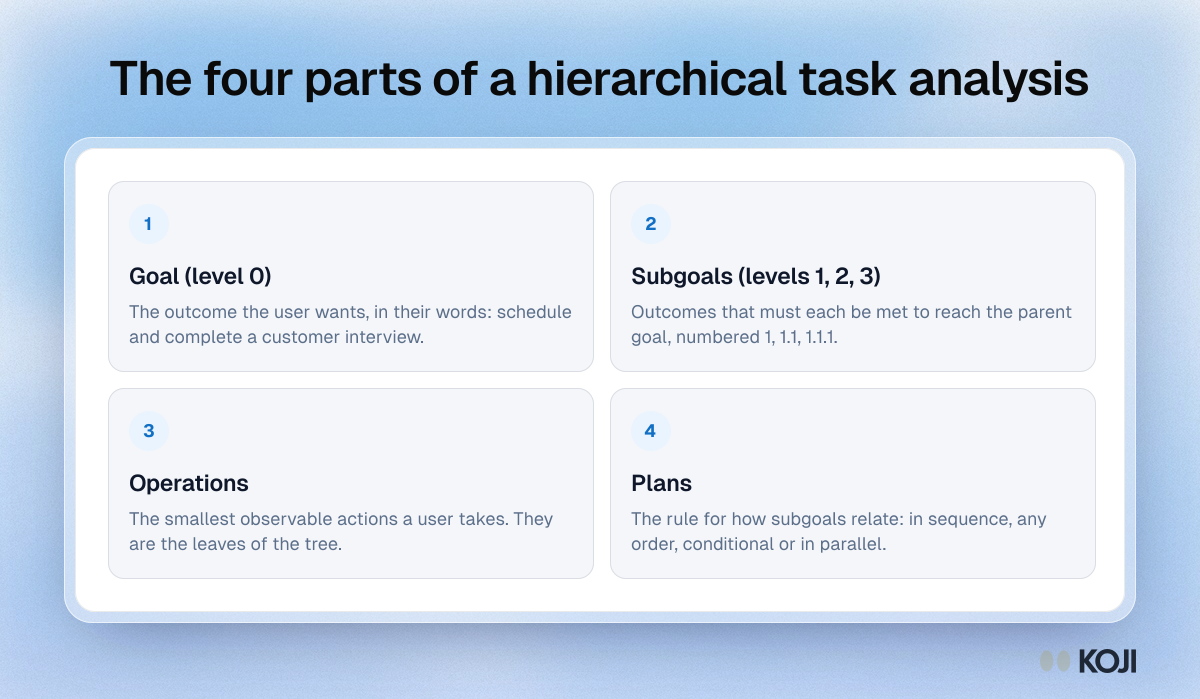
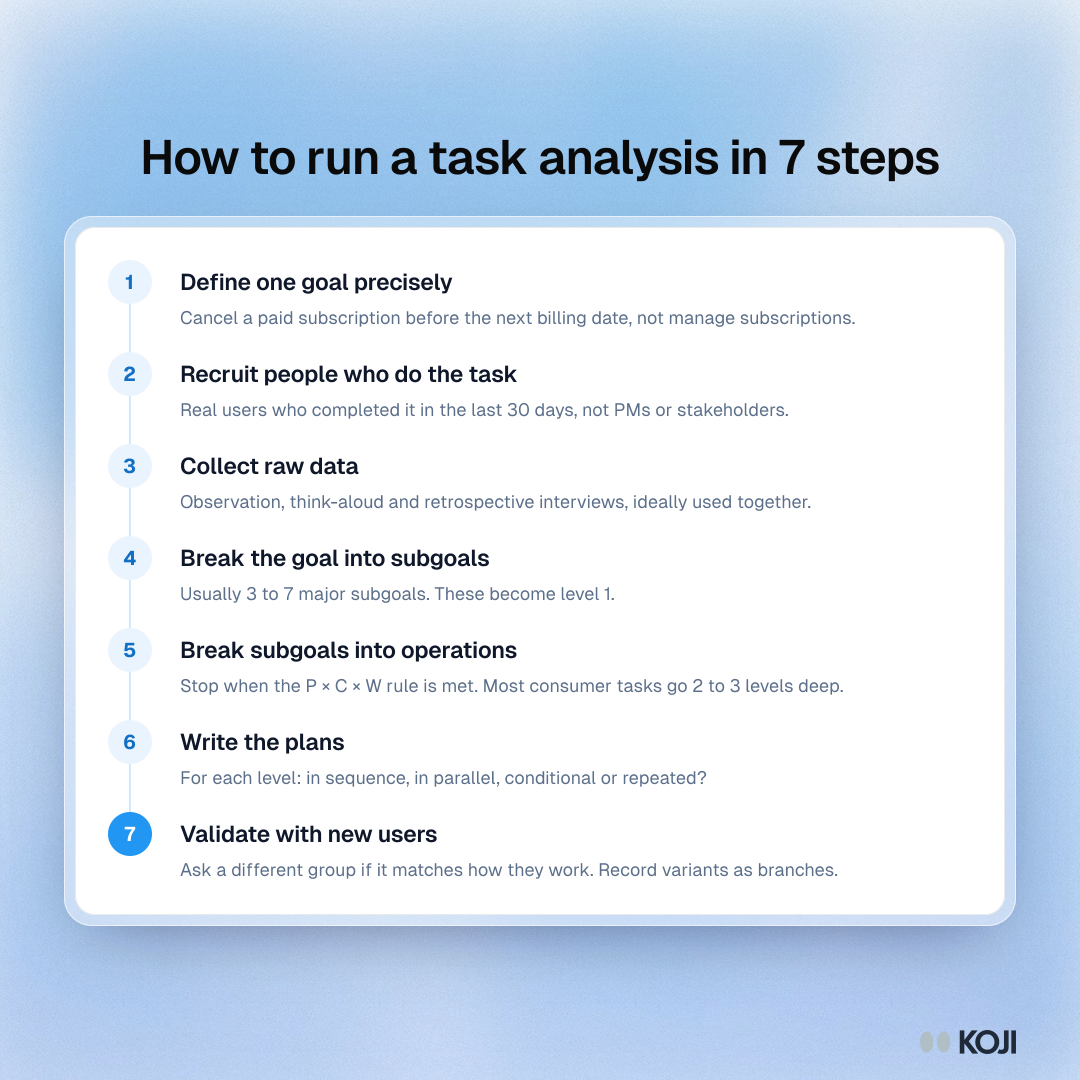
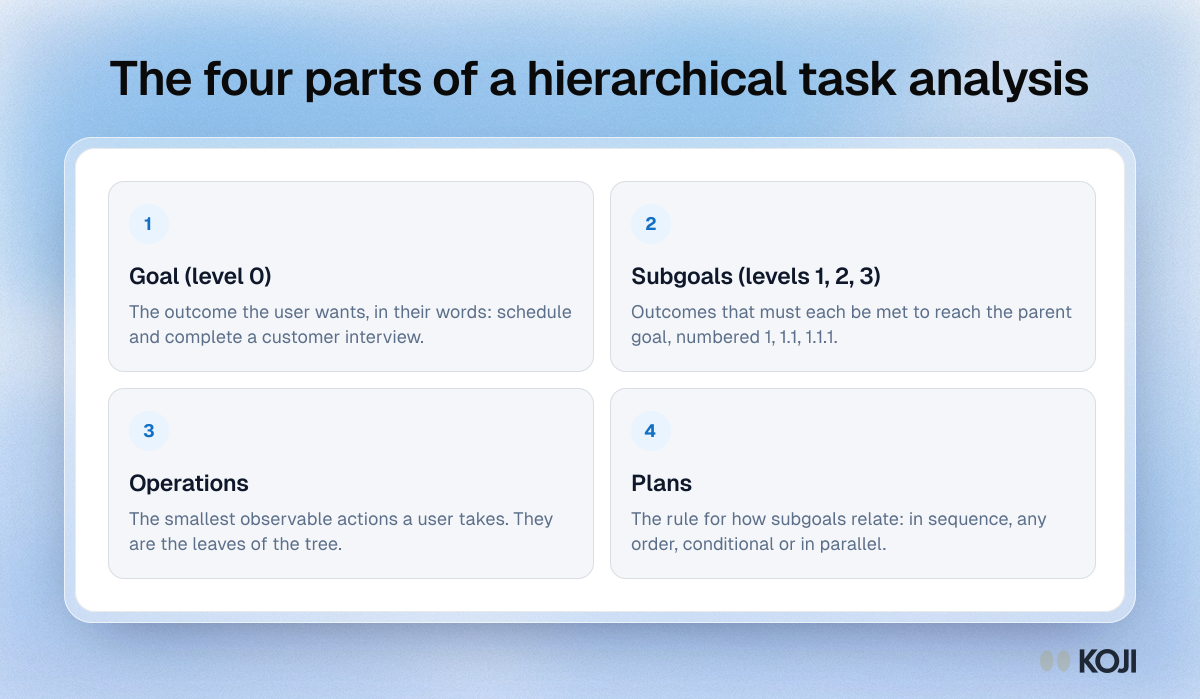
The four building blocks of a hierarchical task analysis (HTA): the top-level goal, the numbered subgoals beneath it, the operations at the bottom of the tree and the plans that say how subgoals relate. Researchers and designers can use it to check an HTA is complete before it becomes a design spec. The numbering scheme and the idea of plans come from Annett and Duncan's 1967 paper.
Where this appears
What's in this framework
- Goal (level 0): The outcome the user wants, in their words: schedule and complete a customer interview.
- Subgoals (levels 1, 2, 3): Outcomes that must each be met to reach the parent goal, numbered 1, 1.1, 1.1.1.
- Operations: The smallest observable actions a user takes. They are the leaves of the tree.
- Plans: The rule for how subgoals relate: in sequence, any order, conditional or in parallel.
Use this image
Free to use in your docs, decks and posts under CC BY 4.0, as long as you credit Koji with a link to this page. To embed it, paste this into your page:
html
<a href="https://www.koji.so/visuals/hierarchical-task-analysis-four-components"><img src="https://www.koji.so/visuals/hierarchical-task-analysis-four-components/hierarchical-task-analysis-four-components.png" alt="Framework showing the four parts of a hierarchical task analysis: the goal at level 0, numbered subgoals, operations as the leaves, and plans." width="1200" height="699" /></a>
<p>Source: <a href="https://www.koji.so/visuals/hierarchical-task-analysis-four-components">The four parts of a hierarchical task analysis</a>, Koji</p>