Reference table
Four task analysis approaches compared
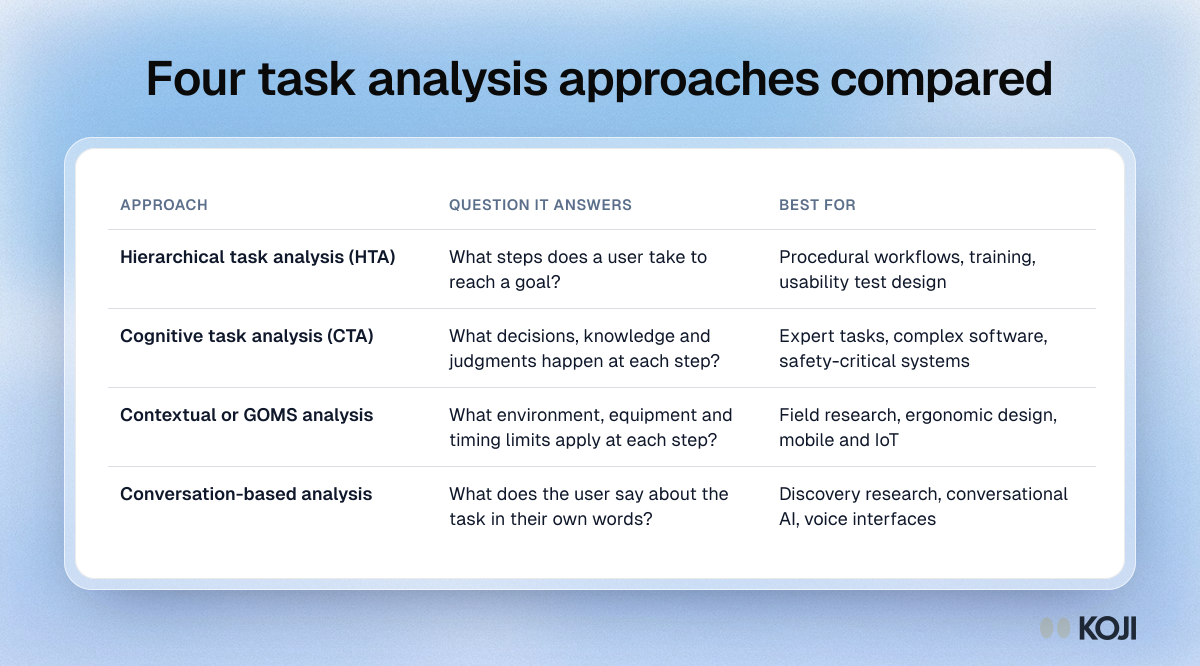
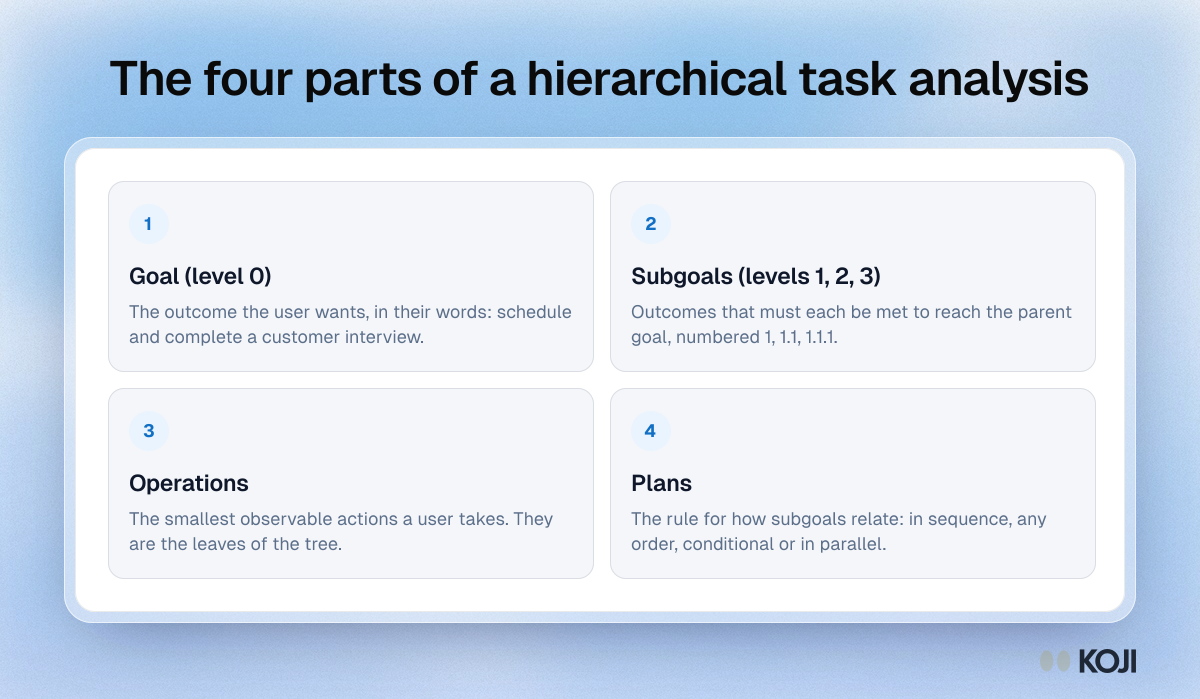
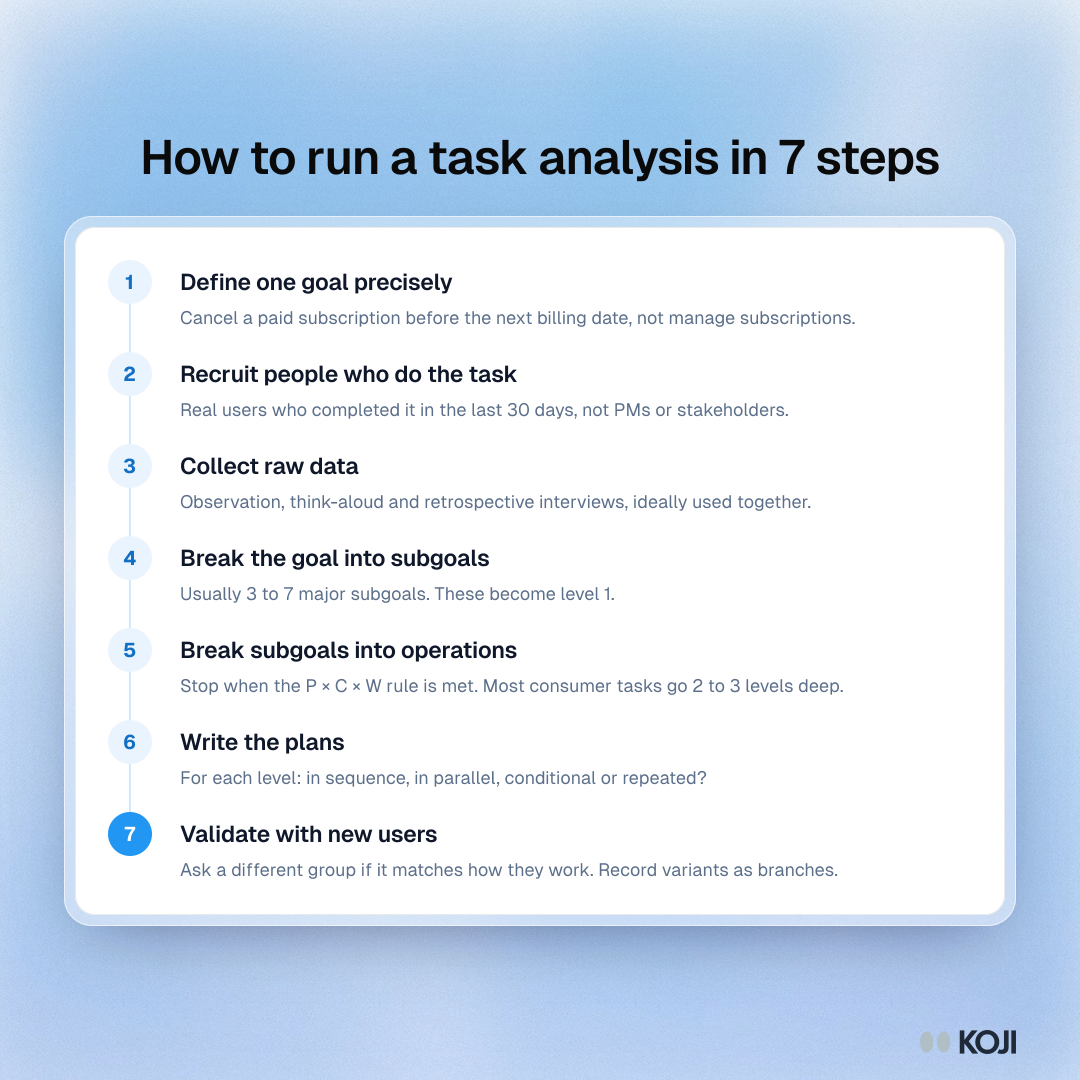
A comparison of the four main task analysis approaches in UX research: hierarchical, cognitive, contextual or GOMS, and conversation-based. It shows the question each one answers and where it fits best, so you can pick the mix for a study. Many teams use HTA as the backbone and add cognitive detail where decisions matter most. Koji's AI-moderated voice interviews can gather the conversation-based layer from many users at once.
Where this appears
What's in this reference table
| Approach | Question it answers | Best for |
|---|---|---|
| Hierarchical task analysis (HTA) | What steps does a user take to reach a goal? | Procedural workflows, training, usability test design |
| Cognitive task analysis (CTA) | What decisions, knowledge and judgments happen at each step? | Expert tasks, complex software, safety-critical systems |
| Contextual or GOMS analysis | What environment, equipment and timing limits apply at each step? | Field research, ergonomic design, mobile and IoT |
| Conversation-based analysis | What does the user say about the task in their own words? | Discovery research, conversational AI, voice interfaces |
Use this image
Free to use in your docs, decks and posts under CC BY 4.0, as long as you credit Koji with a link to this page. To embed it, paste this into your page:
html
<a href="https://www.koji.so/visuals/four-task-analysis-approaches-compared"><img src="https://www.koji.so/visuals/four-task-analysis-approaches-compared/four-task-analysis-approaches-compared.png" alt="Table comparing four task analysis approaches (HTA, CTA, contextual or GOMS, conversation-based) by the question each answers and its best use." width="1200" height="666" /></a>
<p>Source: <a href="https://www.koji.so/visuals/four-task-analysis-approaches-compared">Four task analysis approaches compared</a>, Koji</p>