Reference table
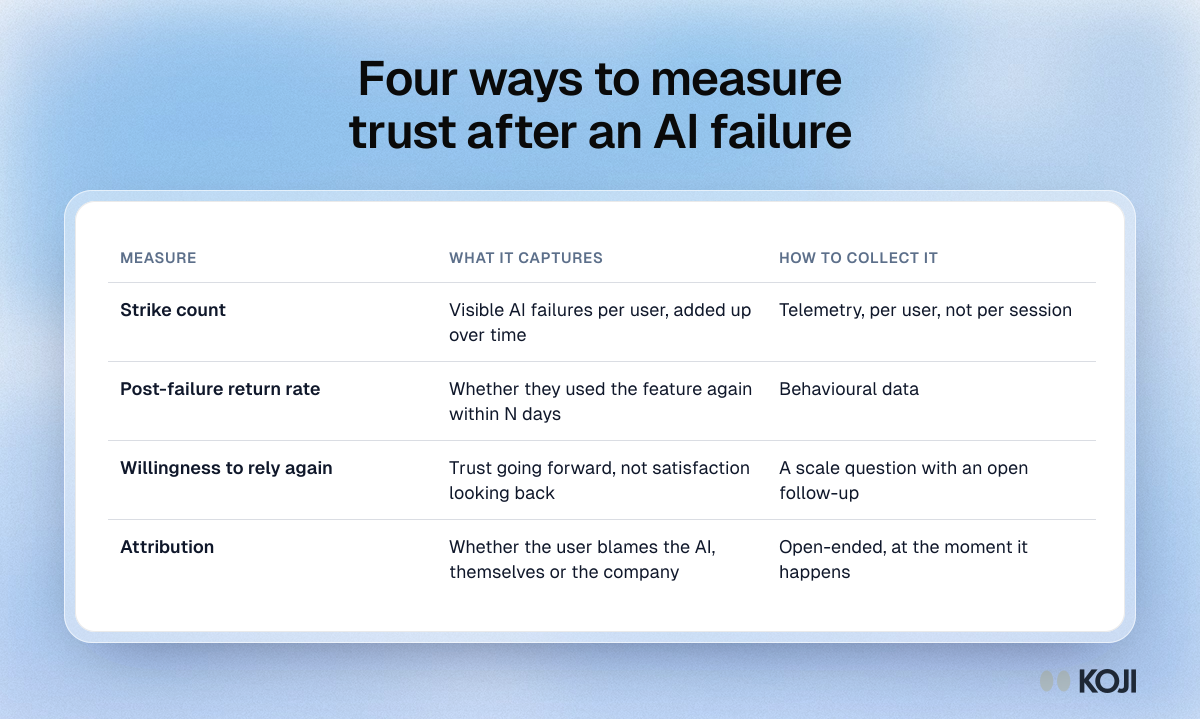
Four ways to measure trust after an AI failure
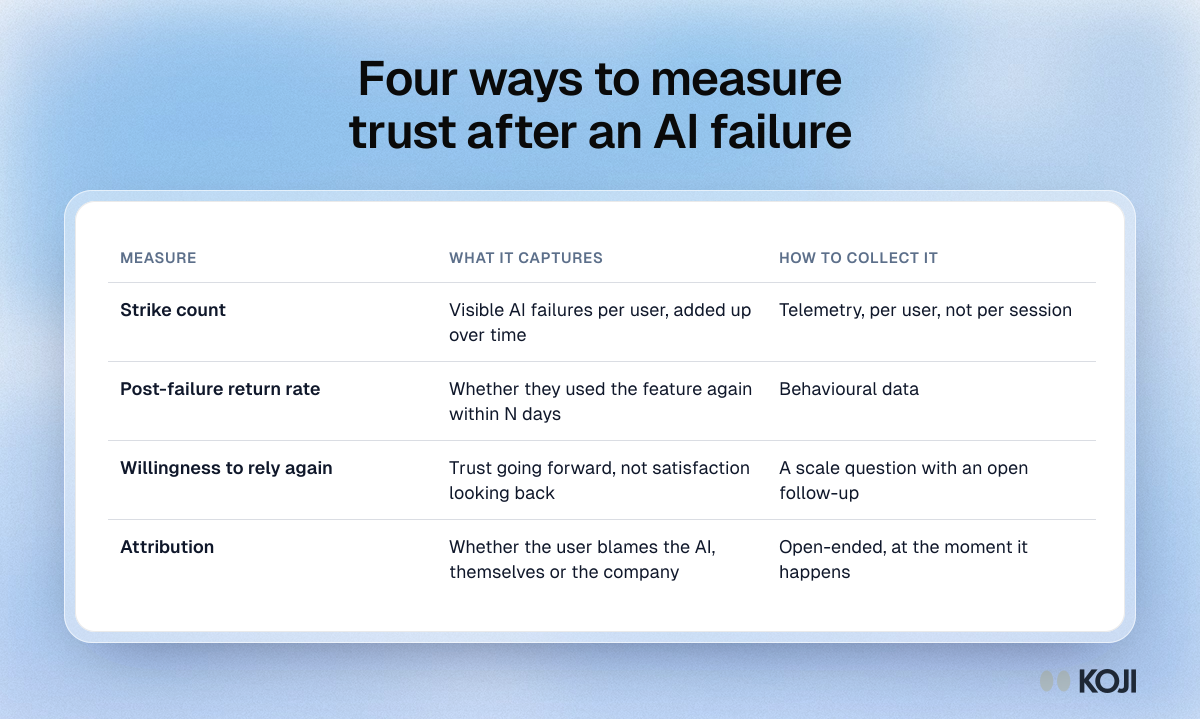
A table of four measures for tracking user trust after an AI feature gets something wrong: how many visible failures each user has seen, whether they come back to the feature, whether they would rely on it again, and who they blame. Each row says what the measure captures and how to collect it, from telemetry to an open question asked right after the failure. Koji can ask the attribution and rely-again questions in a short AI interview.
Where this appears
What's in this reference table
| Measure | What it captures | How to collect it |
|---|---|---|
| Strike count | Visible AI failures per user, added up over time | Telemetry, per user, not per session |
| Post-failure return rate | Whether they used the feature again within N days | Behavioural data |
| Willingness to rely again | Trust going forward, not satisfaction looking back | A scale question with an open follow-up |
| Attribution | Whether the user blames the AI, themselves or the company | Open-ended, at the moment it happens |
Use this image
Free to use in your docs, decks and posts under CC BY 4.0, as long as you credit Koji with a link to this page. To embed it, paste this into your page:
html
<a href="https://www.koji.so/visuals/measuring-trust-after-ai-failure-table"><img src="https://www.koji.so/visuals/measuring-trust-after-ai-failure-table/measuring-trust-after-ai-failure-table.png" alt="Table of four measures of trust after an AI mistake: strike count, return rate after a failure, willingness to rely again and attribution." width="1200" height="719" /></a>
<p>Source: <a href="https://www.koji.so/visuals/measuring-trust-after-ai-failure-table">Four ways to measure trust after an AI failure</a>, Koji</p>