Reference table
Gauge R&R terms translated for product research
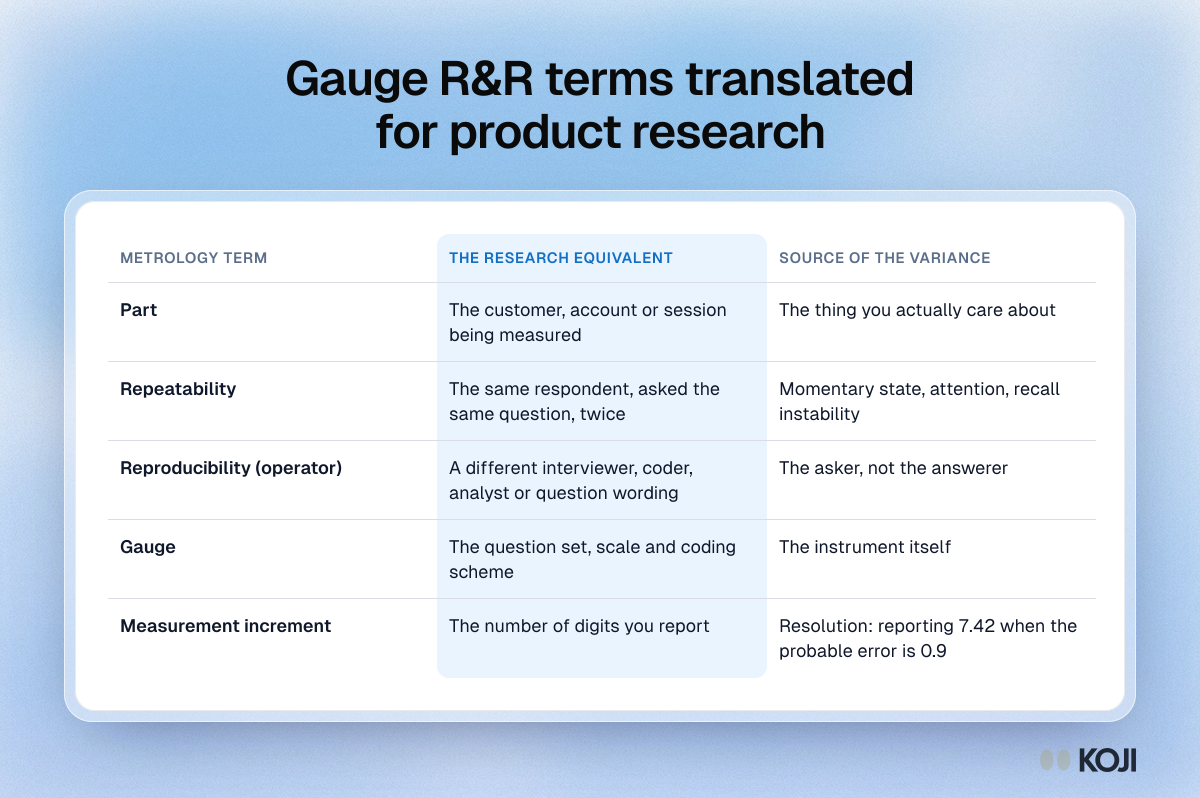
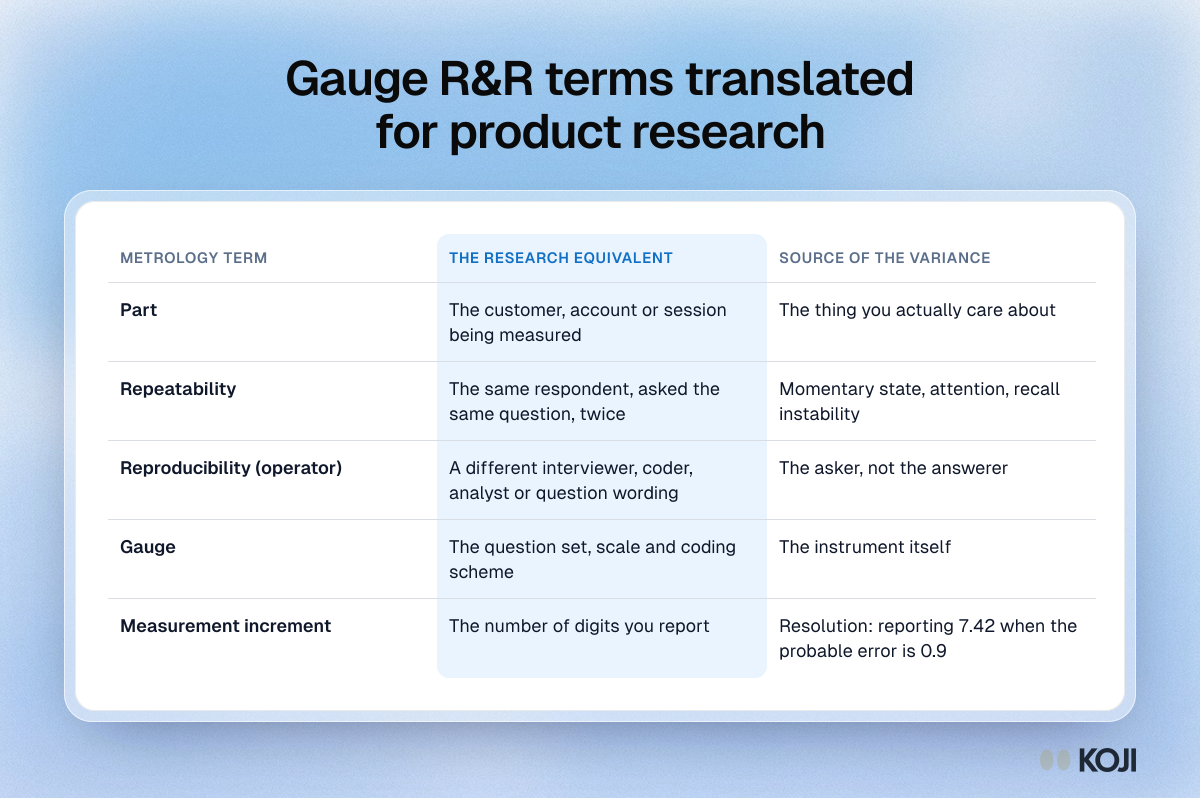
A reference table that maps the vocabulary of a manufacturing gauge R&R study onto product and user research. The part is the customer or account, repeatability is the same person answering twice, reproducibility is a different interviewer, coder or wording, the gauge is the question set and coding scheme, and the measurement increment is the number of digits you report. Use it to plan a measurement system analysis on a survey or interview metric.
Where this appears
What's in this reference table
| Metrology term | The research equivalent | Source of the variance |
|---|---|---|
| Part | The customer, account or session being measured | The thing you actually care about |
| Repeatability | The same respondent, asked the same question, twice | Momentary state, attention, recall instability |
| Reproducibility (operator) | A different interviewer, coder, analyst or question wording | The asker, not the answerer |
| Gauge | The question set, scale and coding scheme | The instrument itself |
| Measurement increment | The number of digits you report | Resolution: reporting 7.42 when the probable error is 0.9 |
Use this image
Free to use in your docs, decks and posts under CC BY 4.0, as long as you credit Koji with a link to this page. To embed it, paste this into your page:
html
<a href="https://www.koji.so/visuals/metrology-terms-in-product-research"><img src="https://www.koji.so/visuals/metrology-terms-in-product-research/metrology-terms-in-product-research.png" alt="Table translating gauge R&R terms into product research: part, repeatability, reproducibility, gauge and measurement increment." width="1200" height="798" /></a>
<p>Source: <a href="https://www.koji.so/visuals/metrology-terms-in-product-research">Gauge R&R terms translated for product research</a>, Koji</p>