Process
How effort can lower course ratings
The misinterpreted-effort hypothesis, step by step
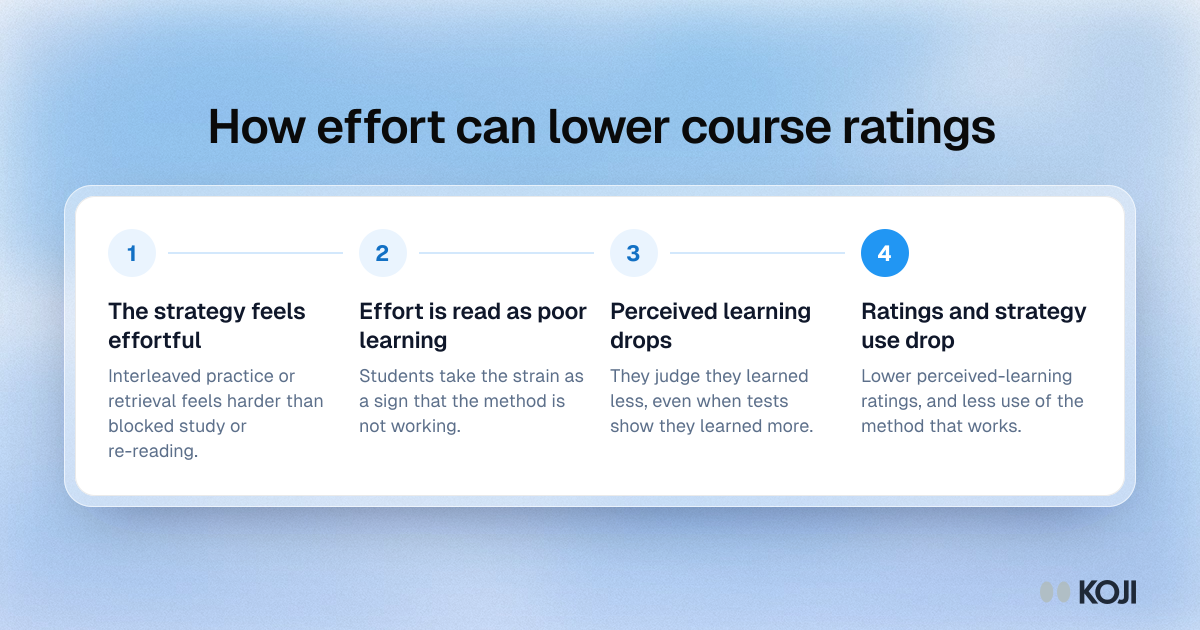
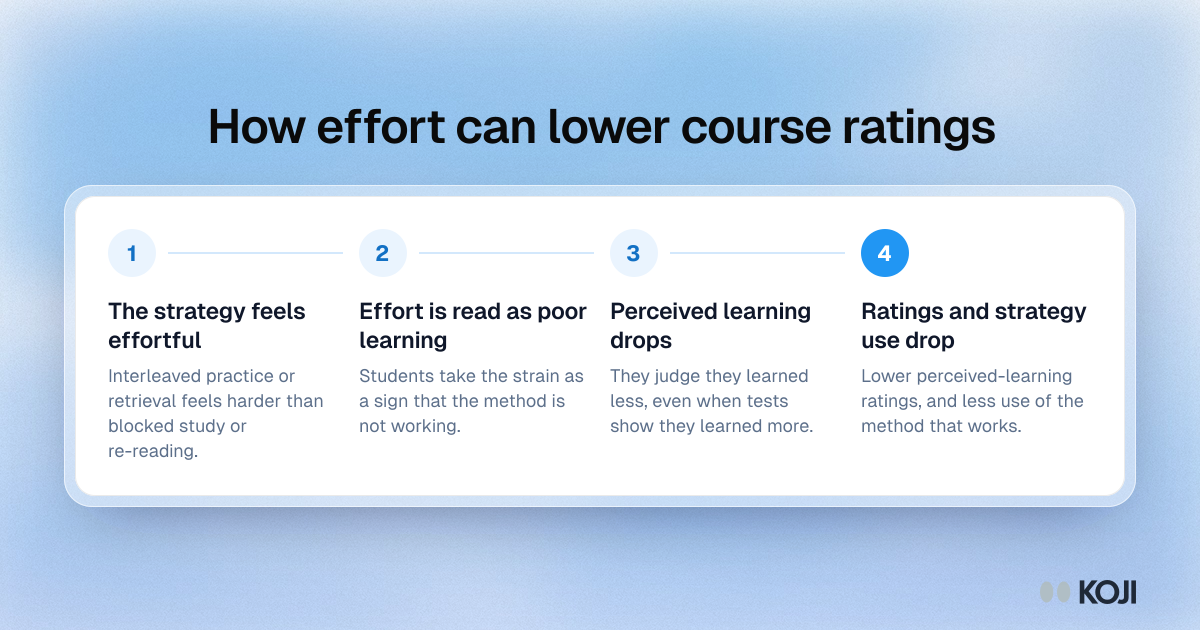
A four-step process based on the misinterpreted-effort hypothesis of Kirk-Johnson, Galla and Fraundorf (2019): students read the effort of a study strategy as a sign of poor learning, which lowers their judgment of learning and their use of effective methods. It is for evaluation committees reading effort and perceived-learning items side by side. The last step applies the finding to course ratings, which is an inference. Koji follows up effort ratings by asking what the effort was spent on.
What's in this process
- The strategy feels effortful: Interleaved practice or retrieval feels harder than blocked study or re-reading.
- Effort is read as poor learning: Students take the strain as a sign that the method is not working.
- Perceived learning drops: They judge they learned less, even when tests show they learned more.
- Ratings and strategy use drop: Lower perceived-learning ratings, and less use of the method that works.
Use this image
Free to use in your docs, decks and posts under CC BY 4.0, as long as you credit Koji with a link to this page. To embed it, paste this into your page:
html
<a href="https://www.koji.so/visuals/misinterpreted-effort-lower-course-ratings-process"><img src="https://www.koji.so/visuals/misinterpreted-effort-lower-course-ratings-process/misinterpreted-effort-lower-course-ratings-process.png" alt="Process showing how effort can lower a course rating: the strategy feels effortful, effort reads as poor learning, perceived learning and ratings drop." width="1200" height="630" /></a>
<p>Source: <a href="https://www.koji.so/visuals/misinterpreted-effort-lower-course-ratings-process">How effort can lower course ratings</a>, Koji</p>