Column chart
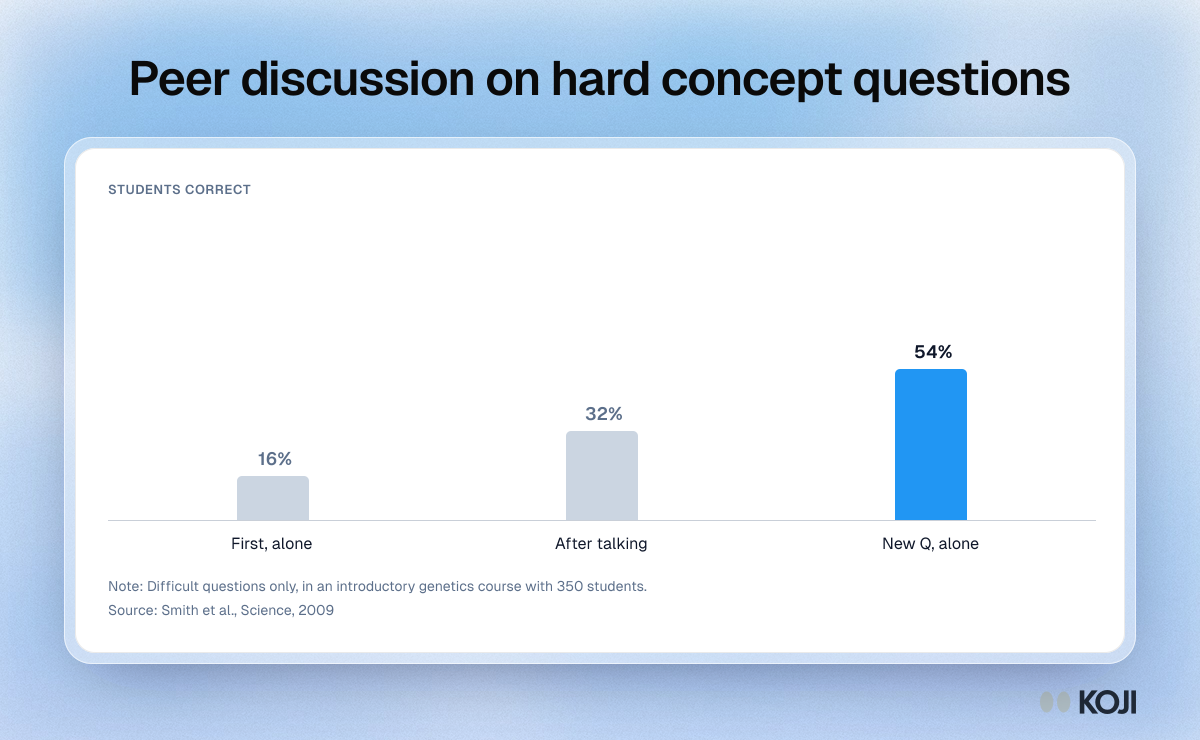
Peer discussion on hard concept questions
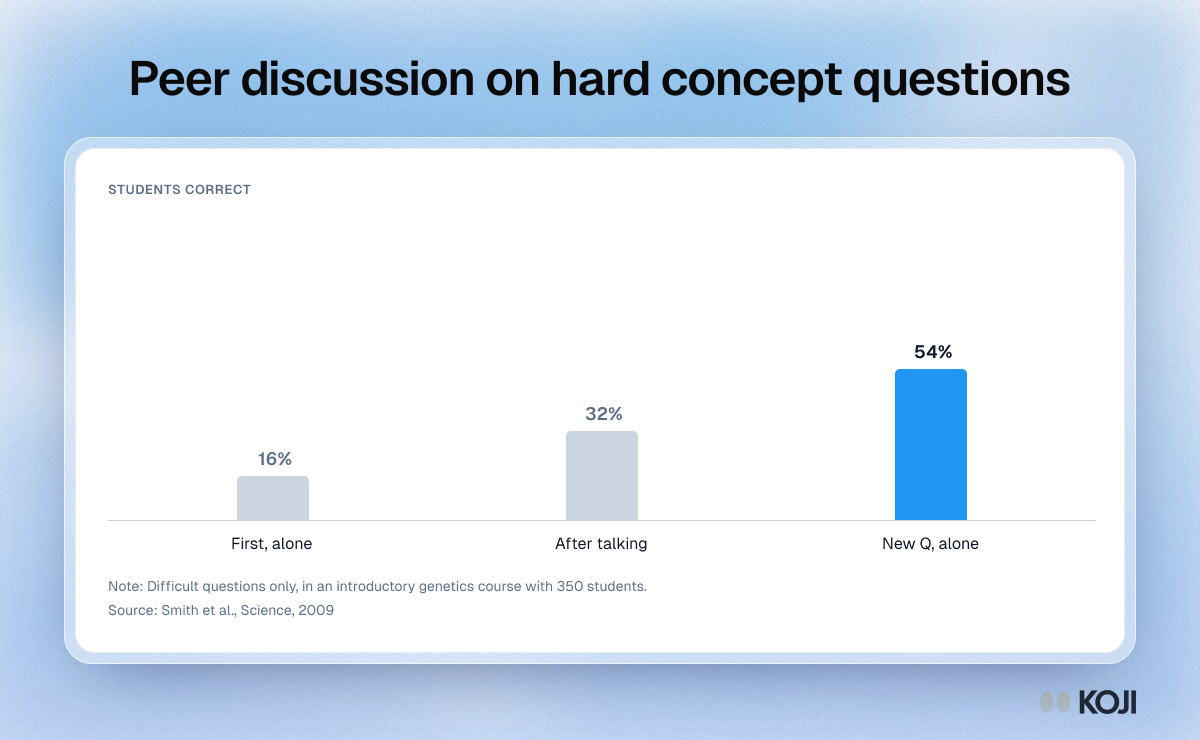
Results from Smith and colleagues (Science, 2009) on difficult concept questions in an introductory genetics course. Students answered alone, discussed with neighbours, answered again, then answered a new question on the same concept alone. The rise on the new question suggests discussion builds understanding rather than copying. Useful for teaching and quality teams evaluating peer instruction. Koji can ask students what happened in their discussions, with follow-up questions.
What's in this column chart
| Correct answers | |
|---|---|
| First, alone | 16% |
| After talking | 32% |
| New Q, alone | 54% |
Difficult questions only, in an introductory genetics course with 350 students.
Use this image
Free to use in your docs, decks and posts under CC BY 4.0, as long as you credit Koji with a link to this page. To embed it, paste this into your page:
html
<a href="https://www.koji.so/visuals/peer-discussion-concept-questions-smith-2009"><img src="https://www.koji.so/visuals/peer-discussion-concept-questions-smith-2009/peer-discussion-concept-questions-smith-2009.png" alt="Column chart of difficult concept questions: 16% correct answering alone, 32% after peer discussion, and 54% on a new question answered alone." width="1200" height="740" /></a>
<p>Source: <a href="https://www.koji.so/visuals/peer-discussion-concept-questions-smith-2009">Peer discussion on hard concept questions</a>, Koji</p>