Comparison
The phantom professor: rating a lecturer who never existed
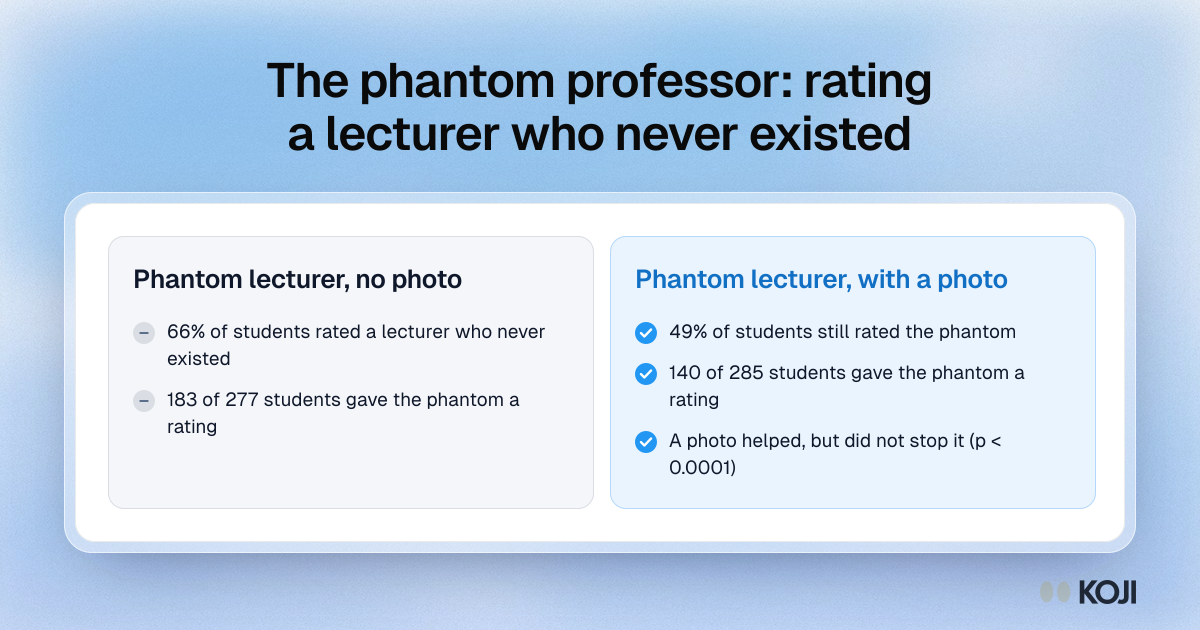
A side-by-side summary of the phantom professor study, in which a lecturer who did not exist was added to routine medical school teaching evaluations. Two thirds of students rated the phantom when only a name appeared, and about half still did with a photo. Quality and evaluation leads can use it to explain why a high response rate is not the same as careful answers. Koji's interview-based course evaluations ask students to describe real moments in a course, which makes this kind of guessing easier to spot.
What's in this comparison
Phantom lecturer, no photo
- 66% of students rated a lecturer who never existed
- 183 of 277 students gave the phantom a rating
Phantom lecturer, with a photo
- 49% of students still rated the phantom
- 140 of 285 students gave the phantom a rating
- A photo helped, but did not stop it (p < 0.0001)
Use this image
Free to use in your docs, decks and posts under CC BY 4.0, as long as you credit Koji with a link to this page. To embed it, paste this into your page:
html
<a href="https://www.koji.so/visuals/phantom-professor-fictitious-lecturer-evaluation-results"><img src="https://www.koji.so/visuals/phantom-professor-fictitious-lecturer-evaluation-results/phantom-professor-fictitious-lecturer-evaluation-results.png" alt="Comparison showing 66% of medical students rated a fictitious lecturer when no photo was shown, and 49% still did when a photo was added." width="1200" height="630" /></a>
<p>Source: <a href="https://www.koji.so/visuals/phantom-professor-fictitious-lecturer-evaluation-results">The phantom professor: rating a lecturer who never existed</a>, Koji</p>