Reference table
Stopping boundaries: Pocock, O'Brien-Fleming, Lan-DeMets
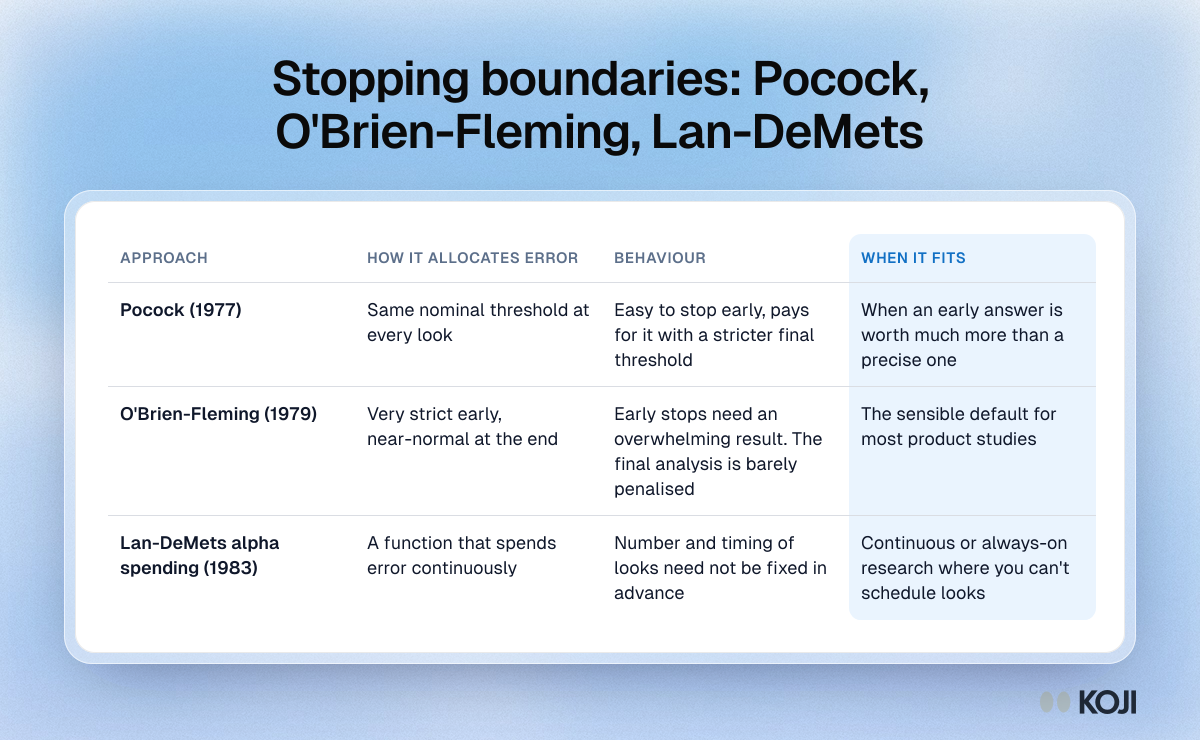
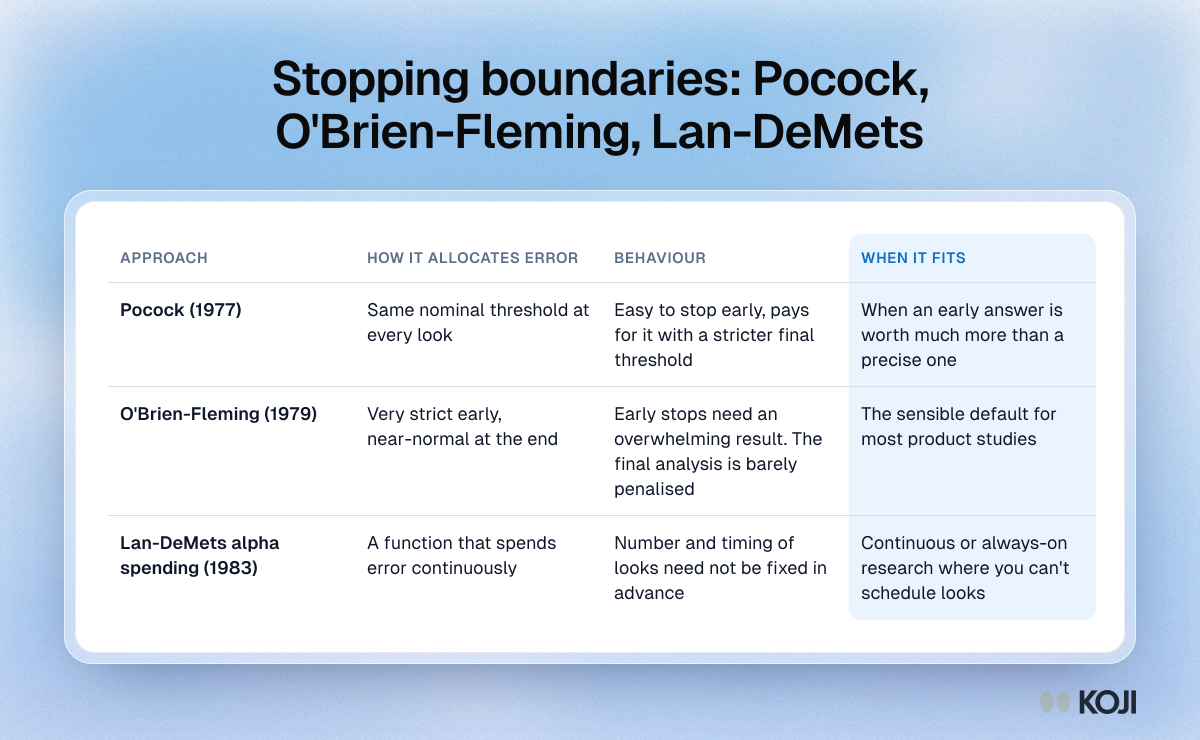
A comparison of the three main ways to spend a study's error budget across interim looks: Pocock's constant boundary, O'Brien-Fleming's strict-early boundary and the Lan-DeMets alpha-spending function. For each it shows how error is allocated, how the boundary behaves and the kind of product research it suits. Use it to choose a stopping rule before you field a survey or experiment, and write that choice into the research brief.
Where this appears
What's in this reference table
| Approach | How it allocates error | Behaviour | When it fits |
|---|---|---|---|
| Pocock (1977) | Same nominal threshold at every look | Easy to stop early, pays for it with a stricter final threshold | When an early answer is worth much more than a precise one |
| O'Brien-Fleming (1979) | Very strict early, near-normal at the end | Early stops need an overwhelming result. The final analysis is barely penalised | The sensible default for most product studies |
| Lan-DeMets alpha spending (1983) | A function that spends error continuously | Number and timing of looks need not be fixed in advance | Continuous or always-on research where you can't schedule looks |
Use this image
Free to use in your docs, decks and posts under CC BY 4.0, as long as you credit Koji with a link to this page. To embed it, paste this into your page:
html
<a href="https://www.koji.so/visuals/pocock-obrien-fleming-lan-demets-stopping-boundaries"><img src="https://www.koji.so/visuals/pocock-obrien-fleming-lan-demets-stopping-boundaries/pocock-obrien-fleming-lan-demets-stopping-boundaries.png" alt="Table comparing three interim analysis boundaries, Pocock, O'Brien-Fleming and Lan-DeMets alpha spending, by how each spends error and when it fits." width="1200" height="740" /></a>
<p>Source: <a href="https://www.koji.so/visuals/pocock-obrien-fleming-lan-demets-stopping-boundaries">Stopping boundaries: Pocock, O'Brien-Fleming, Lan-DeMets</a>, Koji</p>