Process
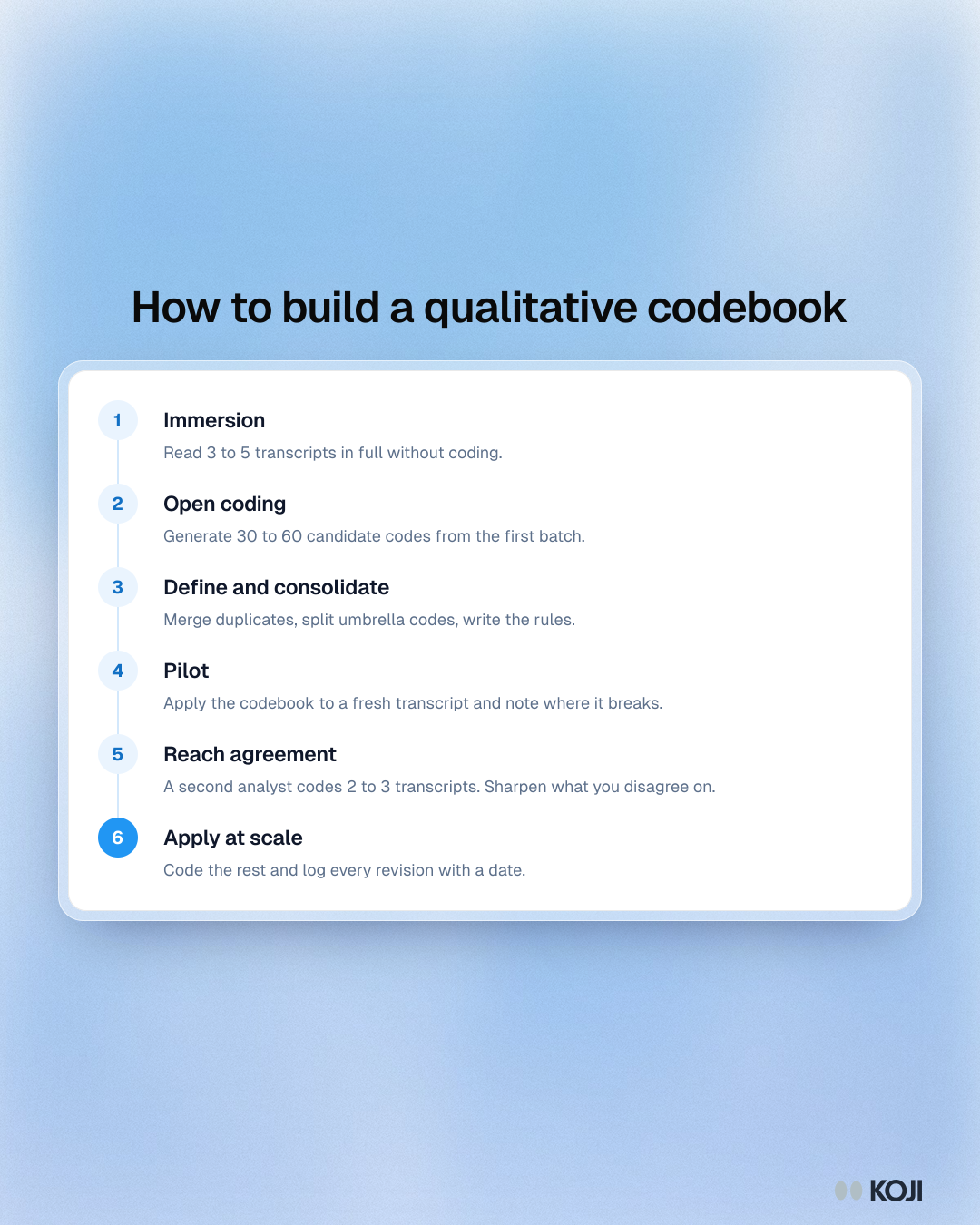
How to build a qualitative codebook
Six phases from first read to a dated revision history
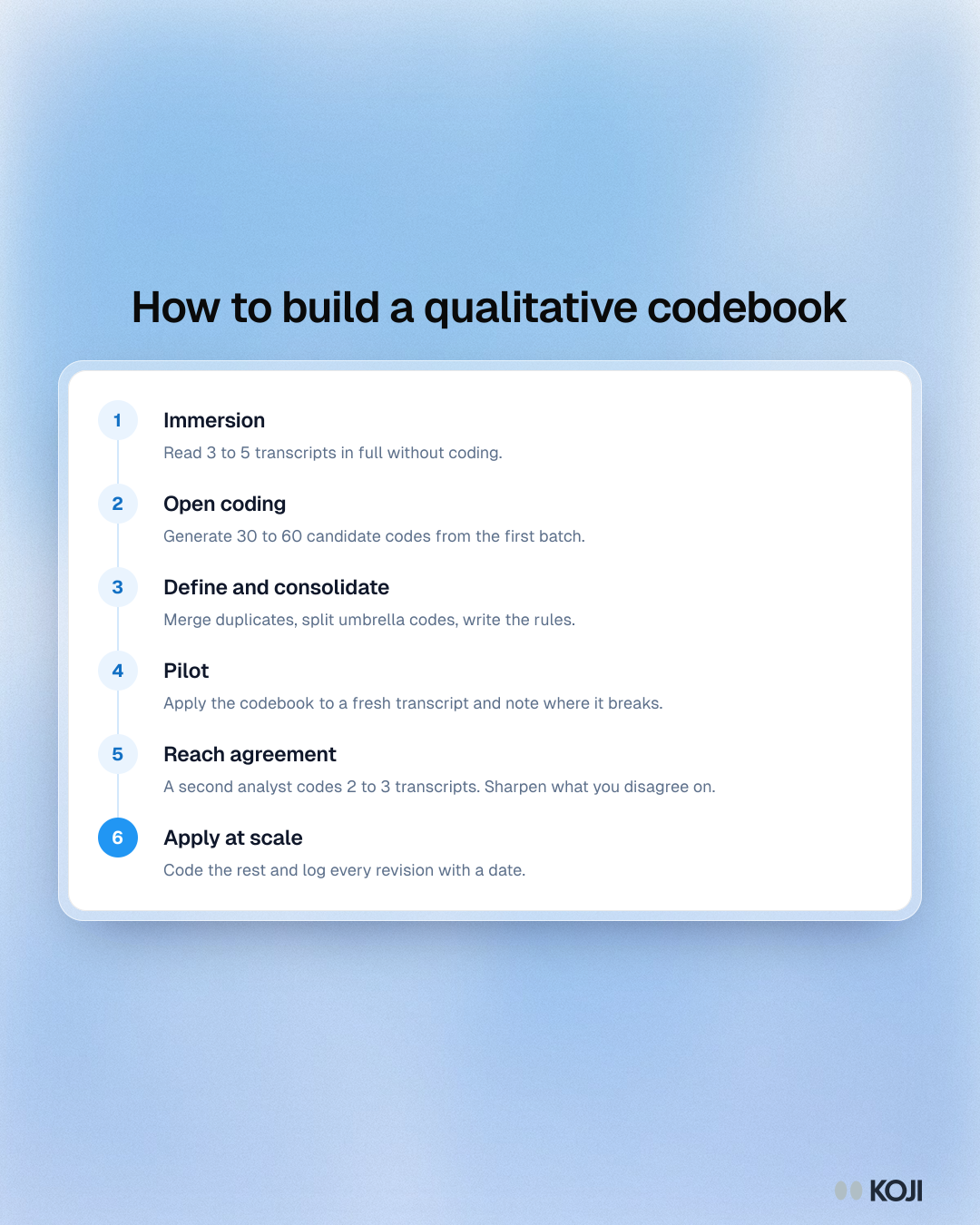
This is the inductive route to a codebook, from reading a few transcripts to coding the full set with a revision log. It suits interview studies where the codes come from the data. Save it as a checklist for the next project, and use phase 5 to find the definitions that two coders read differently.
Where this appears
What's in this process
- Immersion: Read 3 to 5 transcripts in full without coding.
- Open coding: Generate 30 to 60 candidate codes from the first batch.
- Define and consolidate: Merge duplicates, split umbrella codes, write the rules.
- Pilot: Apply the codebook to a fresh transcript and note where it breaks.
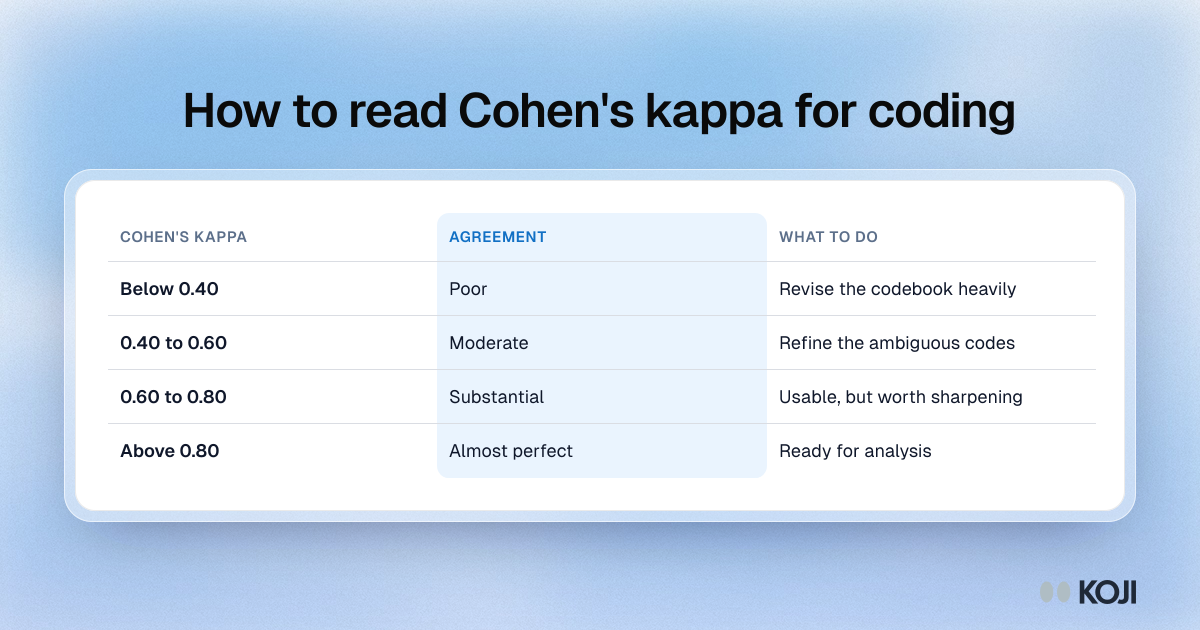
- Reach agreement: A second analyst codes 2 to 3 transcripts. Sharpen what you disagree on.
- Apply at scale: Code the rest and log every revision with a date.
Use this image
Free to use in your docs, decks and posts under CC BY 4.0, as long as you credit Koji with a link to this page. To embed it, paste this into your page:
html
<a href="https://www.koji.so/visuals/qualitative-codebook-build-process"><img src="https://www.koji.so/visuals/qualitative-codebook-build-process/qualitative-codebook-build-process.png" alt="Process showing six phases for building a qualitative codebook: immersion, open coding, define and consolidate, pilot, reach agreement and apply at scale." width="1080" height="1350" /></a>
<p>Source: <a href="https://www.koji.so/visuals/qualitative-codebook-build-process">How to build a qualitative codebook</a>, Koji</p>