Reference table
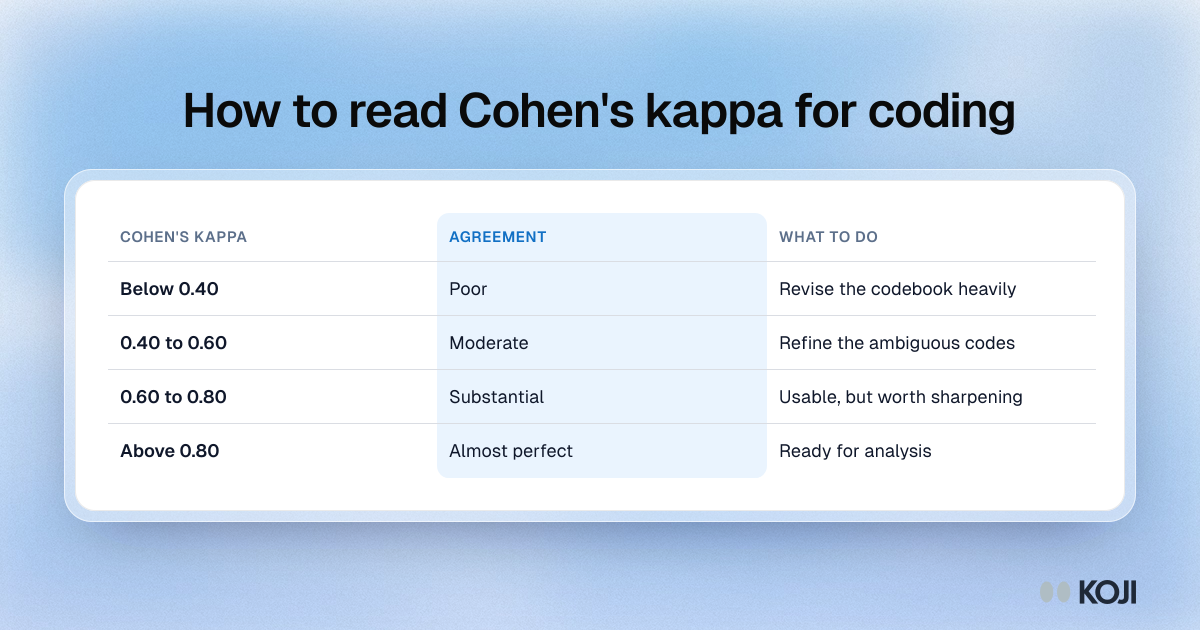
How to read Cohen's kappa for coding
Inter-coder agreement thresholds and what each one means for your codebook
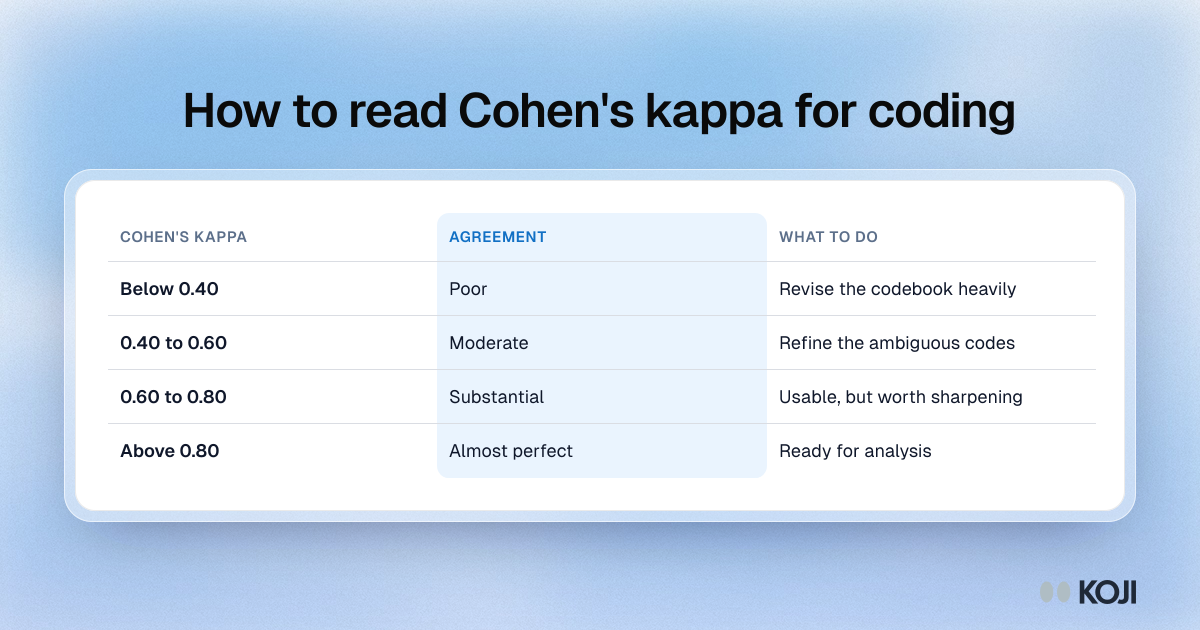
Cohen's kappa compares how often two coders agree with how often they would agree by chance. These are the widely used thresholds for reading it. Use them after a second analyst codes a few transcripts: low agreement usually points to vague criteria in the codebook, so fix the criteria rather than the coders.
Where this appears
What's in this reference table
| Cohen's kappa | Agreement | What to do |
|---|---|---|
| Below 0.40 | Poor | Revise the codebook heavily |
| 0.40 to 0.60 | Moderate | Refine the ambiguous codes |
| 0.60 to 0.80 | Substantial | Usable, but worth sharpening |
| Above 0.80 | Almost perfect | Ready for analysis |
Use this image
Free to use in your docs, decks and posts under CC BY 4.0, as long as you credit Koji with a link to this page. To embed it, paste this into your page:
html
<a href="https://www.koji.so/visuals/cohens-kappa-interpretation-for-codebooks"><img src="https://www.koji.so/visuals/cohens-kappa-interpretation-for-codebooks/cohens-kappa-interpretation-for-codebooks.png" alt="Table of Cohen's kappa thresholds for inter-coder agreement, from poor below 0.40 to almost perfect above 0.80, with what to do at each level." width="1200" height="630" /></a>
<p>Source: <a href="https://www.koji.so/visuals/cohens-kappa-interpretation-for-codebooks">How to read Cohen's kappa for coding</a>, Koji</p>