Framework
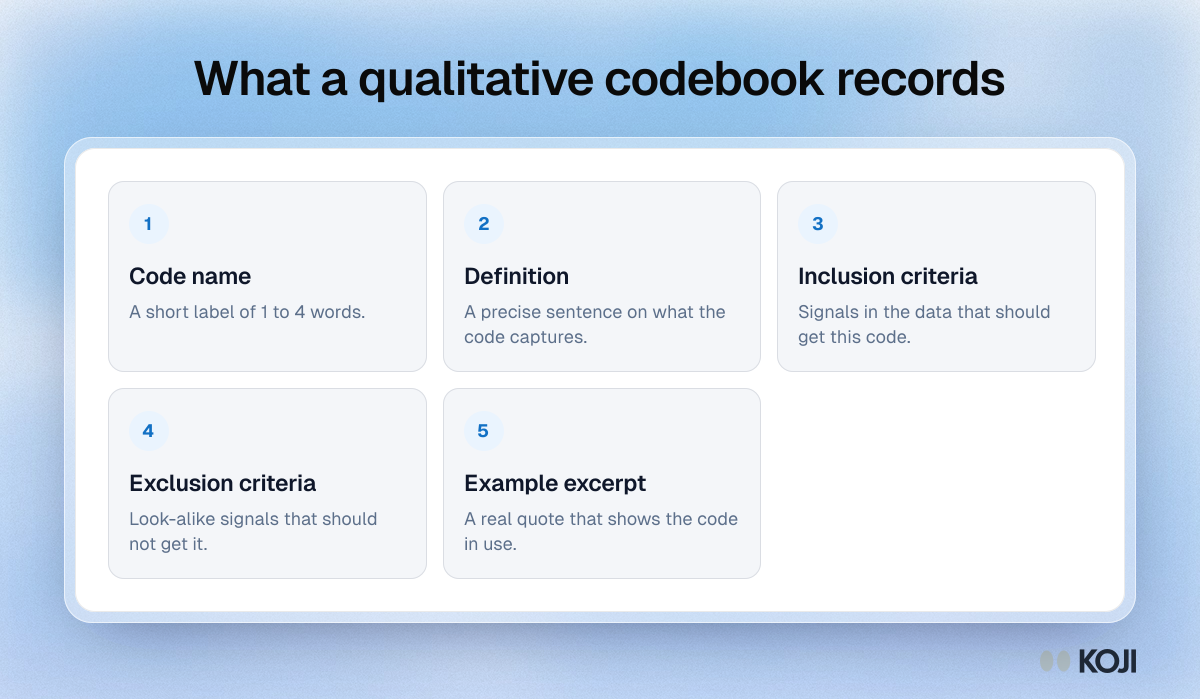
What a qualitative codebook records
The five columns every code needs in a thematic analysis codebook
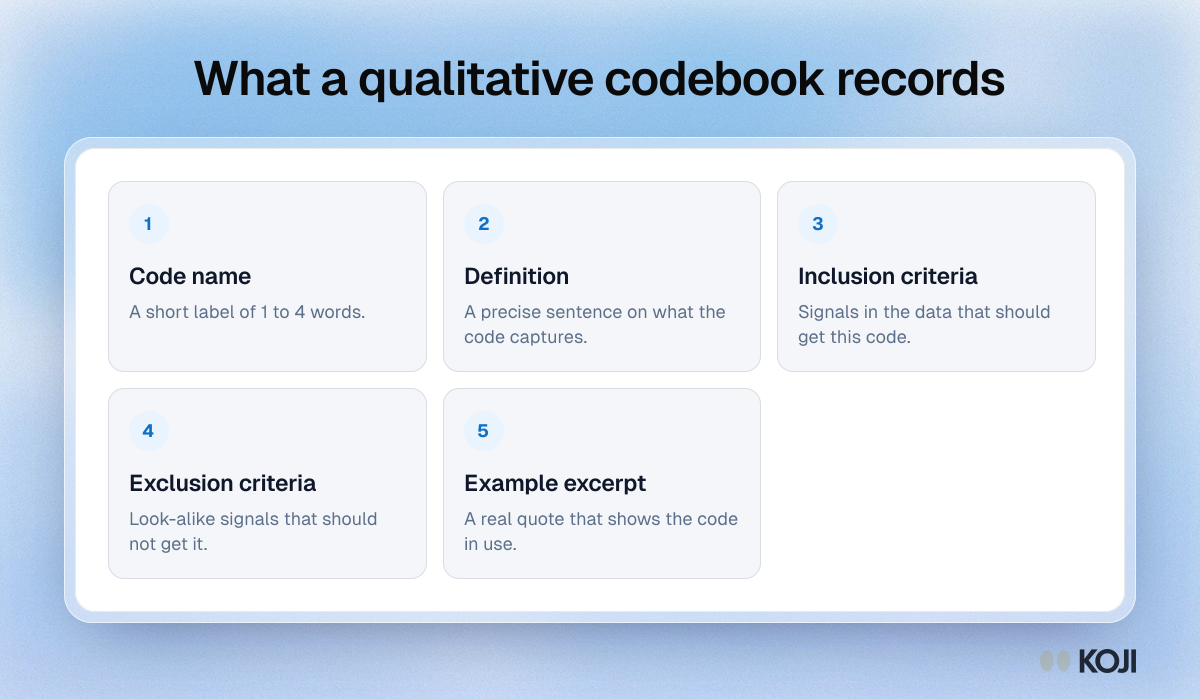
A qualitative codebook is the rulebook behind your coding, so a second analyst can code new data the same way you did. These are the five columns every code needs at a minimum. Use them as the header row of your own codebook spreadsheet, and add parent theme, coder notes and revision dates once the project grows.
Where this appears
What's in this framework
- Code name: A short label of 1 to 4 words.
- Definition: A precise sentence on what the code captures.
- Inclusion criteria: Signals in the data that should get this code.
- Exclusion criteria: Look-alike signals that should not get it.
- Example excerpt: A real quote that shows the code in use.
Use this image
Free to use in your docs, decks and posts under CC BY 4.0, as long as you credit Koji with a link to this page. To embed it, paste this into your page:
html
<a href="https://www.koji.so/visuals/qualitative-codebook-five-columns"><img src="https://www.koji.so/visuals/qualitative-codebook-five-columns/qualitative-codebook-five-columns.png" alt="Framework listing the five columns of a qualitative codebook: code name, definition, inclusion criteria, exclusion criteria and an example excerpt." width="1200" height="699" /></a>
<p>Source: <a href="https://www.koji.so/visuals/qualitative-codebook-five-columns">What a qualitative codebook records</a>, Koji</p>