Framework
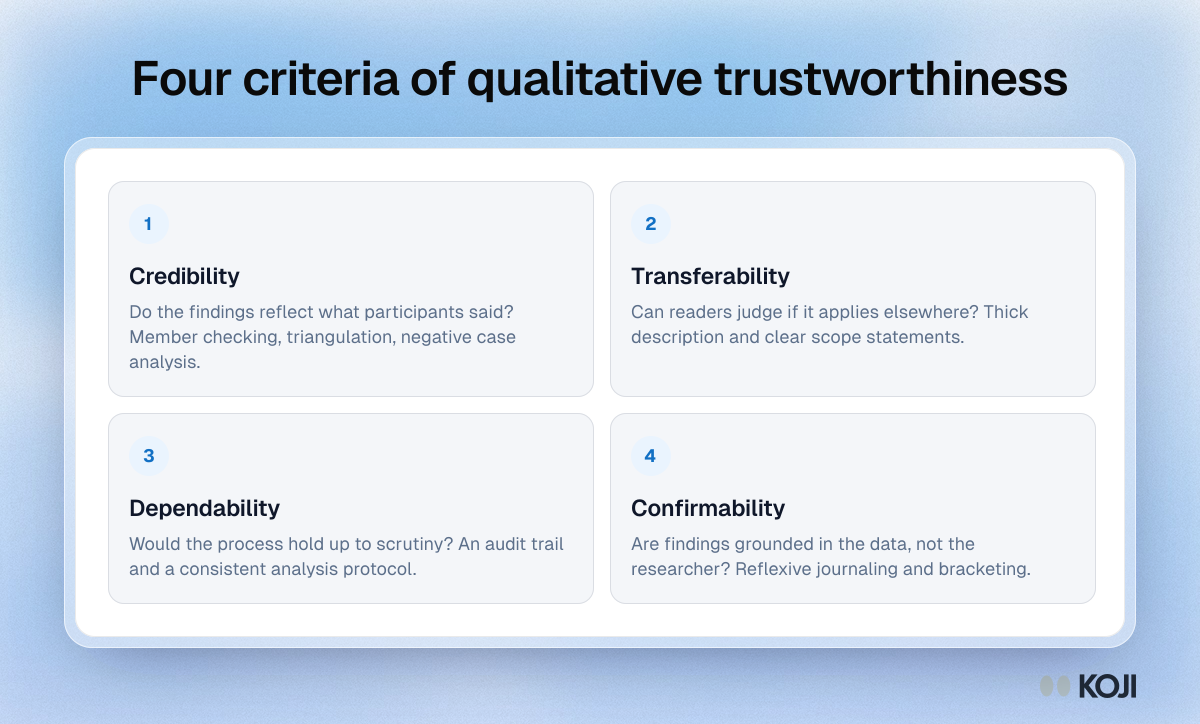
Four criteria of qualitative trustworthiness
Lincoln and Guba's framework for judging rigor in qualitative research
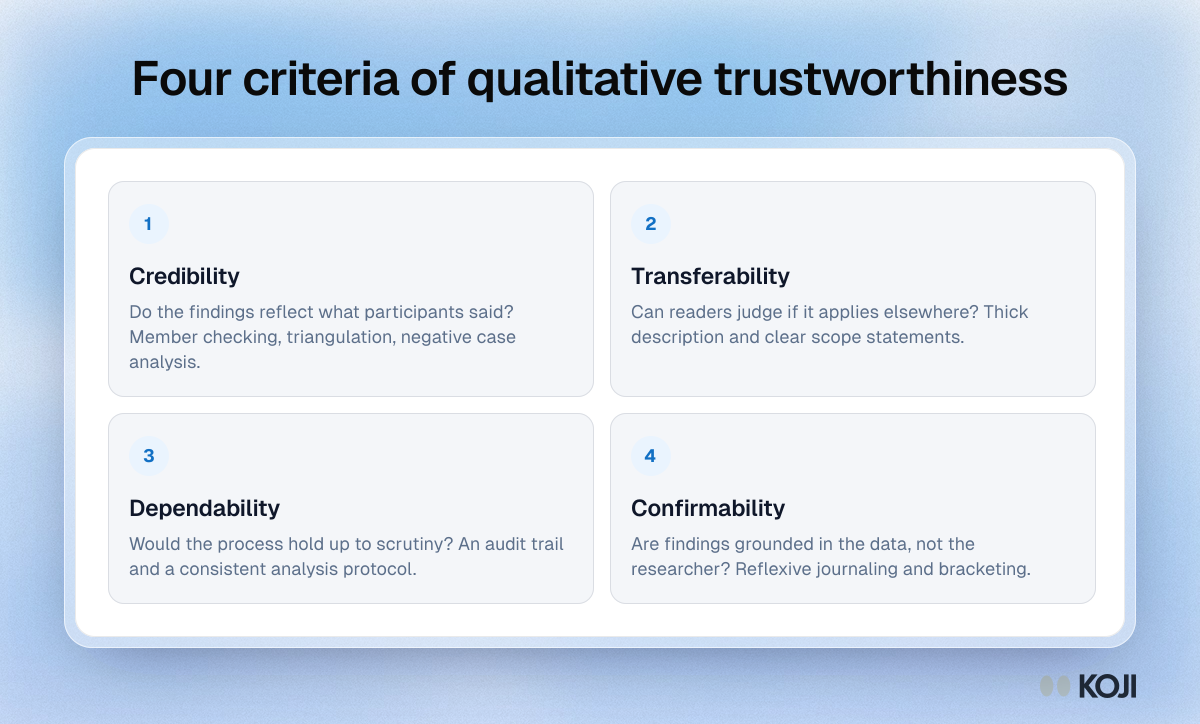
Lincoln and Guba's four criteria replace validity and reliability when you judge qualitative research. Credibility, transferability, dependability and confirmability each come with practical techniques, such as member checking, thick description, an audit trail and reflexive journaling. Researchers can use it to plan a study or to answer a stakeholder who asks how they know the findings are right.
Where this appears
What's in this framework
- Credibility: Do the findings reflect what participants said? Member checking, triangulation, negative case analysis.
- Transferability: Can readers judge if it applies elsewhere? Thick description and clear scope statements.
- Dependability: Would the process hold up to scrutiny? An audit trail and a consistent analysis protocol.
- Confirmability: Are findings grounded in the data, not the researcher? Reflexive journaling and bracketing.
Use this image
Free to use in your docs, decks and posts under CC BY 4.0, as long as you credit Koji with a link to this page. To embed it, paste this into your page:
html
<a href="https://www.koji.so/visuals/qualitative-research-trustworthiness-criteria-framework"><img src="https://www.koji.so/visuals/qualitative-research-trustworthiness-criteria-framework/qualitative-research-trustworthiness-criteria-framework.png" alt="Framework of the four qualitative trustworthiness criteria: credibility, transferability, dependability and confirmability, with the main technique for each." width="1200" height="724" /></a>
<p>Source: <a href="https://www.koji.so/visuals/qualitative-research-trustworthiness-criteria-framework">Four criteria of qualitative trustworthiness</a>, Koji</p>