Process
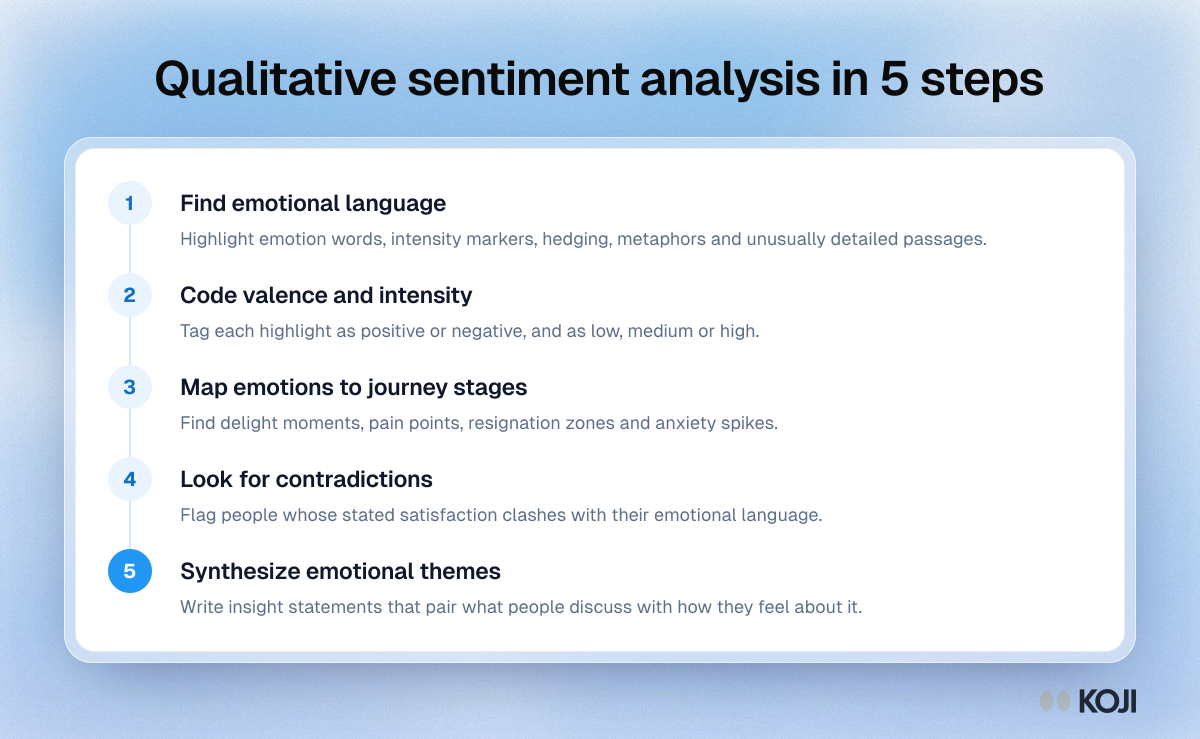
Qualitative sentiment analysis in 5 steps
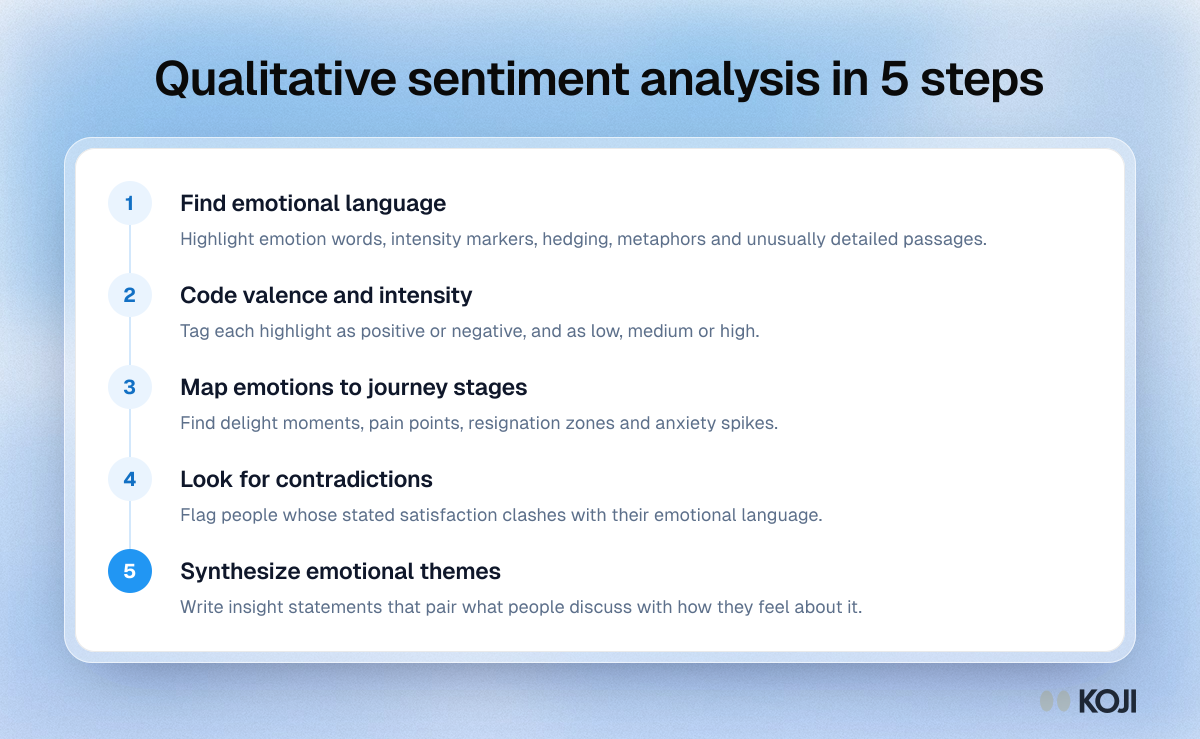
Five steps for analyzing sentiment in interview transcripts and open-ended answers, from highlighting emotional language to writing emotional themes. It goes past positive and negative to intensity, journey stage and the gap between what people say and how they sound. Use it alongside thematic analysis. Koji gives each AI-moderated interview a sentiment read to use as a first pass.
Where this appears
What's in this process
- Find emotional language: Highlight emotion words, intensity markers, hedging, metaphors and unusually detailed passages.
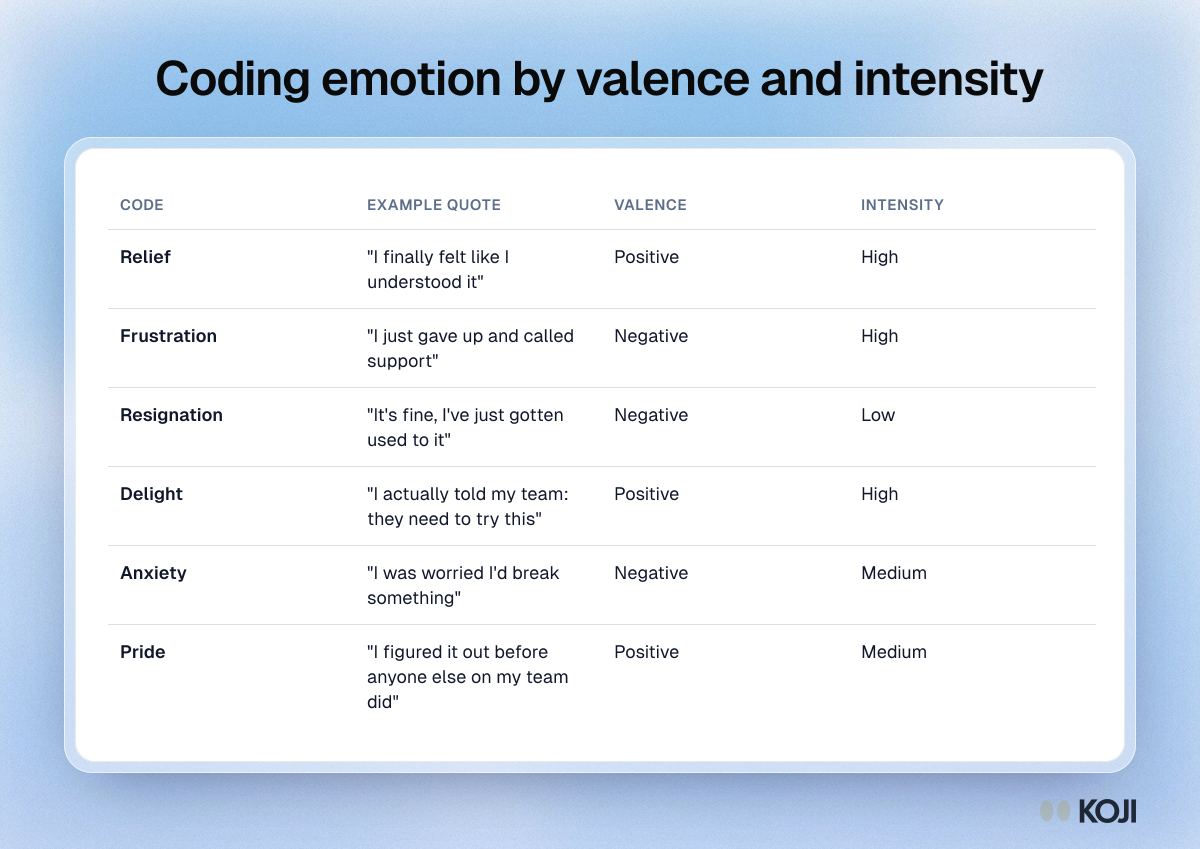
- Code valence and intensity: Tag each highlight as positive or negative, and as low, medium or high.
- Map emotions to journey stages: Find delight moments, pain points, resignation zones and anxiety spikes.
- Look for contradictions: Flag people whose stated satisfaction clashes with their emotional language.
- Synthesize emotional themes: Write insight statements that pair what people discuss with how they feel about it.
Use this image
Free to use in your docs, decks and posts under CC BY 4.0, as long as you credit Koji with a link to this page. To embed it, paste this into your page:
html
<a href="https://www.koji.so/visuals/qualitative-sentiment-analysis-five-steps"><img src="https://www.koji.so/visuals/qualitative-sentiment-analysis-five-steps/qualitative-sentiment-analysis-five-steps.png" alt="Process with five steps of qualitative sentiment analysis: find emotional language, code it, map it to journey stages, spot contradictions, synthesize." width="1200" height="739" /></a>
<p>Source: <a href="https://www.koji.so/visuals/qualitative-sentiment-analysis-five-steps">Qualitative sentiment analysis in 5 steps</a>, Koji</p>