Checklist
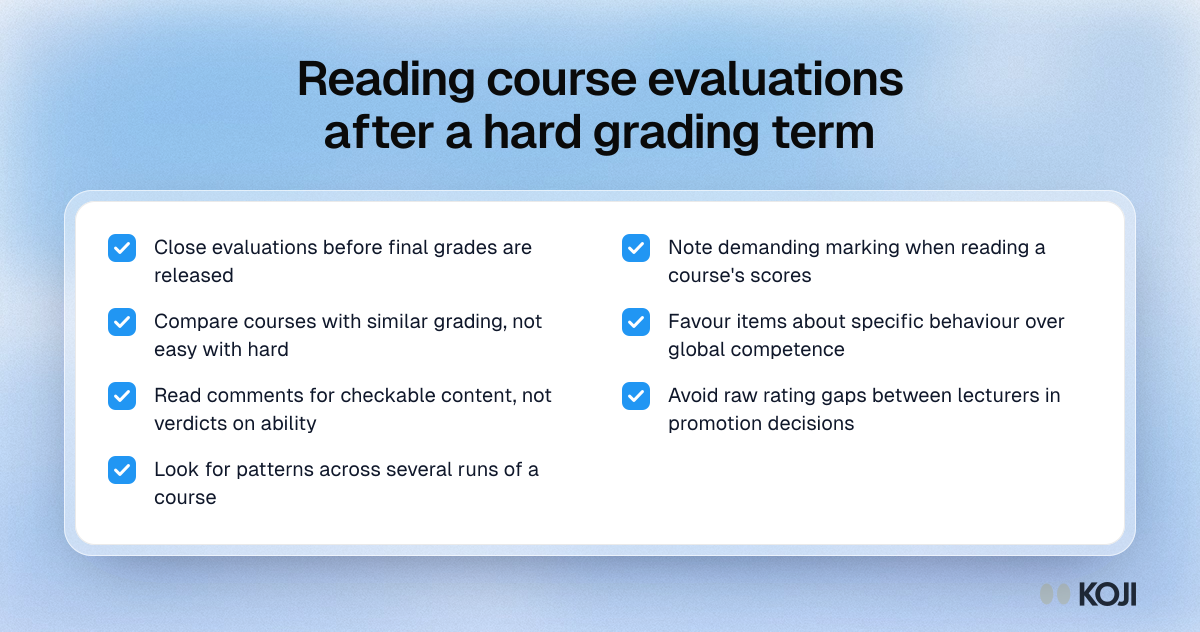
Reading course evaluations after a hard grading term
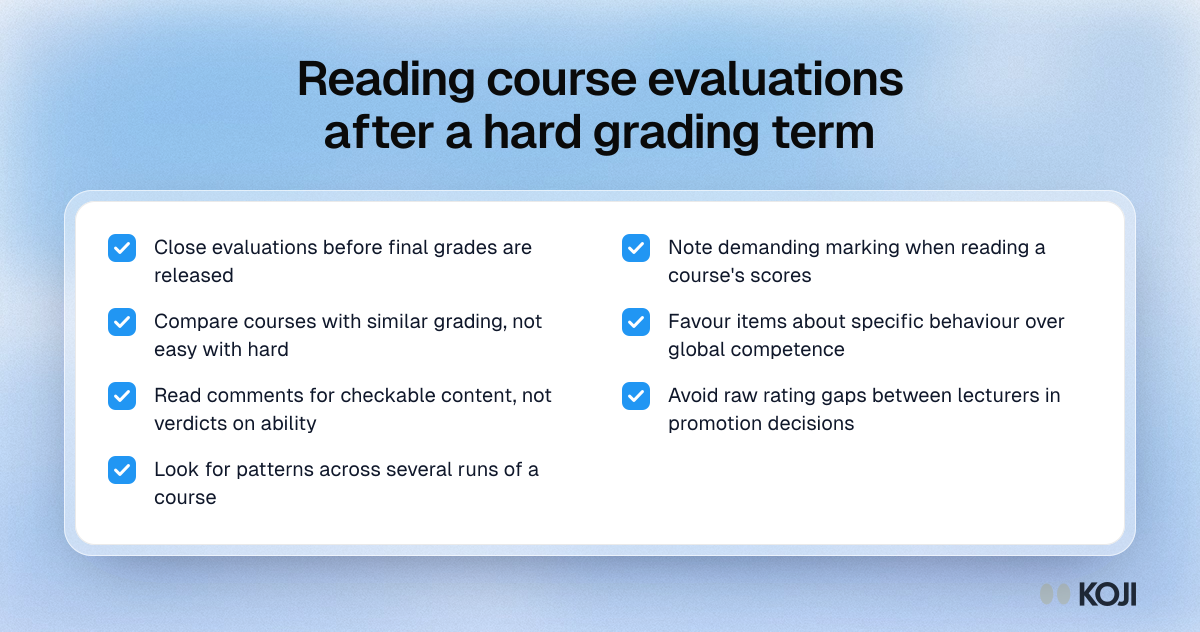
A checklist for quality officers and heads of department reading course evaluations from courses with demanding marking. It draws on Sinclair and Kunda (2000), who found women were rated as less competent after giving negative feedback but not after praise, and on field studies of gender bias in teaching evaluations. Koji for Education lets institutions choose when to collect evaluations and write behaviour-focused questions.
What's in this checklist
- Close evaluations before final grades are released
- Note demanding marking when reading a course's scores
- Compare courses with similar grading, not easy with hard
- Favour items about specific behaviour over global competence
- Read comments for checkable content, not verdicts on ability
- Avoid raw rating gaps between lecturers in promotion decisions
- Look for patterns across several runs of a course
Use this image
Free to use in your docs, decks and posts under CC BY 4.0, as long as you credit Koji with a link to this page. To embed it, paste this into your page:
html
<a href="https://www.koji.so/visuals/reading-course-evaluations-after-low-grades-checklist"><img src="https://www.koji.so/visuals/reading-course-evaluations-after-low-grades-checklist/reading-course-evaluations-after-low-grades-checklist.png" alt="Checklist for reading course evaluations fairly after a demanding grading term, covering timing, item wording, comparisons and comments." width="1200" height="632" /></a>
<p>Source: <a href="https://www.koji.so/visuals/reading-course-evaluations-after-low-grades-checklist">Reading course evaluations after a hard grading term</a>, Koji</p>