Reference table
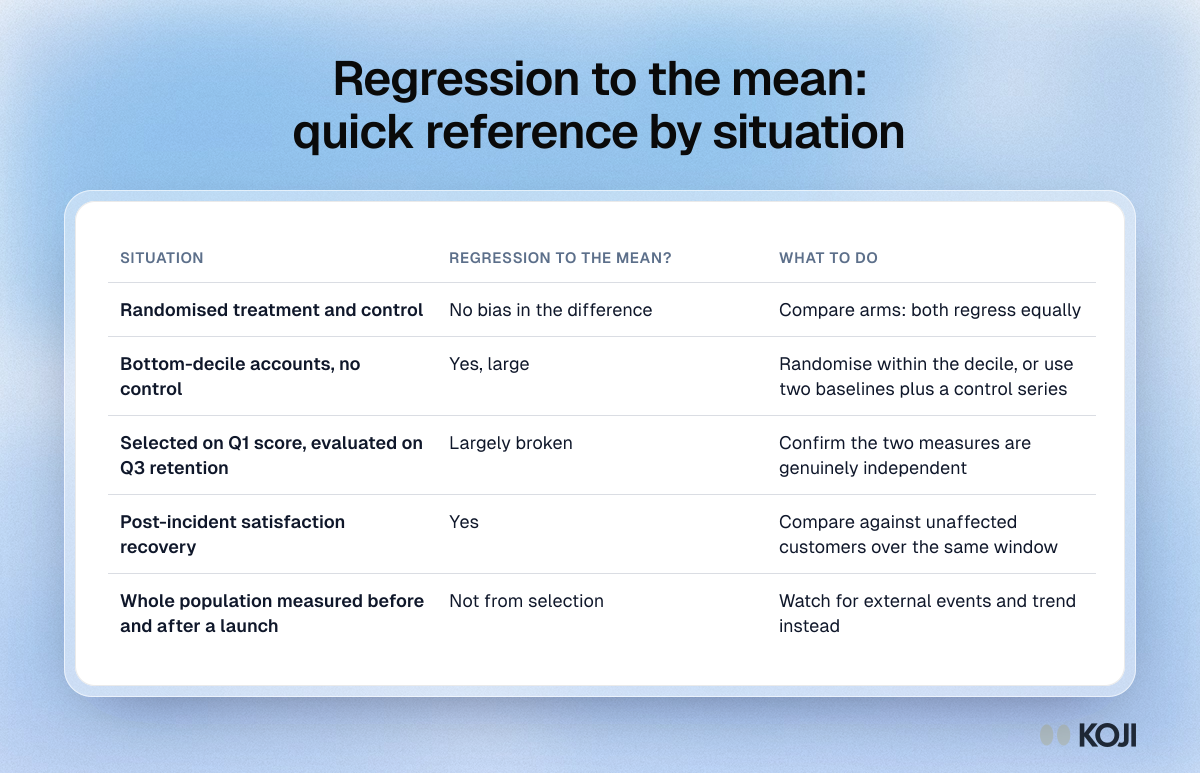
Regression to the mean: quick reference by situation
When selection creates a fake improvement, and what to do about it
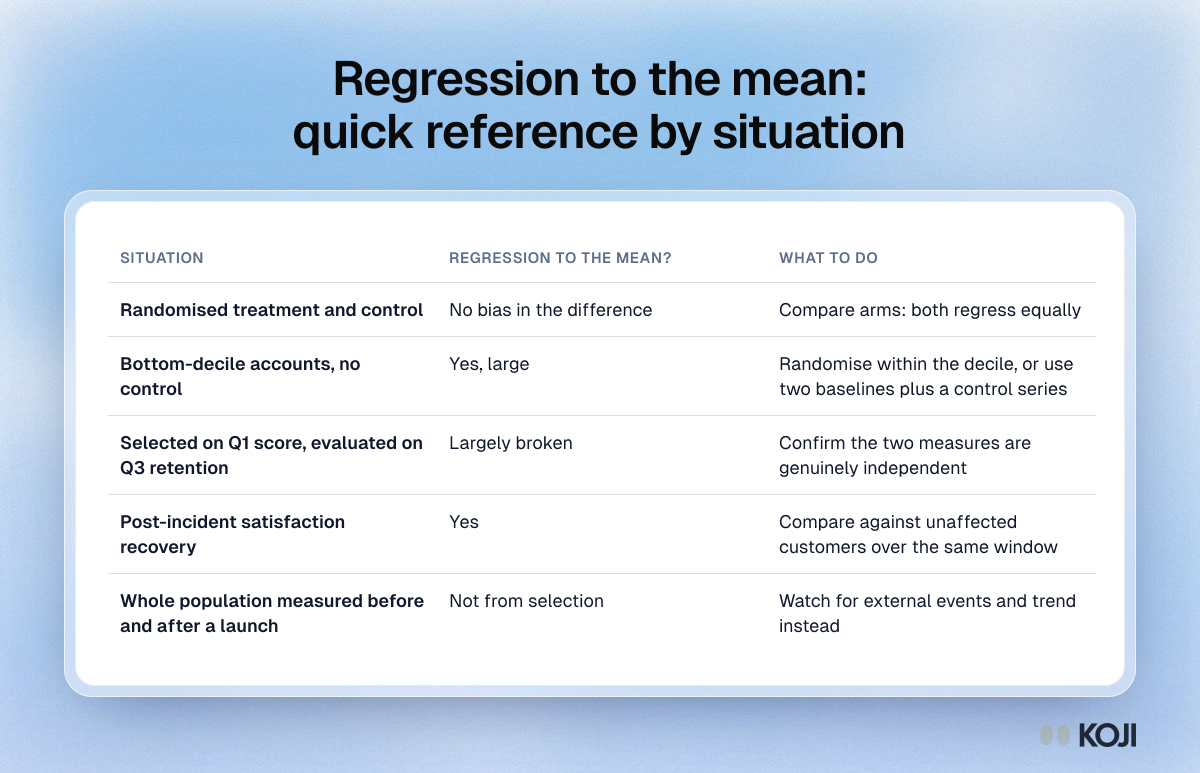
A quick reference for spotting regression to the mean in product and customer research. It lists five common situations, from a randomised test to a rescue programme for bottom-decile accounts with no control group, says whether selection on an extreme score will inflate the result, and gives the fix for each. Use it when reviewing an evaluation of a churn intervention, a support recovery or a launch.
Where this appears
What's in this reference table
| Situation | Regression to the mean? | What to do |
|---|---|---|
| Randomised treatment and control | No bias in the difference | Compare arms: both regress equally |
| Bottom-decile accounts, no control | Yes, large | Randomise within the decile, or use two baselines plus a control series |
| Selected on Q1 score, evaluated on Q3 retention | Largely broken | Confirm the two measures are genuinely independent |
| Post-incident satisfaction recovery | Yes | Compare against unaffected customers over the same window |
| Whole population measured before and after a launch | Not from selection | Watch for external events and trend instead |
Use this image
Free to use in your docs, decks and posts under CC BY 4.0, as long as you credit Koji with a link to this page. To embed it, paste this into your page:
html
<a href="https://www.koji.so/visuals/regression-to-the-mean-quick-reference-by-situation"><img src="https://www.koji.so/visuals/regression-to-the-mean-quick-reference-by-situation/regression-to-the-mean-quick-reference-by-situation.png" alt="Table of five research situations, whether regression to the mean is present in each, and what to do, from randomised tests to bottom-decile rescues" width="1200" height="773" /></a>
<p>Source: <a href="https://www.koji.so/visuals/regression-to-the-mean-quick-reference-by-situation">Regression to the mean: quick reference by situation</a>, Koji</p>