Comparison
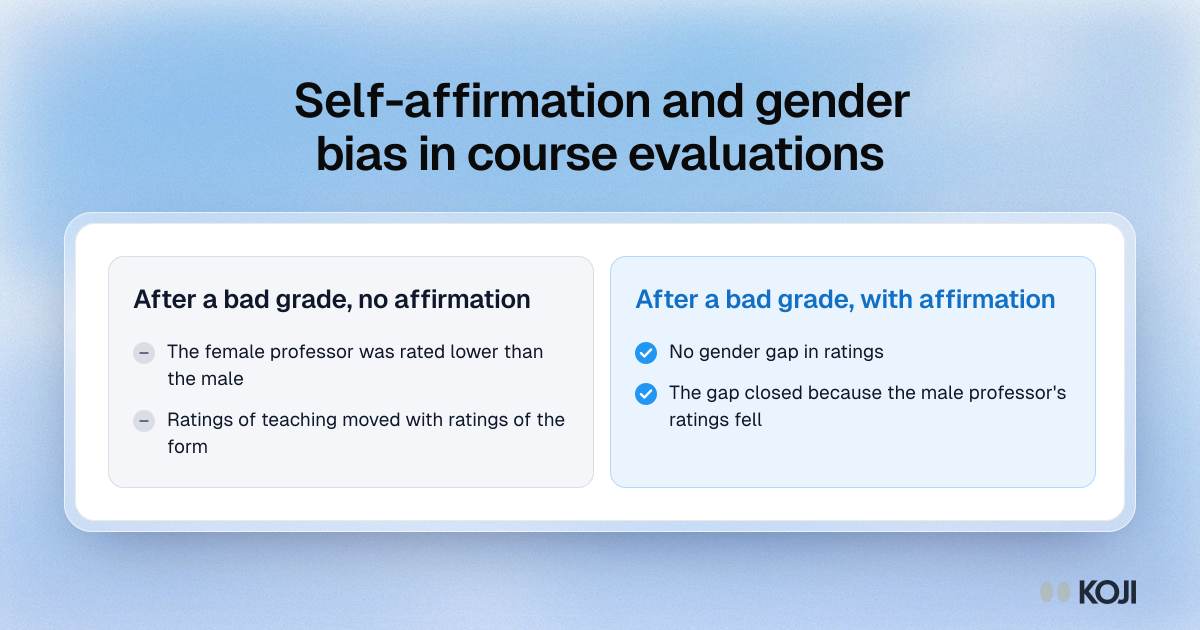
Self-affirmation and gender bias in course evaluations
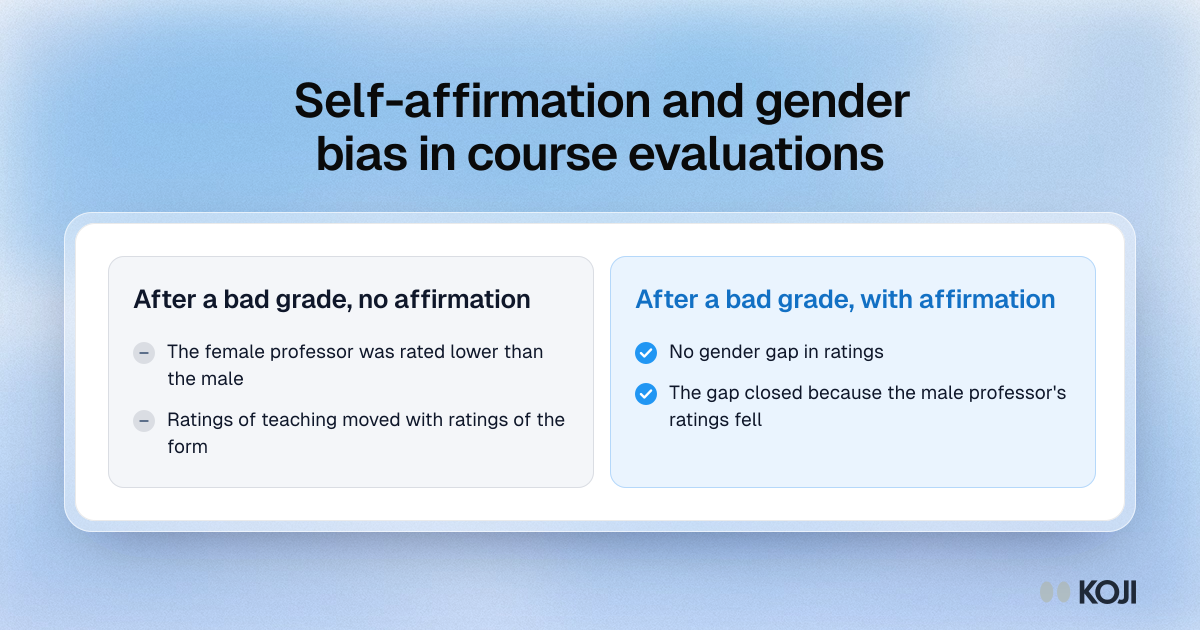
A summary of an experiment with 568 Belgian students in which those who first affirmed their own values showed no gender gap when rating a professor after a bad grade. The gap closed because the male professor was rated lower, which the authors read as bias that overvalues men. It is meant for quality and equality leads deciding how to time and use course evaluations. Koji lets institutions choose when evaluations run, so they can close before grades are released.
What's in this comparison
After a bad grade, no affirmation
- The female professor was rated lower than the male
- Ratings of teaching moved with ratings of the form
After a bad grade, with affirmation
- No gender gap in ratings
- The gap closed because the male professor's ratings fell
Use this image
Free to use in your docs, decks and posts under CC BY 4.0, as long as you credit Koji with a link to this page. To embed it, paste this into your page:
html
<a href="https://www.koji.so/visuals/self-affirmation-gender-bias-course-evaluations-hoorens"><img src="https://www.koji.so/visuals/self-affirmation-gender-bias-course-evaluations-hoorens/self-affirmation-gender-bias-course-evaluations-hoorens.png" alt="Comparison of ratings after a bad grade: without self-affirmation the female professor was rated lower; with it the gap closed as the male rating fell." width="1200" height="630" /></a>
<p>Source: <a href="https://www.koji.so/visuals/self-affirmation-gender-bias-course-evaluations-hoorens">Self-affirmation and gender bias in course evaluations</a>, Koji</p>