Comparison
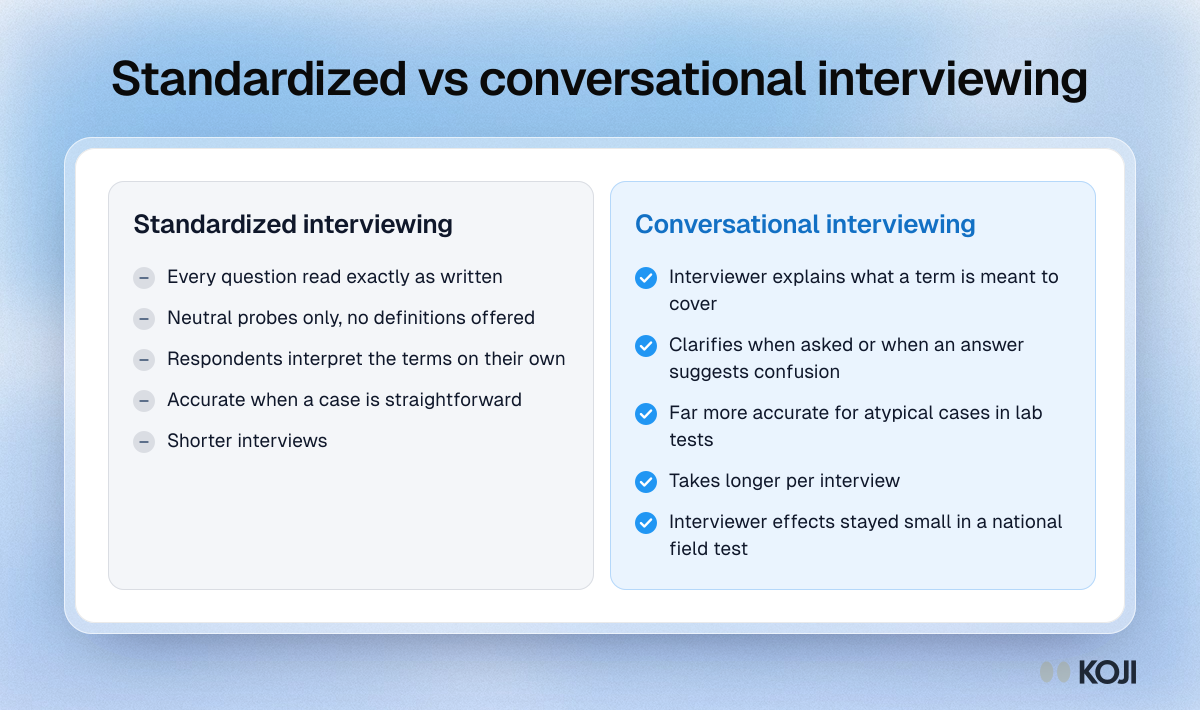
Standardized vs conversational interviewing
What changes when the interviewer is allowed to explain what a question means
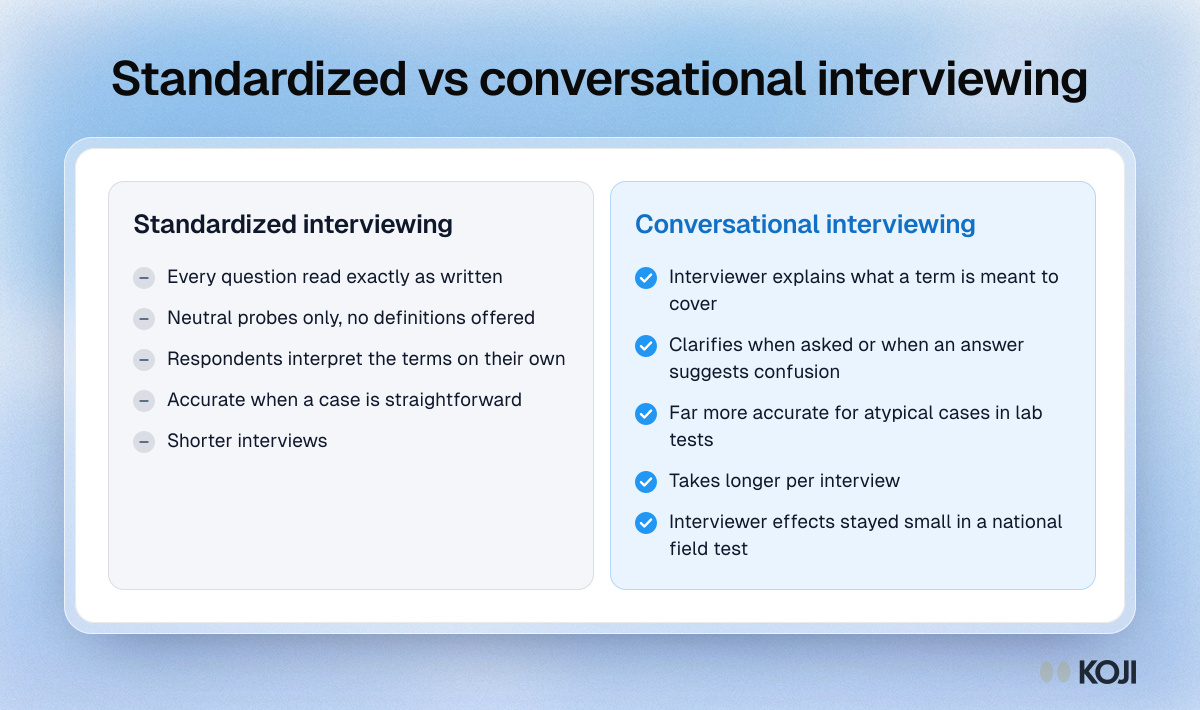
A side by side comparison of the two main ways to run an interviewer-administered survey, drawn from laboratory and field experiments by Schober, Conrad and colleagues. It is meant for survey methodologists and quality officers deciding how much freedom an interviewer, human or automated, should have to explain course evaluation questions. Koji's conversational interviews sit closer to the right-hand column, with one question per turn and follow-ups set per question.
What's in this comparison
Standardized interviewing
- Every question read exactly as written
- Neutral probes only, no definitions offered
- Respondents interpret the terms on their own
- Accurate when a case is straightforward
- Shorter interviews
Conversational interviewing
- Interviewer explains what a term is meant to cover
- Clarifies when asked or when an answer suggests confusion
- Far more accurate for atypical cases in lab tests
- Takes longer per interview
- Interviewer effects stayed small in a national field test
Use this image
Free to use in your docs, decks and posts under CC BY 4.0, as long as you credit Koji with a link to this page. To embed it, paste this into your page:
html
<a href="https://www.koji.so/visuals/standardized-vs-conversational-interviewing-comparison"><img src="https://www.koji.so/visuals/standardized-vs-conversational-interviewing-comparison/standardized-vs-conversational-interviewing-comparison.png" alt="Comparison of standardized and conversational interviewing: fixed wording and neutral probes against clarified definitions and longer interviews." width="1200" height="710" /></a>
<p>Source: <a href="https://www.koji.so/visuals/standardized-vs-conversational-interviewing-comparison">Standardized vs conversational interviewing</a>, Koji</p>