Comparison
Stated vs revealed preferences
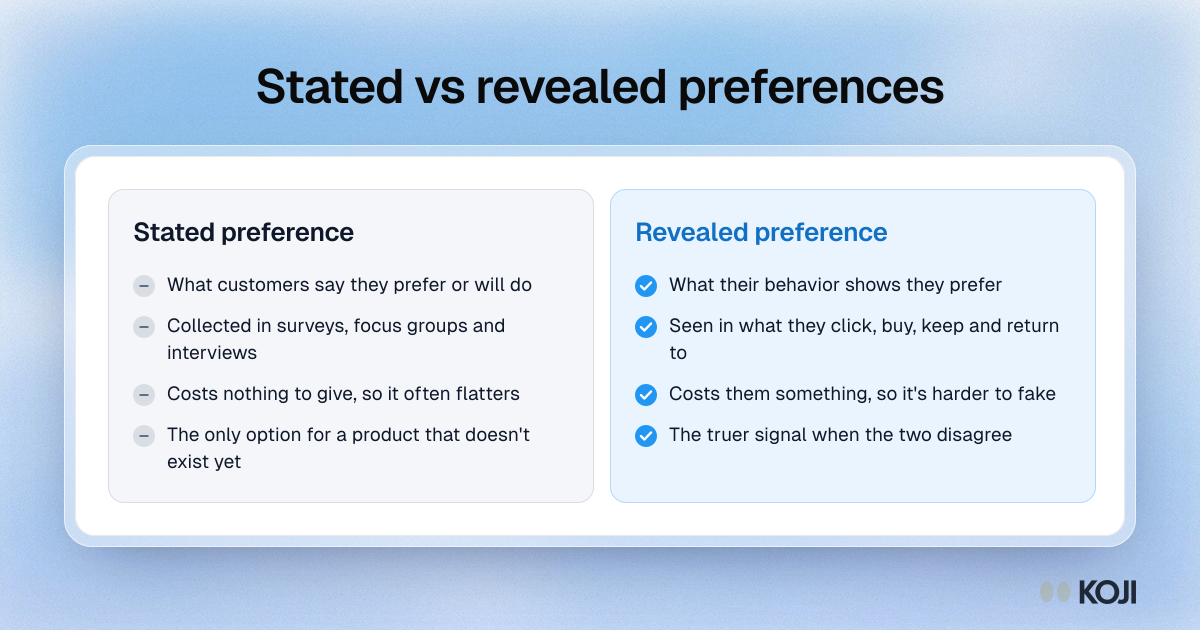
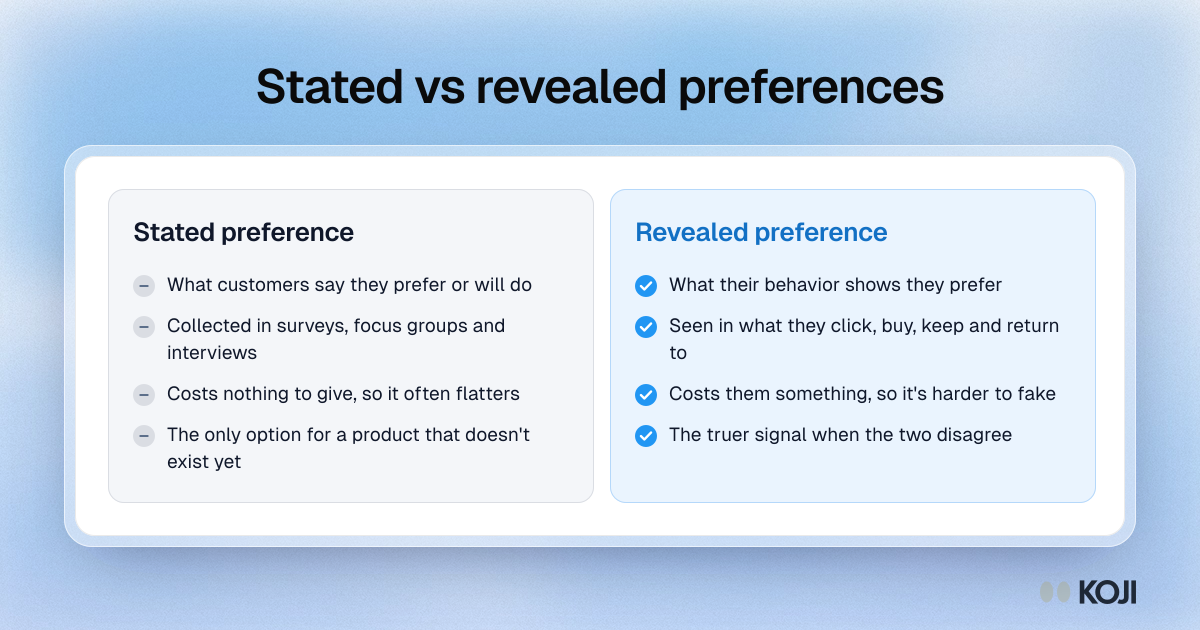
A quick comparison of stated preferences (what people tell you in surveys, focus groups and interviews) and revealed preferences (what they actually click, buy and keep). The idea goes back to Paul Samuelson's 1938 work on revealed preference. Use it to decide how much weight to give an answer, and to plan research that asks about past behavior instead of future intentions.
Where this appears
What's in this comparison
Stated preference
- What customers say they prefer or will do
- Collected in surveys, focus groups and interviews
- Costs nothing to give, so it often flatters
- The only option for a product that doesn't exist yet
Revealed preference
- What their behavior shows they prefer
- Seen in what they click, buy, keep and return to
- Costs them something, so it's harder to fake
- The truer signal when the two disagree
Use this image
Free to use in your docs, decks and posts under CC BY 4.0, as long as you credit Koji with a link to this page. To embed it, paste this into your page:
html
<a href="https://www.koji.so/visuals/stated-vs-revealed-preferences-comparison"><img src="https://www.koji.so/visuals/stated-vs-revealed-preferences-comparison/stated-vs-revealed-preferences-comparison.png" alt="Comparison of stated and revealed preferences: what customers say in surveys and interviews against what their behavior shows." width="1200" height="630" /></a>
<p>Source: <a href="https://www.koji.so/visuals/stated-vs-revealed-preferences-comparison">Stated vs revealed preferences</a>, Koji</p>