Reference table
Four UX research team models compared
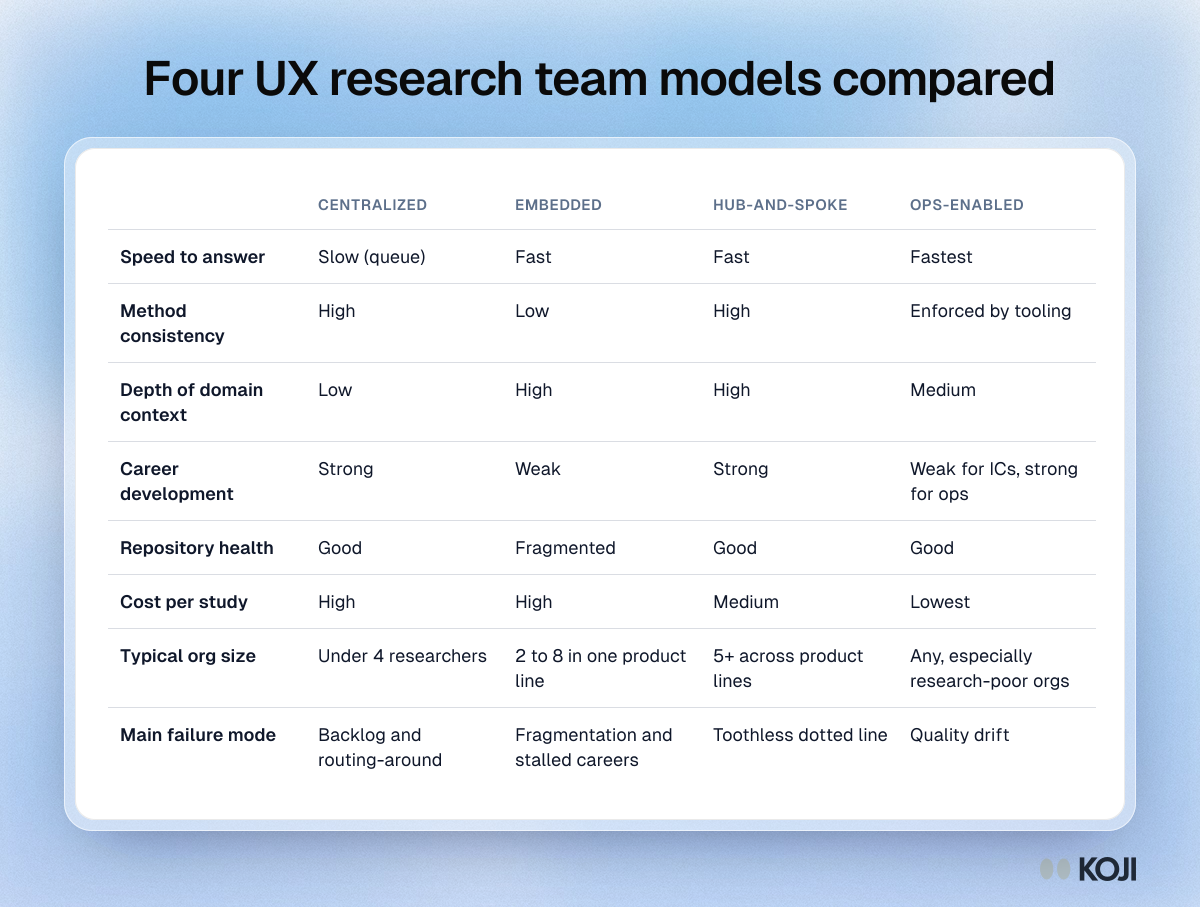
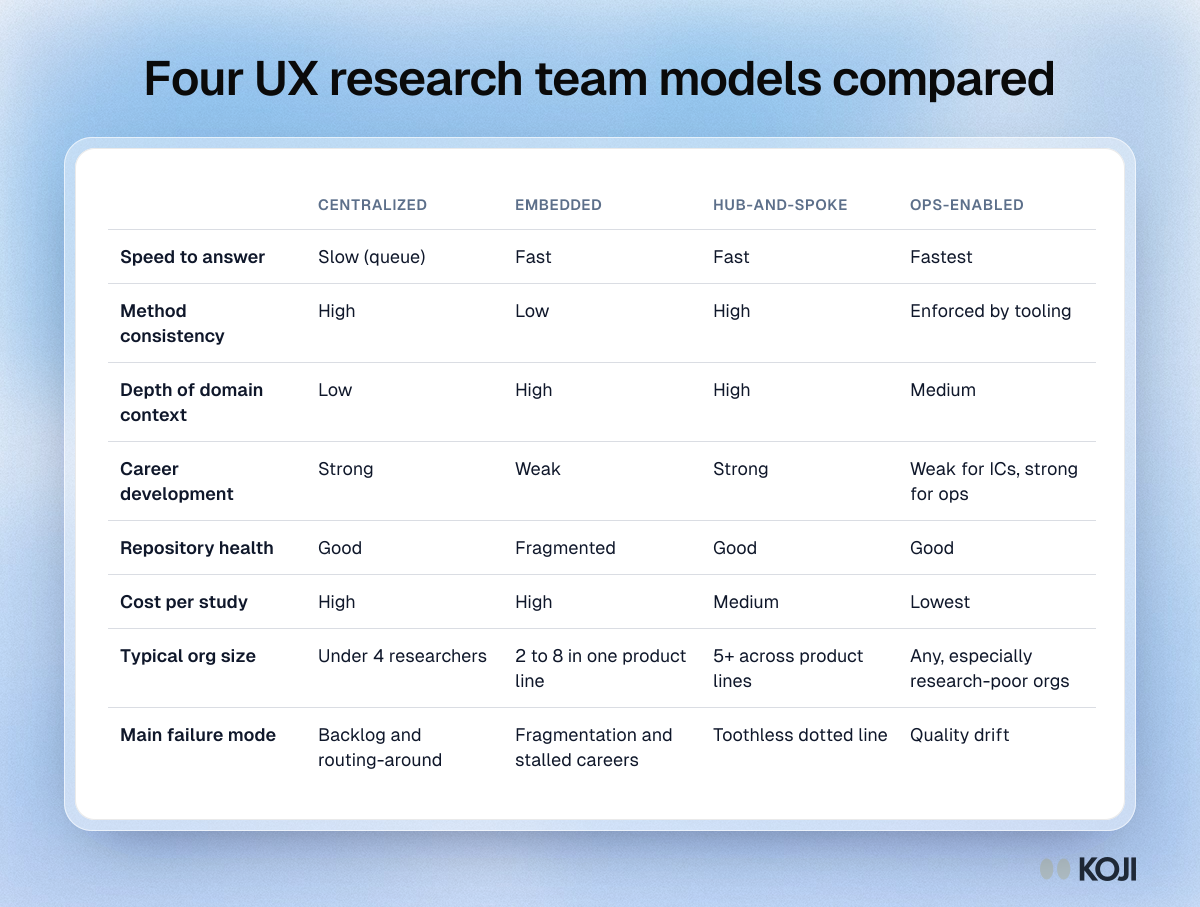
A comparison of the four UX research operating models: centralized, embedded, hub-and-spoke and ops-enabled democratization. It rates each on speed to answer, method consistency, domain context, career development, repository health, cost per study, typical team size and main failure mode. Use it to choose a structure or to explain why the current one is struggling. With Koji, a small central team owns templates and quality review while product teams run their own studies.
Where this appears
What's in this reference table
| Centralized | Embedded | Hub-and-spoke | Ops-enabled | |
|---|---|---|---|---|
| Speed to answer | Slow (queue) | Fast | Fast | Fastest |
| Method consistency | High | Low | High | Enforced by tooling |
| Depth of domain context | Low | High | High | Medium |
| Career development | Strong | Weak | Strong | Weak for ICs, strong for ops |
| Repository health | Good | Fragmented | Good | Good |
| Cost per study | High | High | Medium | Lowest |
| Typical org size | Under 4 researchers | 2 to 8 in one product line | 5+ across product lines | Any, especially research-poor orgs |
| Main failure mode | Backlog and routing-around | Fragmentation and stalled careers | Toothless dotted line | Quality drift |
Use this image
Free to use in your docs, decks and posts under CC BY 4.0, as long as you credit Koji with a link to this page. To embed it, paste this into your page:
html
<a href="https://www.koji.so/visuals/ux-research-operating-models-comparison"><img src="https://www.koji.so/visuals/ux-research-operating-models-comparison/ux-research-operating-models-comparison.png" alt="Table comparing centralized, embedded, hub-and-spoke and ops-enabled research teams on speed, consistency, context, careers, cost, size and failure mode." width="1200" height="907" /></a>
<p>Source: <a href="https://www.koji.so/visuals/ux-research-operating-models-comparison">Four UX research team models compared</a>, Koji</p>