Guide
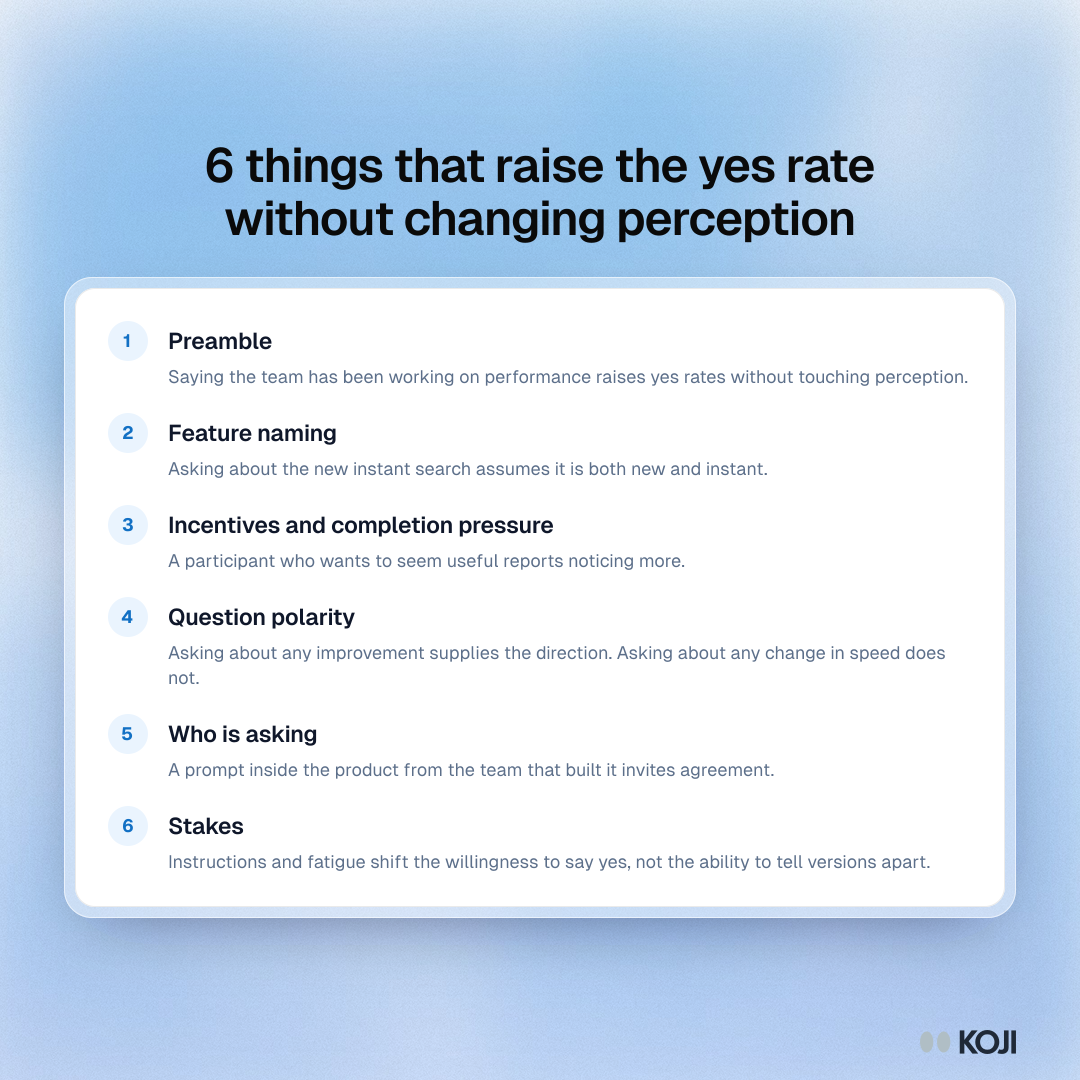
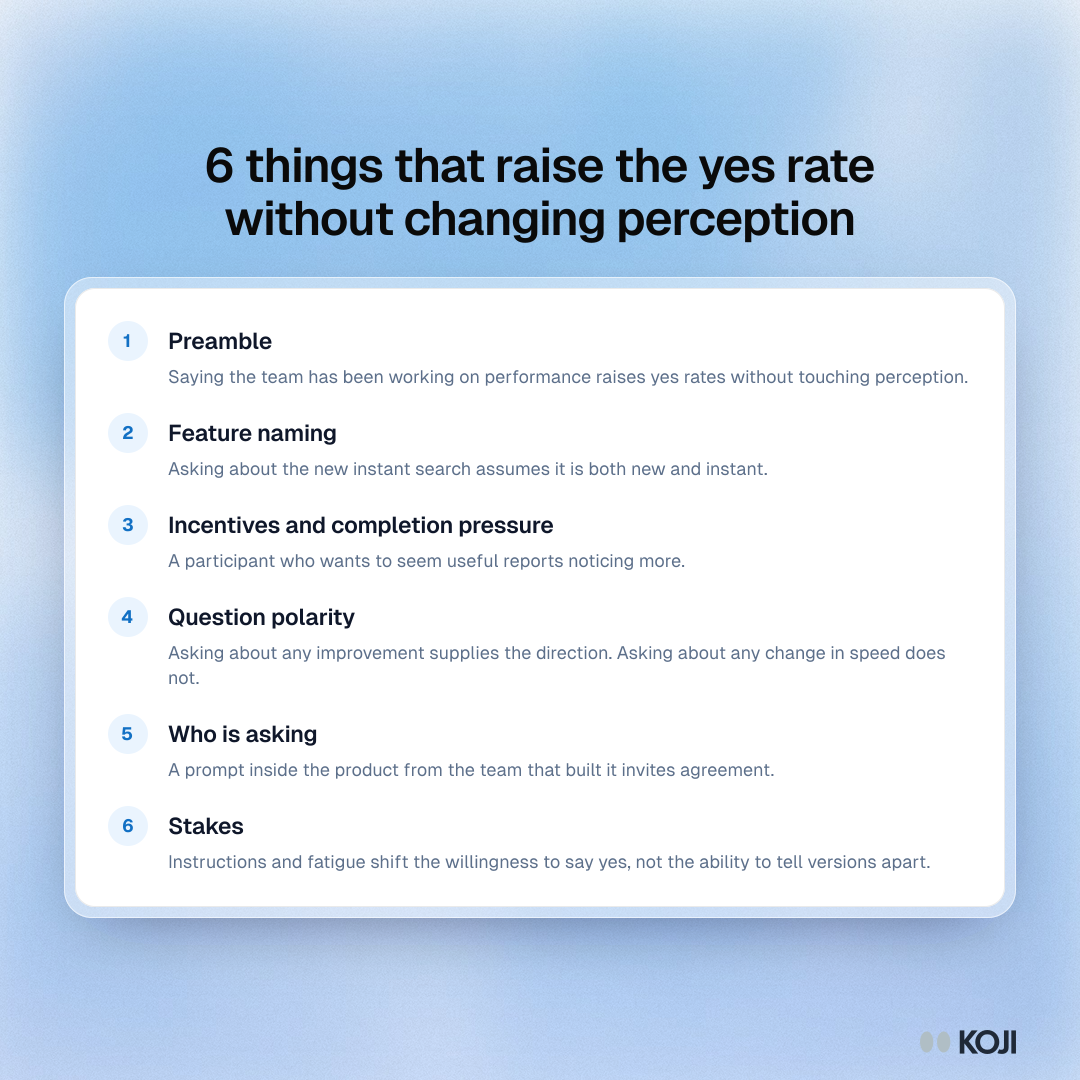
6 things that raise the yes rate without changing perception
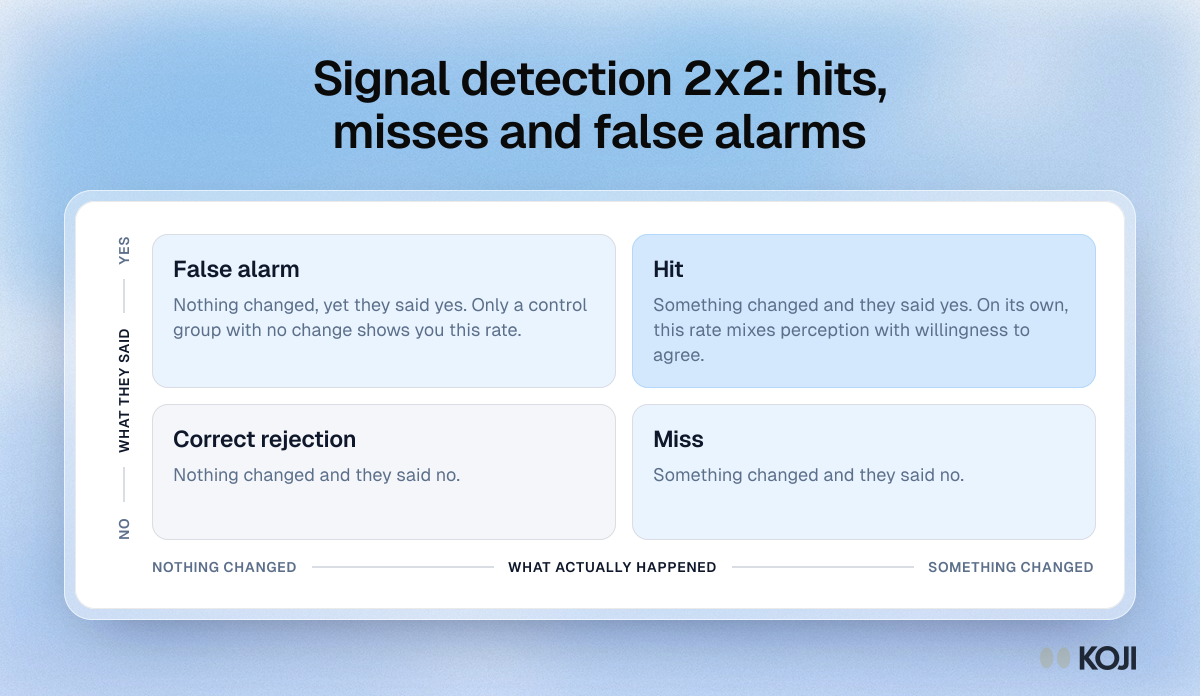
Six cheap features of a study that change how willing people are to say they noticed something, without changing what they can actually perceive. Use it when you write a did-users-notice question, a release survey or an in-product prompt, and pair every such question with a matched no-change control group so the false alarm rate shows how much of the yes rate is criterion. Based on the signal detection reference by Stanislaw and Todorov.
Where this appears
What's in this guide
- Preamble: Saying the team has been working on performance raises yes rates without touching perception.
- Feature naming: Asking about the new instant search assumes it is both new and instant.
- Incentives and completion pressure: A participant who wants to seem useful reports noticing more.
- Question polarity: Asking about any improvement supplies the direction. Asking about any change in speed does not.
- Who is asking: A prompt inside the product from the team that built it invites agreement.
- Stakes: Instructions and fatigue shift the willingness to say yes, not the ability to tell versions apart.
Use this image
Free to use in your docs, decks and posts under CC BY 4.0, as long as you credit Koji with a link to this page. To embed it, paste this into your page:
html
<a href="https://www.koji.so/visuals/what-moves-response-criterion-yes-rate-listicle"><img src="https://www.koji.so/visuals/what-moves-response-criterion-yes-rate-listicle/what-moves-response-criterion-yes-rate-listicle.png" alt="List of six things that move response criterion in a perception study: preamble, feature naming, incentives, question polarity, who is asking and stakes." width="1080" height="1080" /></a>
<p>Source: <a href="https://www.koji.so/visuals/what-moves-response-criterion-yes-rate-listicle">6 things that raise the yes rate without changing perception</a>, Koji</p>