Answer first: A market research agency should judge an AI-moderated interview platform on what happens around the interview, not only in it. The follow-up questions matter, but most platforms now probe well enough for evaluative work. What separates a platform an agency can sell from one it can only use internally is how it keeps clients apart, how far your brand reaches into the interview, what you can tell a client about the AI and their data, whether you can cost a project before you quote it, and whether the output survives a client debrief. This guide covers those agency-specific checks, a pilot you can run before a client project depends on it, and the cases where a human moderator is still the right call.
If you want the general feature checklist (voice and text, languages, quality checks, integrations), start with what to look for in an AI customer research platform. This page is the layer on top of it for agencies, consultancies and fieldwork teams running research for clients.
Why agencies need a different checklist
An in-house insights team buys a platform for itself. An agency buys one to put in front of clients, so every weakness becomes a client conversation. Three numbers show where client expectations sit.
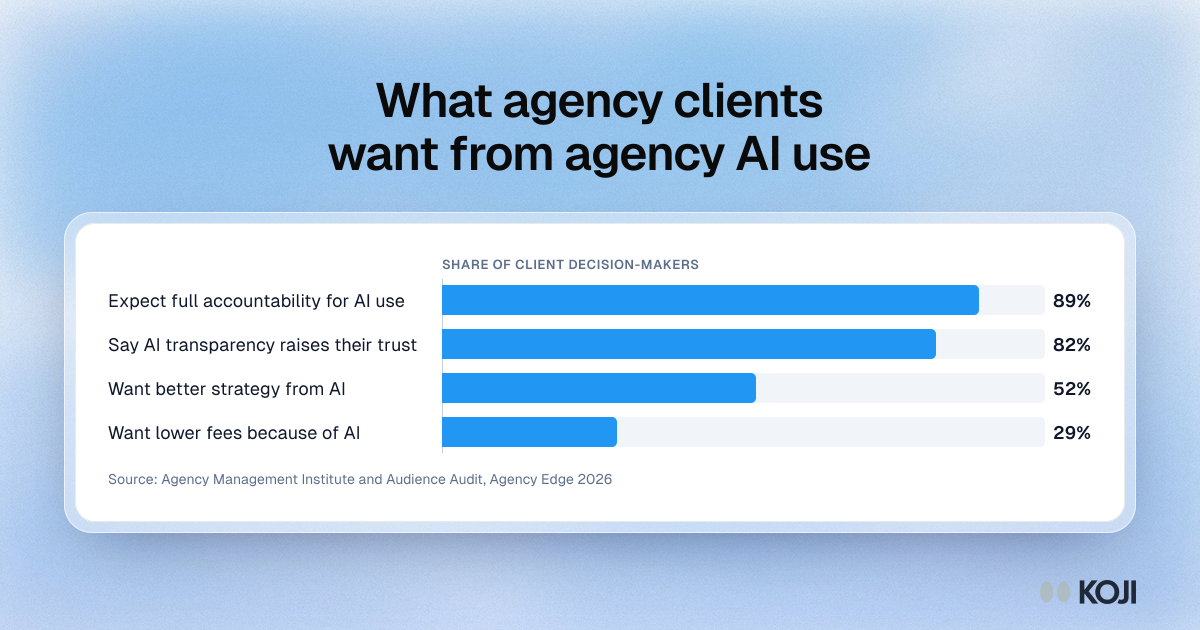
In the Agency Edge 2026 study by Agency Management Institute and Audience Audit, 400 client-side decision-makers were asked what they want from agencies that use AI. 89% expect full accountability for AI use in work done on their behalf, 82% say transparency about AI raises their trust, 52% want better strategy from it, and only 29% want lower fees (Agency Management Institute, Agency Edge 2026). Clients are not asking for a discount. They are asking you to know exactly what the AI did.
On the supply side, Greenbook's 2025 GRIT Business Outlook reports that 67% of research suppliers already build generative AI into client deliverables (Greenbook, 2025 GRIT Business Outlook). So the question is no longer whether to use AI in fieldwork and analysis. It is whether you can defend the specific tool when procurement asks. And the industry bodies have started asking: a joint MRS and ESOMAR guidance note on client data and AI says agencies should check what their platforms are contractually allowed to do with data, and expects disclosure of the platforms used to become normal when contracting (MRS and ESOMAR, Client Data, AI and the Boundaries of Consent).
The agency checks: what to ask before you sign
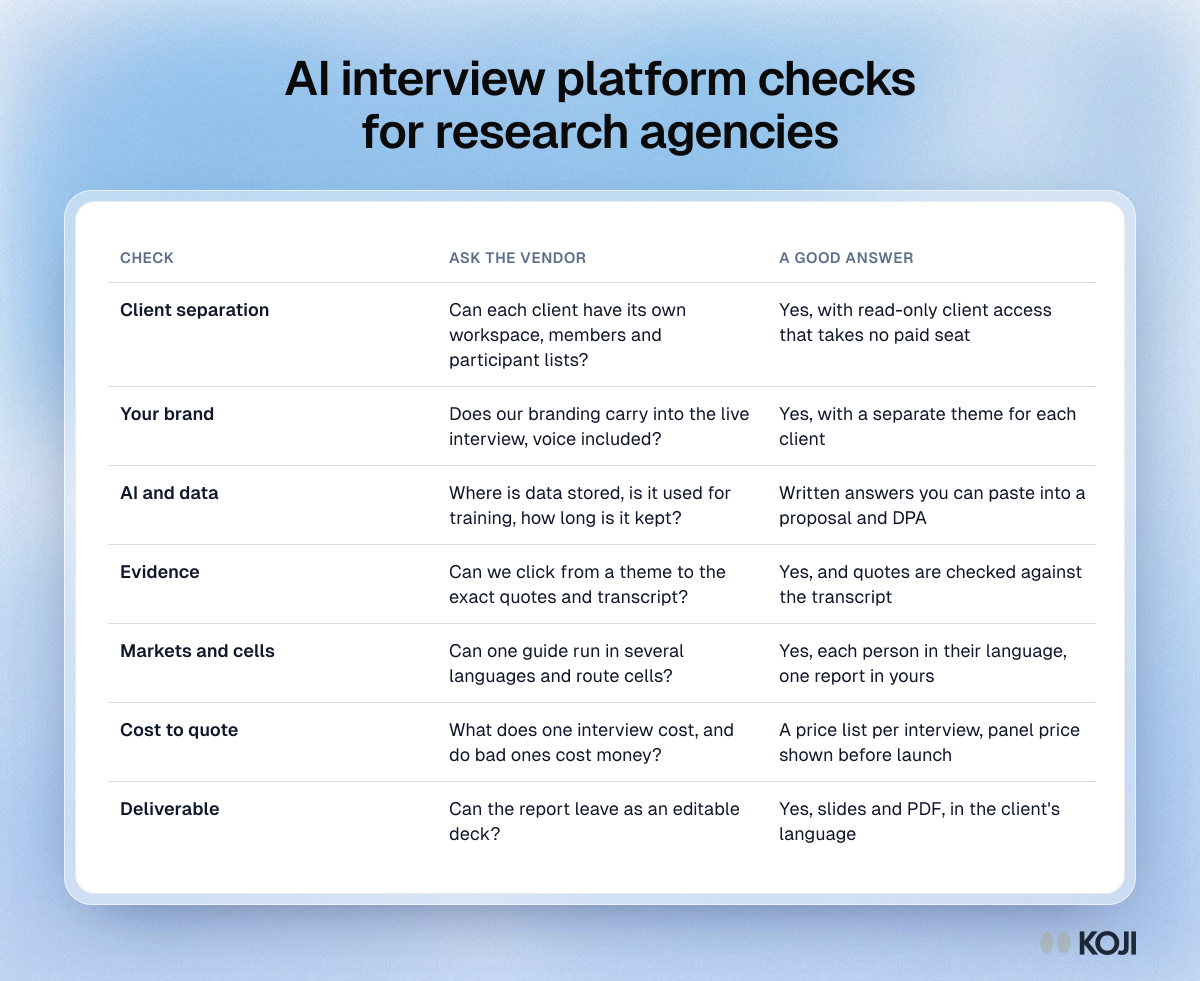
These are the checks that matter for client work. Each one names what to ask the vendor and what a good answer looks like.
1. Client separation
Ask whether each client can live in its own workspace with its own members, studies and participant lists, and whether a researcher on one account can see another client's data by accident. A shared folder with a naming convention is not separation. Also ask how you give a client read access without giving them a paid seat, because clients increasingly want to watch fieldwork come in.
2. Your brand, all the way in
Many tools put your logo on a landing page and then drop the participant into the vendor's own interface. Check that your branding carries into the live interview, in voice as well as text, and that you can keep a separate theme per client. Our white-label AI interviews guide has a short checklist for this.
3. What you can tell the client about the AI and their data
Get written answers to four questions: where interview data is stored, whether it is used to train models, how long recordings and transcripts are kept, and whether personal details can be stripped from transcripts before anyone reads them. Those answers go straight into your proposal and your data processing agreement. If a vendor can't answer in writing, you can't either.
4. Evidence behind every finding
A client will challenge the finding that surprises them. The platform should let you click from a theme to the exact quotes and the transcript they came from, and those quotes should be checked against the transcript rather than paraphrased by the model. This is also your answer to the 89%: accountability means you can show your working.
5. Comparable fieldwork across markets and cells
Agencies rarely run one audience. Check that one discussion guide can run in several languages with the same questions, that each participant can answer in their own language while the report comes out in yours, and that you can send different cells (concept A and B, users and lapsed users) down different question paths inside one study. The multi-market qualitative research playbook walks through fielding one guide in many languages.
6. A cost you can quote before fieldwork
You price projects before you run them. Look for a per-interview cost you can read off a price list, a rule for what happens to bad interviews (do they still cost money?), and a panel price shown before you launch, not invoiced after. Unpredictable usage pricing eats agency margin.
7. A deliverable the client will actually use
The output has to reach the client in their format, usually slides. Check whether you can export the report as an editable deck, not just a web link, and whether the report can be written in the client's language while quotes stay verbatim.
When AI moderation fits a client brief, and when it doesn't
AI moderation is strongest on evaluative, structured work: concept and message tests, early reactions to packaging or ads, usage and attitude follow-ups, churn and win-loss interviews, and fast multi-market reads. Greenbook's report from QRCA 2026 summed up the qualitative community's view as AI moderation being good enough for tactical, evaluative work, with human moderators still ahead on complex, sensitive or exploratory topics (Greenbook, The signal from QRCA 2026).
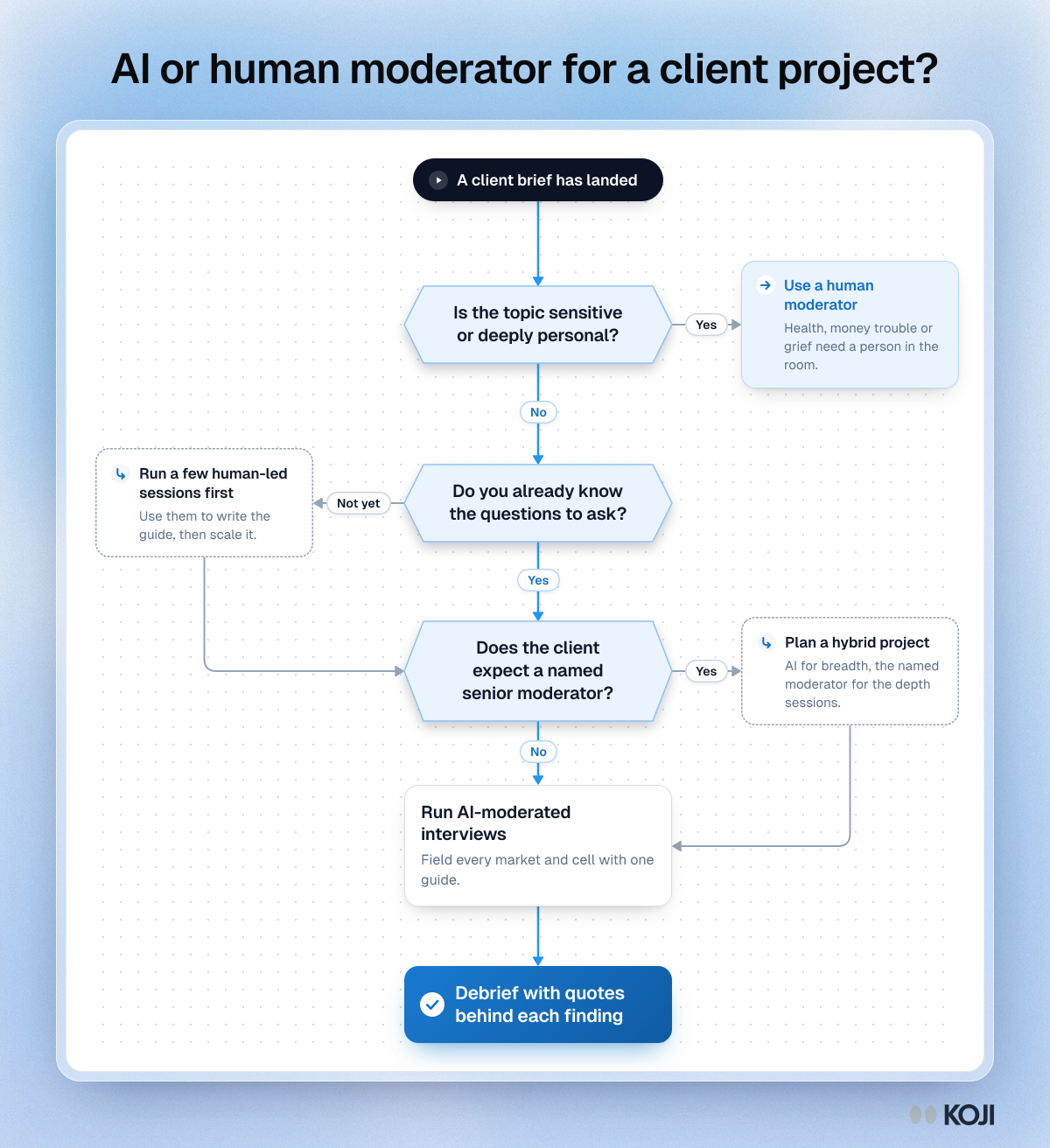
Keep a human moderator in the room when the topic is sensitive (health, money trouble, grief), when the participant is senior and expects a peer (C-suite B2B), when the brief is open-ended discovery and you don't yet know the right questions, or when the client is paying for a named moderator's judgement. If you don't know the questions yet, a few human-led sessions can write the guide you then scale with AI. A common agency pattern is hybrid: AI interviews for breadth across markets, then a handful of human-led depth sessions on the themes that surprised you.
Run a pilot before a client project depends on it
Procurement and your own senior researchers will want proof. A two-week pilot answers most of their questions.

Photo by Babak Eshaghian on Unsplash
- Pick a past project you know well. Rerun a slice of its guide with 15 to 20 participants in one market so you can compare AI output against findings you trust.
- Score the transcripts, not the demo. Read ten full transcripts. Did the follow-ups go where a good moderator would have gone? Where did it miss?
- Check the evidence trail. Take three findings from the report and click through to the quotes. Are they verbatim, and do they say what the finding claims?
- Test client separation and access. Set up a second workspace, invite a colleague as a read-only viewer and confirm they see only what you intend.
- Cost it as if you were quoting. Work out what the pilot would cost at full scale, panel and incentives included, and compare it with your last human-moderated quote.
- Write the disclosure paragraph. If you can't describe the tool, its data handling and your quality checks in one paragraph a client would accept, you're not ready to sell it.
The AI-moderated interviews method guide explains how the interviewer probes, which helps when you brief your senior team.
Where Koji fits (our product)
Koji publishes this page, and Koji is one of the platforms you might evaluate, so here is how it answers the checks above, with what it costs and where it isn't the right choice. Agency-specific details live on the Koji for agencies page.
How Koji answers the agency checks
- Client separation: each client can have its own team workspace with its own studies and participant lists. Clients can join a workspace as viewers: they read studies, reports and transcripts, never take a paid seat and can't edit, spend or invite.
- Branding: brand themes (your logo, colours and font, through text and voice interviews, one theme per client) and the white-label platform are part of the Enterprise plan.
- Data and disclosure: a per-study setting removes names, emails, phone numbers, addresses and employers from transcripts when each interview finishes. Data handling, the DPA and sub-processors are documented in Koji's compliance hub.
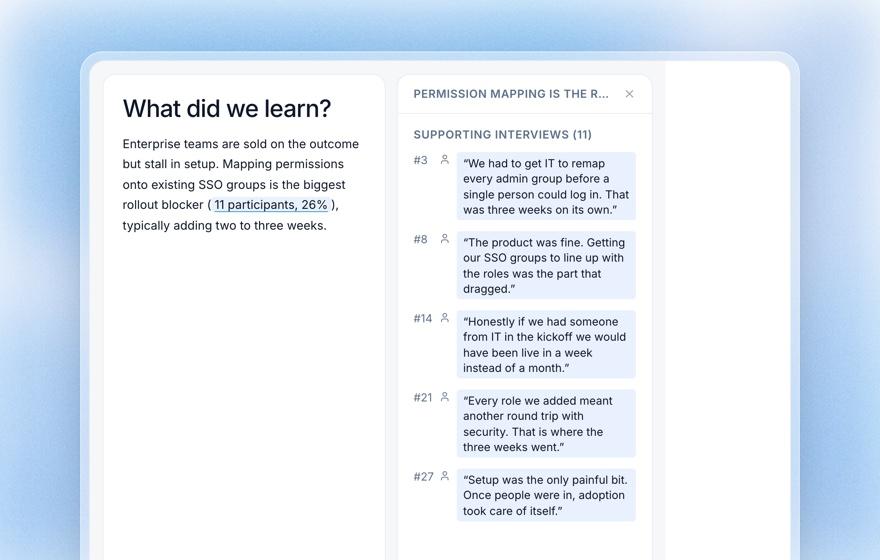
- Evidence: every theme in a report links to the verbatim quotes behind it, and Koji leaves out any quote it can't find in the transcript.
- Markets and cells: interviews run in 33 languages and open in the participant's own language. Reports can be written in any supported language while quotes stay in the participant's words. Branching can route cells through a study using a value in the interview link, such as a cell or segment code.
- Cost: credits cost €1. A text interview uses 1 credit, a voice interview 3, a phone interview 0.6 per minute, and only interviews that score 3 or more out of 5 on quality use credits at all. Panel recruitment in 130+ countries shows the price before you launch.
- Deliverable: any report downloads as an editable PowerPoint deck or a PDF.
What it costs. The Insights plan is €29 a month with 29 credits and one seat. The Interviews plan is €79 a month with 79 credits, voice interviews, API and MCP access and three seats, with extra seats at €15 a month. Enterprise is priced by contract and adds SAML single sign-on, white-label, brand themes and a dedicated success manager. A worked example: 30 voice interviews across two markets use 90 credits, so about €90 in interview credits before incentives and any panel recruitment.
When Koji is the wrong choice. If the brief is a live, moderated group discussion with clients watching from a back room, use a focus group platform. If you need a long-running insight community with diaries and tasks over weeks, use a community platform. And if your clients only accept a named senior moderator, Koji's role is the breadth around those sessions, not a replacement for them.
Next step
Rerun a slice of a past client project as your pilot. Start a study on Koji with the free signup credits, invite a colleague as a viewer, and compare the report with the findings you delivered last time.