Answer first: A qualitative study bought from a research agency in the US typically costs $5,000 to $15,000 for 10 to 15 in-depth interviews and $7,000 to $20,000 or more per focus group, according to Drive Research's 2026 pricing guide. That works out to roughly $330 to $1,500 per interview. Run it in-house and the cash cost falls to incentives, recruitment and tools, but you pay in researcher time. AI-moderated interviews cut the moderation and much of the analysis time, so the cost per interview drops to a few euros plus incentives and recruitment. The biggest variable on every route is the same: how hard your audience is to find.
This guide breaks down each line of a qualitative budget, compares the three ways to get the work done, and costs one study three ways so you can see where the money goes. It's written for market research and insights teams and the agencies they hire. Koji makes AI interview software and publishes this page; our own prices are in a labelled section near the end.
What qualitative research costs, by method
There is no official price list for qualitative fieldwork, and most published figures come from firms that sell it. Treat these as planning ranges.
| Method | Typical cost | What's usually included |
|---|---|---|
| In-depth interviews, agency | $5,000 to $15,000 per 10 to 15 interviews | Recruitment, incentives, moderation, analysis, report |
| Focus groups, agency | $7,000 to $20,000+ per group | Recruitment, facility or platform, moderation, report |
| Online survey, for comparison | $5,000 to $15,000+ for 400 responses | Programming, sample, data tables |
Source: Drive Research, How Much Does Market Research Cost in 2026?, updated August 2026. Our focus group cost breakdown goes deeper on groups, including the over-recruit you pay for when people don't show.
The ranges are wide for a reason. A 10-interview study with general consumers and a 15-interview study with hospital procurement directors are both "10 to 15 IDIs", and they are not the same job.
The six lines in every qualitative budget
Whoever does the work, the money goes to the same places.
1. Recruitment
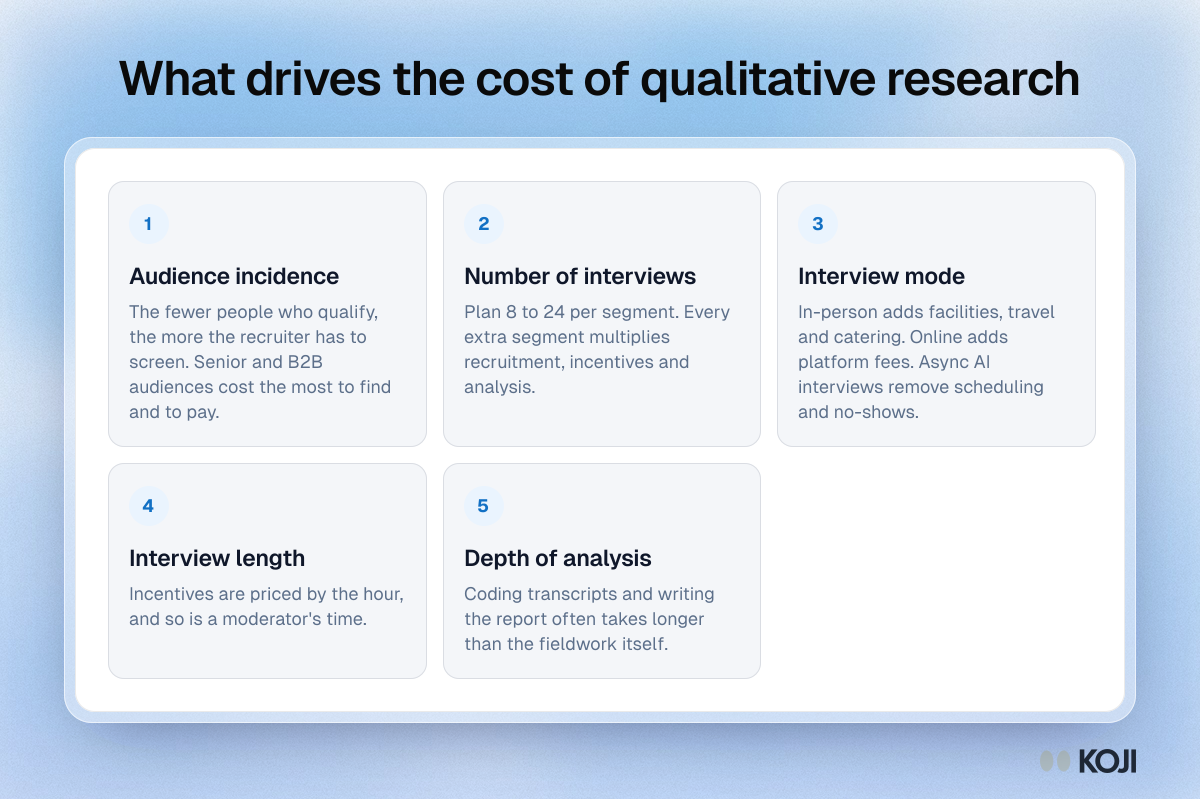
Finding and screening the right people. Drive Research advises earmarking 15% to 25% of the total qualitative budget for recruitment, and notes that business audiences cost more than consumers. The cost climbs as incidence falls: if only one in twenty panel members qualifies, the recruiter screens twenty people to find one.
2. Incentives
What you pay participants for their time. User Interviews' incentive guide, based on more than 25,000 completed sessions in the US and Canada, recommends about $80 an hour for a remote consumer interview and $100 an hour for professionals, rising to $150 to $225 an hour for high-earning roles. Drive Research puts doctors and C-level participants at $250 to $300 or more per interview, and quotes $300 to $500 for a 60-minute web interview with CEOs of companies with 100+ employees.
3. Moderation
Someone has to run each session. In an agency quote this is usually bundled into the per-interview price. In-house, it's a researcher's hour per interview plus the time to schedule, reschedule and chase no-shows. Drive Research reports focus group show rates of 75% to 85%, so plan to recruit more people than you need.
4. Transcription and translation
Recording, transcribing and, for multi-market work, translating each session. Small per session, large across a 40-interview, four-country study. Our guide to translating interview transcripts compares the options.
5. Analysis and reporting
Usually the biggest hidden cost. Reading every transcript, coding, building themes and writing the deck often takes longer than the fieldwork. Nelson Recruiting's 2026 IDI guide notes that analysts working by hand get through 8 to 12 interviews a day, against 50 to 100 transcripts on AI-assisted platforms.
6. Tools and overheads
Video or interview platform licences, a repository, facility hire for in-person work, observer travel and catering. These rarely show up in the first quote.
How many interviews you actually need
Sample size is the multiplier on every line above, so get it right before you price anything. Nelson Recruiting's guide reports that most qualitative studies reach saturation, the point where new interviews stop adding themes, at 9 to 17 interviews, and recommends 8 to 24 interviews per audience segment. Three segments means three times the interviews, not one study with a few extra. Our guide to how many user interviews you need has the decision rules.
Three ways to get it done, and what each really costs
Route 1: A full-service agency
You pay one price and get recruitment, moderation, analysis and a report. It's the most expensive route per interview and the least work for your team. It makes sense for hard-to-reach audiences, sensitive topics, in-person work, or when you need an outside party's name on the findings. Ask every agency to split the quote into the six lines above so you can compare like with like.
Route 2: In-house with human moderators
Your researchers recruit (or buy panel), moderate and analyse. The cash cost falls to incentives, recruitment fees and tools, but the time cost is real: each interview takes about an hour to run, plus scheduling, plus analysis at 8 to 12 transcripts a day. For a 20-interview study, that's easily two working weeks of one researcher's time before anyone sees a finding.
Route 3: AI-moderated interviews
An AI interviewer runs every session by voice or text, asks follow-up questions on each answer, and produces transcripts and a first-pass analysis. Participants take part when it suits them, so there is no scheduling and no no-show problem. You still pay for recruitment and incentives, and your team still checks the findings and writes the recommendation. What drops away is the moderator's hour per interview and most of the hand coding. It fits best when you need more interviews than your team could moderate, across several markets or languages, on a short deadline. It fits worst for in-person work, very sensitive topics, or audiences that won't talk to software. If that's your question, our comparison of AI-moderated and human-moderated interviews covers when each one wins.
A worked example: 20 interviews with B2B buyers
Say you need 20 one-hour interviews with IT decision-makers in the US.
Agency. At Drive Research's range of $5,000 to $15,000 per 10 to 15 interviews, the per-interview cost runs from about $330 to $1,500. Twenty interviews: roughly $6,700 to $30,000, depending on how hard the audience is and how much reporting you want.
In-house, human moderated. Incentives at User Interviews' professional rate of $100 an hour come to $2,000. Add recruitment (panel or recruiter fees vary a lot for B2B, so get a quote), your video and transcription tools, and about two weeks of a researcher's time.
AI-moderated, in Koji. The same $2,000 in incentives, plus recruitment if you don't have your own list. Twenty voice interviews use 60 credits, which is €60, and that fits inside the Interviews plan's monthly 79 credits. Only interviews that pass Koji's quality check use credits. Your researcher's time goes on the brief at the start and on checking findings against quotes at the end, not on the sessions in between.
Incentives and recruitment cost the same on every route. The routes differ on moderation, analysis and the agency's margin, and that's where you choose.
How to budget a qualitative project
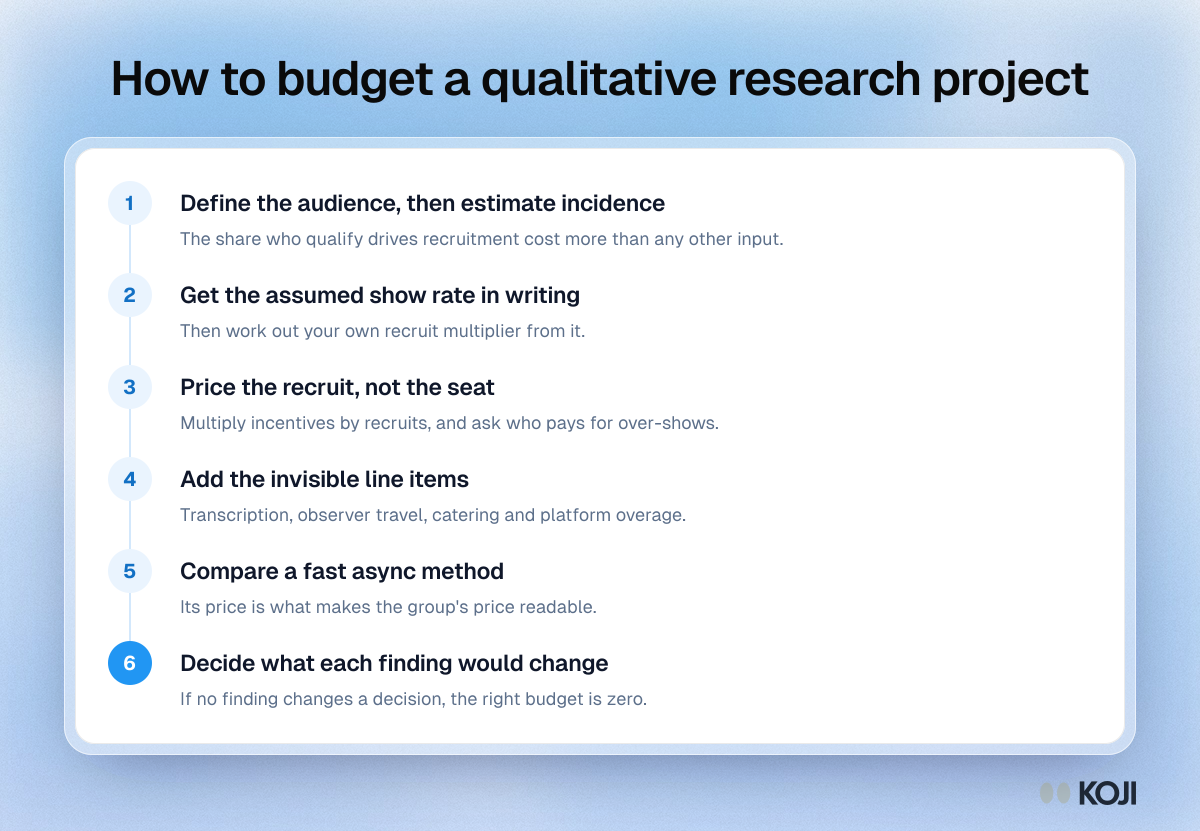
- Define the audience, then estimate incidence. The share of people who qualify drives recruitment cost more than any other input.
- Get the assumed show rate in writing. At a 75% to 85% show rate you recruit more than you seat, and you pay for the extras.
- Price the recruit, not the seat. Multiply incentives by the number recruited, and ask who pays for people who show up but aren't used.
- Add the invisible line items: transcription, observer travel, catering and platform overage.
- Price a fast async method alongside. Even if you don't use it, an AI-moderated quote makes the traditional quote easier to judge.
- Decide what each finding would change. If no answer would change a decision, the right budget is zero.
For a quick estimate of your own study, try our user research cost calculator.
Questions to ask before you sign a quote
- What is the price per completed interview, and what counts as completed?
- What incidence and show rate does the quote assume, and what happens if they're wrong?
- Are incentives included, and at what rate per hour?
- Who owns the recordings and transcripts, and in what format do we get them?
- How many rounds of revisions does the report include?
- What would the same study cost with half the interviews, or twice?
Where Koji fits (our product)
Koji publishes this page, so here's what our own tool costs and where it doesn't fit.
Koji runs AI-moderated interviews by voice, text or phone. You write the research goal (or let the research assistant draft the brief), invite your own customers or recruit from Koji's research panel in 130+ countries on paid plans, and pay incentives through Koji if you want to. The AI interviewer asks follow-up questions on each answer, in more than 30 languages, and the report groups what people said into themes, each with the quotes behind it. Reports download as PowerPoint or PDF.
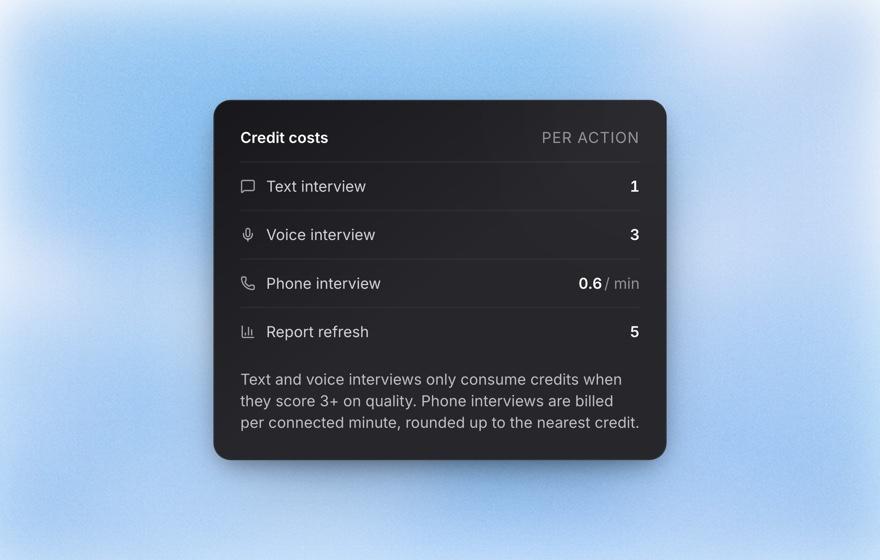
What it costs (checked November 2026): a free account comes with 10 credits and needs no card. Paid plans are Insights at €29 a month (29 credits) and Interviews at €79 a month (79 credits), with Enterprise on a contract. A credit is €1. A text interview uses 1 credit, a voice interview 3, a phone interview 0.6 a minute, and only interviews that pass the quality check use credits. Panel participants and incentives are paid on top. See koji.so/pricing for the current plans.
When Koji is the wrong choice: in-person research, live focus groups with clients watching, ethnography, and audiences so rare or senior that only a specialist recruiter can reach them. For those, an agency is worth its price.
Insights teams can see how Koji fits their work on the page for researchers, and agencies on the page for agencies. Or price your next study for real: set it up free and see the cost before you launch.