

Short answer: CoLoop and Koji solve different halves of qualitative research. CoLoop analyses interviews that people have already run: you upload recordings, transcripts or open-ended answers, or let its recorder join your calls, and it finds themes, quotes and patterns across them. Koji runs the interviews itself: an AI interviewer talks to participants by voice, text or phone, then Koji builds the report. If your team moderates every session and drowns in transcripts, CoLoop fits that work. If the bottleneck is getting enough conversations done in the first place, Koji removes it, and the analysis comes with it.
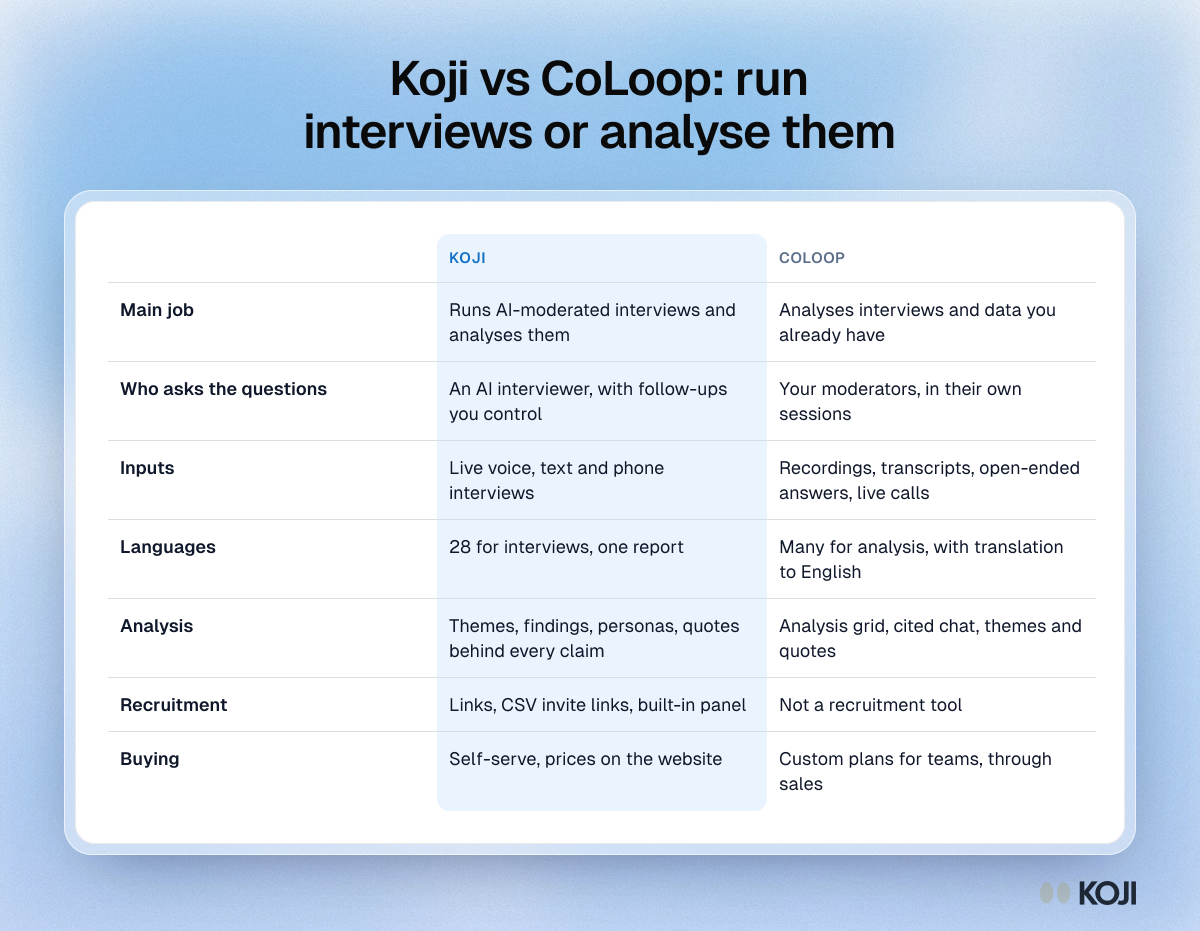
Koji vs CoLoop at a glance
| Koji | CoLoop | |
|---|---|---|
| Main job | Runs AI-moderated interviews and analyses them | Analyses interviews and data you already have |
| Who asks the questions | An AI interviewer, with follow-ups you control | Your moderators, in their own sessions |
| Inputs | Live voice, text and phone interviews | Recordings, transcripts, open-ended answers, live calls |
| Languages | 28 for interviews, one report | Many for analysis, with translation to English |
| Analysis | Themes, findings, personas, quotes behind every claim | Analysis grid, cited chat, themes and quotes |
| Recruitment | Links, CSV invite links, built-in panel | Not a recruitment tool |
| Buying | Self-serve, prices on the website | Custom plans for teams, through sales |
Why synthesis is where research stalls
Most research teams do not lack opinions about what customers think. They lack time to turn conversations into something a stakeholder can act on. In Lyssna's 2025 research synthesis report, a survey of 300 practitioners, 60.3% named time-consuming manual work as their biggest synthesis pain point, and 54.7% already use AI somewhere in analysis and synthesis (Lyssna, 2025). User Interviews' State of User Research 2025 found AI use among researchers rose 24 points in a year to 80%, while 91% worry about the accuracy of what AI produces (User Interviews, 2025). On the agency side, Greenbook's 2025 GRIT Business Outlook reports that 67% of research suppliers now build generative AI directly into client deliverables (Greenbook, 2025).
So both tools are aimed at the same pain, slow and manual synthesis, with the same caveat: AI output has to be checkable. Where they differ is how far upstream they start.
What CoLoop does
CoLoop calls itself "AI analysis for qualitative research" (coloop.ai). It is a London company from Y Combinator's Summer 2021 batch, founded by Jack Bowen and Adrien Wald, and it raised a $3.5M round in early 2025 (Research Live). It says it serves hundreds of research agencies and corporate insight teams.
Its core features:
- Upload and transcribe. Bring recordings, transcripts and open-ended survey answers. CoLoop transcribes, translates and organises them (CoLoop docs).
- A live recorder that joins Zoom, Google Meet, Microsoft Teams or Webex calls so sessions arrive ready to analyse (CoLoop docs).
- The analysis grid. Put questions or prompts against participants, segments or groups, with each cell linked to the exact moment in the source.
- A cited chat for thematic, concept and some quantitative analysis across a project.
- Security credentials including SOC 2 Type 1 and Type 2 and EU deployment, according to CoLoop's site.
Running sessions with human moderators
CoLoop shines when your researchers are already running interviews and focus groups by hand, which is still how many agencies and insight teams work. A senior moderator builds rapport, reads the room and chases the odd answer, and CoLoop takes over the part nobody enjoys: re-watching hours of footage, tagging quotes and building the grid for the debrief. An independent review by Cascade Insights called it one of the strongest qualitative analysis tools for B2B researchers (Cascade Insights).

Photo by Edi Kurniawan on Unsplash
CoLoop's trade-offs
- It does not run interviews. At the time of writing we found no AI interviewer in CoLoop. Someone still has to recruit, schedule and moderate every session before analysis can start.
- Team pricing is custom. CoLoop's site says plans are "custom and built around your research programme rather than fixed tiers". Budgeting starts with a demo and a quote, which the Cascade review flags as friction for small teams.
- Integrations are mostly export and upload. Many connections work by exporting a file from one tool and uploading it to CoLoop, not by live sync.
- Few public reviews. Capterra lists no user reviews at the time of writing.
What Koji does
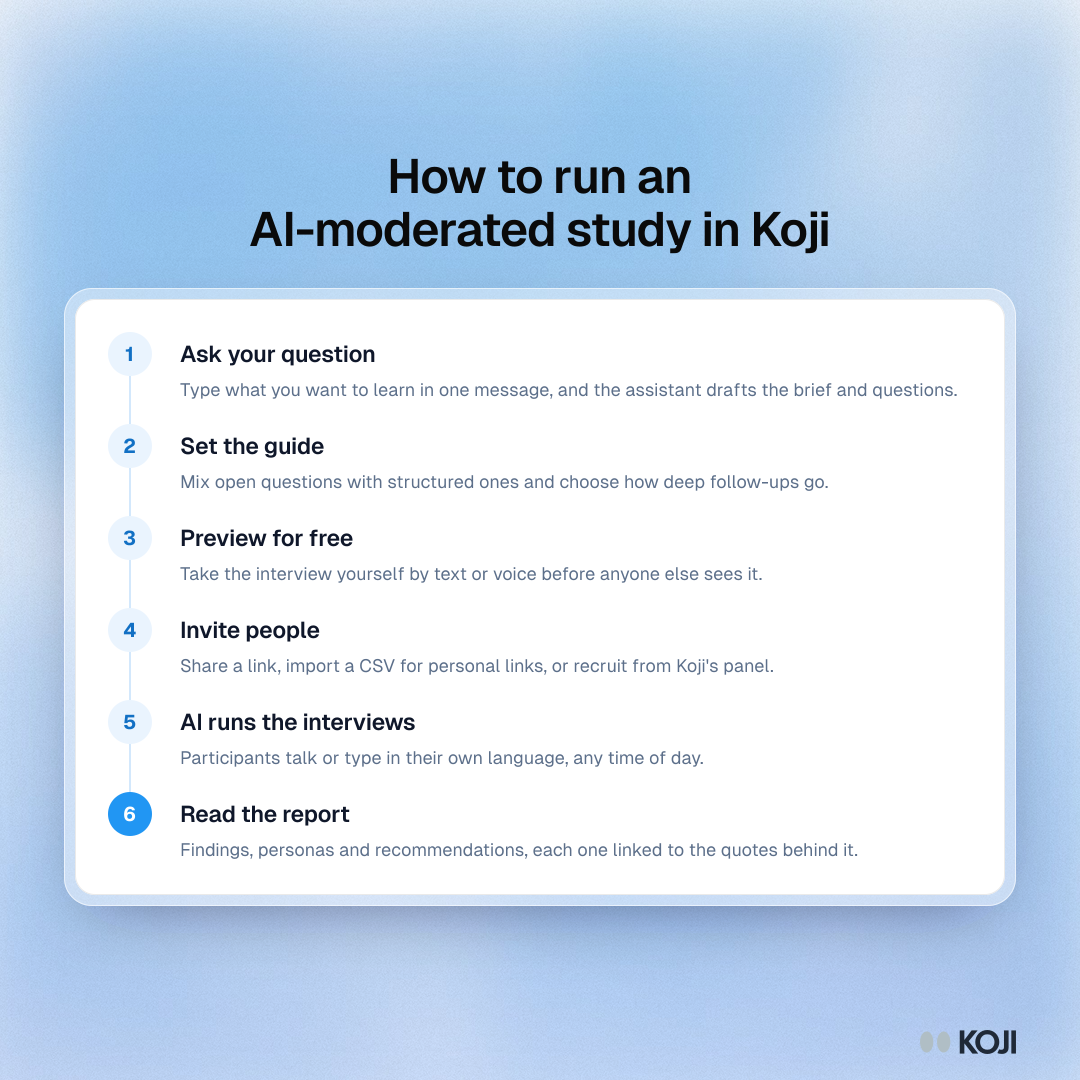
Koji starts one step earlier. You describe what you want to learn, Koji drafts the brief and interview guide, an AI interviewer runs the conversations, and the report builds as interviews come in. The steps look like this:
- Ask your question. Type what you want to learn in one message, and the assistant drafts the brief and questions.
- Set the guide. Mix open questions with structured ones and choose how deep follow-ups go.
- Preview for free. Take the interview yourself by text or voice before anyone else sees it.
- Invite people. Share a link, import a CSV for personal links, or recruit from Koji's panel.
- AI runs the interviews. Participants talk or type in their own language, any time of day.
- Read the report. Findings, personas and recommendations, each one linked to the quotes behind it.
The details that matter when you compare it with an analysis tool:
- Voice, text and phone interviews in 28 languages, with every answer landing in one report. See AI voice interviews and voice vs text interviews.
- Six structured question types alongside open-ended probing: open ended, scale, single choice, multiple choice, ranking and yes/no, each charted in the report. See the structured questions guide.
- Screening questions that turn away people who do not qualify before the interview starts.
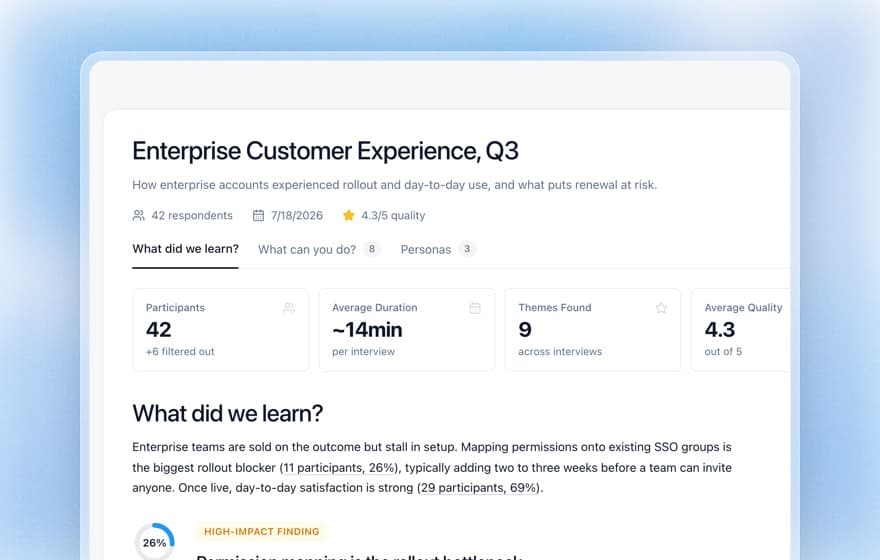
- A quality score from 1 to 5 on every interview. Only interviews scoring 3 or more enter the report or use credits (how the quality gate works).
- Evidence behind every claim. Click a number or finding in the report and a panel lists every participant behind it, in their own words. See tracing report findings to evidence.
- Chat with your transcripts to ask follow-up questions of the whole study (chat with interview transcripts).
One honest limit: Koji analyses the interviews it runs. It is not built to ingest a folder of old Zoom recordings, so if your archive of human-moderated sessions is the main thing you need to mine, CoLoop is the better tool for that job. You can upload documents to Koji as context for the interviewer, such as a product guide or support tickets, but that sharpens the questions rather than replacing analysis of past sessions.
What Koji costs
Prices are on Koji's website. You start free with 10 credits and no card. Insights is €29 a month with 29 credits, Interviews is €79 a month with 79 credits, and Enterprise is on contract. Extra credits cost €1. A text interview uses 1 credit, a voice interview 3 and a phone interview 0.6 credits a minute. Interviews scoring under 3 cost nothing.
Which one should you pick?
Pick CoLoop if
- Your researchers moderate every session themselves and want to keep doing so.
- You have a large archive of recordings and transcripts to analyse.
- You run focus groups and live sessions on Zoom, Teams or Meet for agency clients.
Pick Koji if
- You cannot schedule and moderate enough interviews to answer your question.
- You want dozens of conversations this week instead of eight next month.
- You want structured data (ratings, rankings, choices) and the "why" from the same conversation.
- You want to price a study before you start it, without a sales call.
- You research in several languages and want one report.
Or use both
Some teams will. Keep senior researchers on the high-stakes sessions, where a human moderator earns their fee, and analyse those in CoLoop. Use Koji for the volume work, such as churn interviews, onboarding feedback and concept checks, where the bottleneck is reach, not depth of a single conversation.
The bottom line
CoLoop makes human-moderated research faster to analyse. Koji makes the interviews themselves cheap and quick to run, and hands you a report you can check line by line. Ask where your research actually stalls. If it is the hours after the sessions, look at CoLoop. If it is getting the sessions done at all, Koji is the shorter path.
Run your first AI-moderated study
Start free on Koji with 10 credits. Describe what you want to learn, preview the interview, and send the link to ten customers. By the time you would have finished scheduling the first human-moderated call, you will have a report to read. For more detail, see how AI interviewers work and analysing AI-moderated interview results.


