

Short answer: Tellet and Koji both run AI-moderated research interviews and turn them into themes and reports. Tellet comes from market research: it was founded in Amsterdam by a market research veteran, sells to agencies and brands, and does not publish its prices. Koji is built for product, research and customer teams who want to start a study today on public, per-interview pricing, with voice, text and phone interviews, six structured question types and a report where every finding links back to the people who said it. If you run agency fieldwork and want a vendor relationship, Tellet is worth a demo. If you want to launch this week and know what it will cost before you start, Koji is the faster route.
Koji vs Tellet at a glance
| Koji | Tellet | |
|---|---|---|
| Interview formats | Voice, text and phone calls | Voice, video, photo and text responses |
| Languages | 28, chosen per study | Not consistently stated (sources say 30 to 64) |
| Structured questions | Six types: open ended, scale, single choice, multiple choice, ranking, yes/no | Qualitative and quantitative questions |
| Recruitment | Your own list, links, CSV invite links, or Koji's built-in panel | Your own participants or panel partners |
| Analysis | Themes, personas, findings with linked evidence, quality score per interview | Themes, patterns, recommendations and quotes |
| Pricing | Published on the website; free to start, pay per interview | Not published; demo or free trial |
| Best fit | Product, UX, CX and founder teams; agencies wanting self-serve | Market research agencies, consultancies and brands |
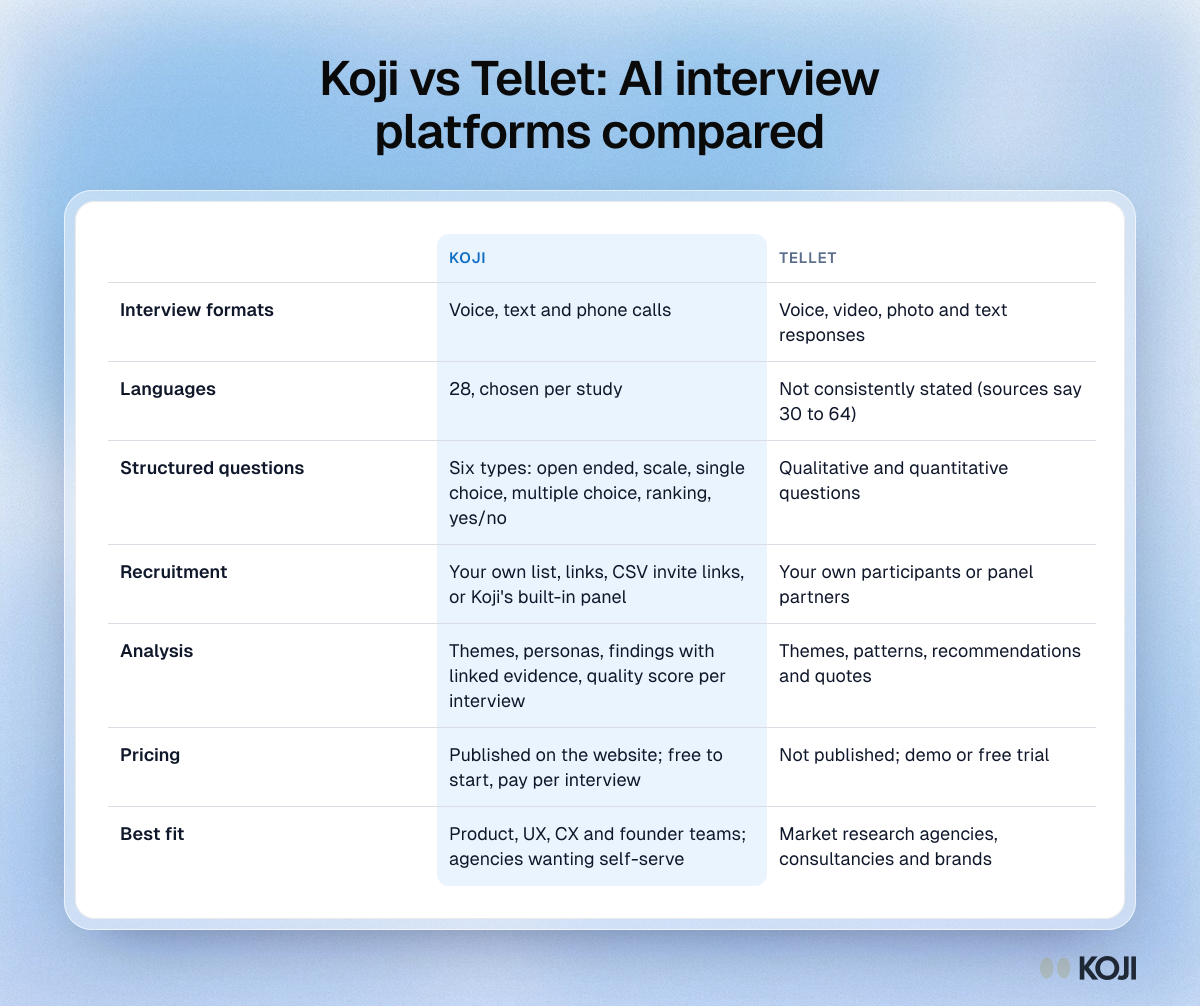
The table hides one thing worth saying out loud: on most features these two products are closer than their marketing suggests. The real split is in who they are built for and how you buy them.
Why AI-moderated interviews became a category
Two numbers explain why a dozen platforms now do what Tellet and Koji do. In User Interviews' State of User Research 2025, the share of researchers using AI jumped 24 points in a year to reach 80% (User Interviews, 2025). Qualtrics' 2025 Market Research Trends report, which surveyed 3,198 researchers across 14 countries, found 89% already use AI tools regularly or experimentally (Qualtrics, 2024). Maze's 2026 Future of User Research report puts it at 69% of research participants using AI in at least some projects (Maze, 2026).
The trust gap matters just as much. The same User Interviews report found 91% of researchers worry about the accuracy of AI output. That is why the comparison below spends as much time on evidence and quality as on features. An AI moderator that asks good follow-ups is only half the job. You also need to check what it concluded.
What Tellet does
Tellet describes itself as a way to "use AI to conduct and analyse consumer research interviews" (tellet.ai). The company is based in Amsterdam and was founded around 2022 by Merik te Grotenhuis, who spent roughly 25 years in market research and sold his previous firm, CG Research, to Norstat in 2021. Tellet raised a €400K pre-seed round from angel investors (Silicon Canals).
What you get, based on Tellet's own pages:
- Rich response formats. Participants can answer by voice, video, photo or text, and the AI asks follow-up questions as they go (Tellet solution page).
- A design co-pilot that sharpens your questions and suggests new ones, with support for both qualitative and quantitative questions.
- An analysis co-pilot that surfaces themes, patterns, opportunities and recommendations, with automatic transcription. Its reports include tensions, decision drivers and quotes.
- Recruitment through your own participants or Tellet's network of panel partners (Insight Platforms).
- Security claims of GDPR compliance, AES-256 encryption and models that are never trained on your data. Tellet's site describes ISO 27001 as in progress rather than certified, at the time of writing.
Who Tellet is built for
Tellet's home page says it is "trusted by the world's leading agencies, consultancies and brands", and research agencies such as Blauw have written publicly about using it as a moderator (Blauw). That heritage shows. Photo and video answers suit consumer and shopper studies, and an agency running a client project is used to booking a demo and agreeing terms.

Photo by Cherrydeck on Unsplash
Tellet's trade-offs
- No public pricing. Tellet's site points visitors to a demo, an email or a free trial. You cannot work out what a 200-interview study costs before you talk to them.
- Few public reviews. At the time of writing we could not find a Tellet listing with reviews on G2 or Capterra, so there is little independent user feedback to read.
- Exports are basic. Tellet's guide lists CSV and TXT exports of transcripts and metadata, with PowerPoint export marked as coming soon (Tellet guide).
- Language count is unclear. Tellet's own content and third parties give figures from 30 to 64. Check the current number with them if you research in many markets.
What Koji does
Koji is an AI-native research platform. You describe what you want to learn, Koji drafts the research brief and interview guide, an AI interviewer runs the conversations, and a report builds itself as interviews come in.
- Voice, text and phone interviews. Participants choose voice or text on the welcome screen, and phone interviews work through a call-back link or outbound calls you schedule. See AI voice interviews and voice vs text interviews.
- 28 languages. You pick which languages a study offers, participants choose theirs, and the whole interview, follow-ups included, runs in that language. Every answer lands in one report.
- Six structured question types in the same conversation as open-ended probing: open ended, scale, single choice, multiple choice, ranking and yes/no. Each gets the right chart in the report. See the structured questions guide.
- Follow-ups you control. You set how deep the AI probes on each question, and guardrails keep it away from topics it must not touch.
- Screening before the interview. Screening questions run for every participant, however they arrived, and turn away anyone who does not qualify.
- Recruitment built in. Share a link, import a CSV to give each person a personal invite link, or recruit from Koji's panel and see the cost before you launch.
- Free previews. Take your own interview by text or voice before launch. Previews never use credits and never reach the report.
Reports you can check
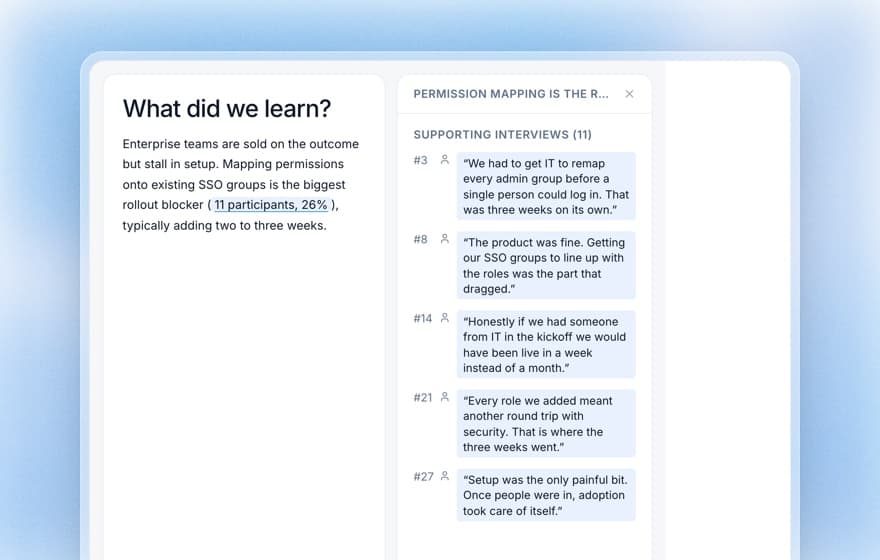
This is where Koji answers the 91% who worry about AI accuracy. Every interview gets a quality score from 1 to 5, and only interviews scoring 3 or more enter the report or use credits (how the quality gate works). The report opens with what you learned, then lists findings, recommendations and personas. Click any number or claim and a panel opens with every participant behind it, in their own words. See tracing report findings to evidence.
What Koji costs
Koji's pricing is on its website. You start free with 10 credits and no card. Paid plans are Insights at €29 a month (29 credits) and Interviews at €79 a month (79 credits), with Enterprise on contract. Extra credits cost €1. A text interview uses 1 credit, a voice interview 3, and a phone interview 0.6 credits a minute. Because of the quality gate, a low-effort interview costs nothing.
Head to head: where each one wins
Choose Tellet if
- You are a market research agency or consultancy and want photo and video answers for consumer work.
- You prefer a sales-led relationship with onboarding and agreed terms.
- Your participants come from panel partners you already use with Tellet.
Choose Koji if
- You want to set up and launch a study today without a demo.
- You need to know the cost of a study before you start it.
- You want qualitative depth and structured data (ratings, rankings, choices) from the same conversation.
- You need phone interviews for people who will not sit at a laptop.
- Your stakeholders will ask "how many people said that?" and you want the answer one click away.
- You research across many markets and want one report for all languages.
Questions to ask any AI interview vendor
Whichever platform you shortlist, run the same checks. These are the questions that separate a good demo from a tool that holds up on a real study:
- Can I take the interview myself before launch, for free?
- How deep does the AI probe, and can I set that per question?
- Can I screen people out before the interview starts?
- Are low-effort interviews scored, filtered and left uncharged?
- Can I trace every finding back to the quotes behind it?
- What will a 100-interview study cost, in writing, before I start?
- Which languages work for voice, not only text?
- Where is the data stored, and is it used to train models?
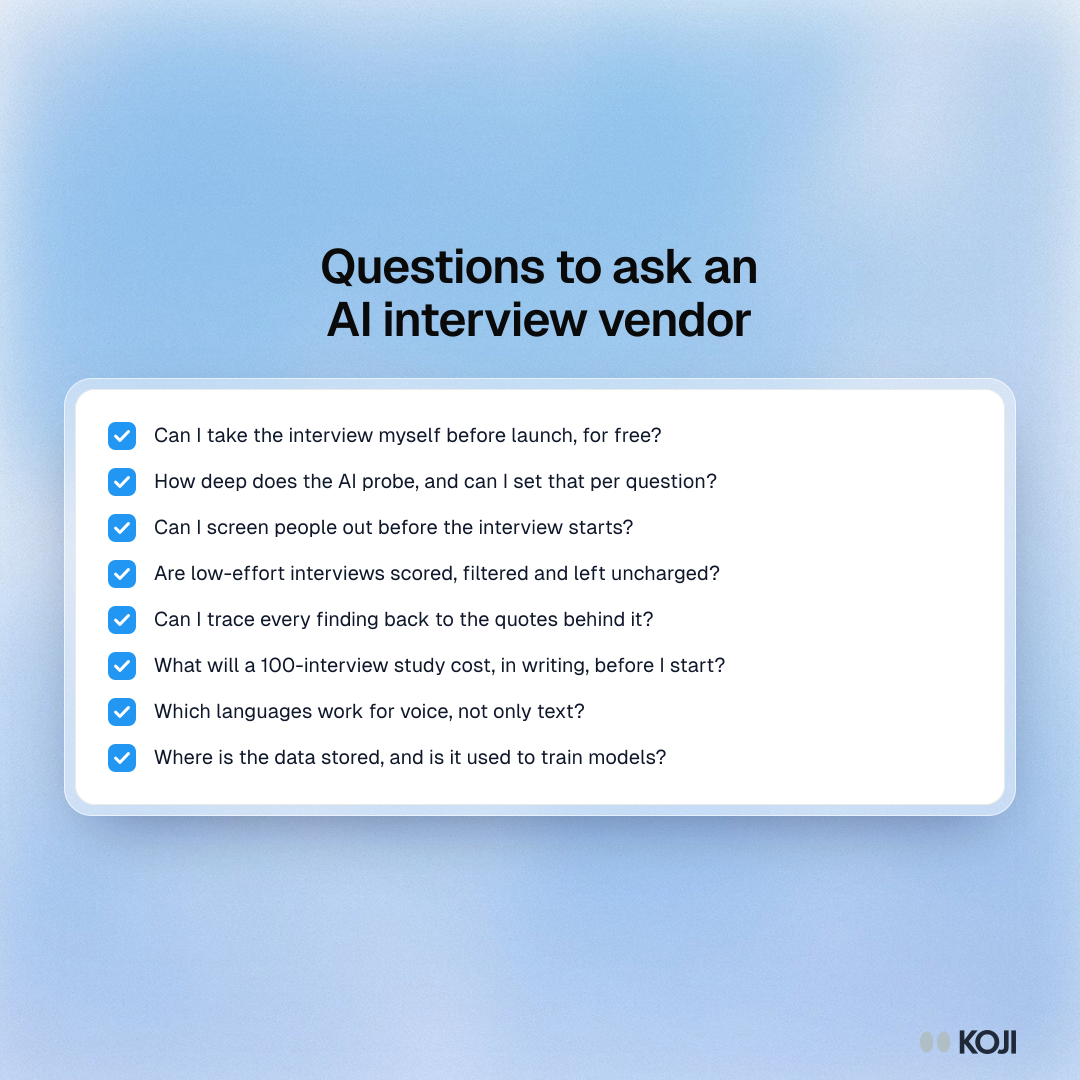
Koji answers yes to the first five out of the box and publishes its prices, which covers the sixth.
The bottom line
Tellet is a credible AI moderator with real market research roots, a strong fit for agencies that work in photo and video and are happy to buy through a demo. Koji covers the same core job, AI interviews and automatic analysis, for teams that want to move on their own schedule: voice, text and phone interviews in 28 languages, structured questions alongside open ones, a quality gate on every interview, and a report you can audit line by line, on pricing you can read before you sign up.
Try Koji on your next study
The quickest way to compare is to run something real. Start free on Koji with 10 credits, describe what you want to learn in one message, preview the interview yourself, then send the link to a handful of customers. You will have a report to judge before a demo call would have been booked. For the details, start with how AI interviewers work and AI-moderated interviews.


