Laddering Technique: How to Uncover the Deep 'Why' Behind User Decisions
The laddering technique is a qualitative interview method that climbs from product attributes through functional consequences to personal values — revealing the motivational chain behind user decisions. This guide covers means-end chain theory, step-by-step laddering interview structure, and how AI makes laddering scalable.
The bottom line: The laddering technique is a qualitative interview method that moves beyond surface-level answers to reveal the values that actually drive user decisions. By repeatedly asking "Why is that important to you?" researchers climb a three-level hierarchy — from product attributes to functional consequences to personal values — uncovering the motivational chain that explains why users choose and stay loyal to products. AI-moderated platforms like Koji can now run laddering-style deep interviews at scale, making this traditionally expensive method accessible to any research team.
What Is the Laddering Technique?
Laddering is an in-depth, one-on-one qualitative interview method developed from means-end chain theory. Thomas J. Reynolds and Jonathan Gutman formally defined it in their landmark 1988 paper as "an in-depth, one-on-one interviewing technique used to develop an understanding of how consumers translate the attributes of products into meaningful associations with respect to self, following means-end theory."

Photo by Priscilla Du Preez 🇨🇦 on Unsplash
The core insight behind laddering: when you ask users what they like about a product, they give you attributes — surface-level features and characteristics. But attributes are not what actually drives decisions. What drives decisions are the consequences those attributes enable and the personal values those consequences fulfill.
Traditional survey questions are good at identifying the attributes influencing decisions but rarely surface consequences and are very ineffective at reaching values. Laddering is specifically designed to climb past attributes to the motivational drivers that truly explain loyalty, switching behavior, and product advocacy.
The Means-End Chain: The Theory Behind Laddering
Laddering is grounded in Means-End Chain (MEC) theory, which proposes that consumers perceive products as "means" to achieve valued "ends." The hierarchy has three levels:
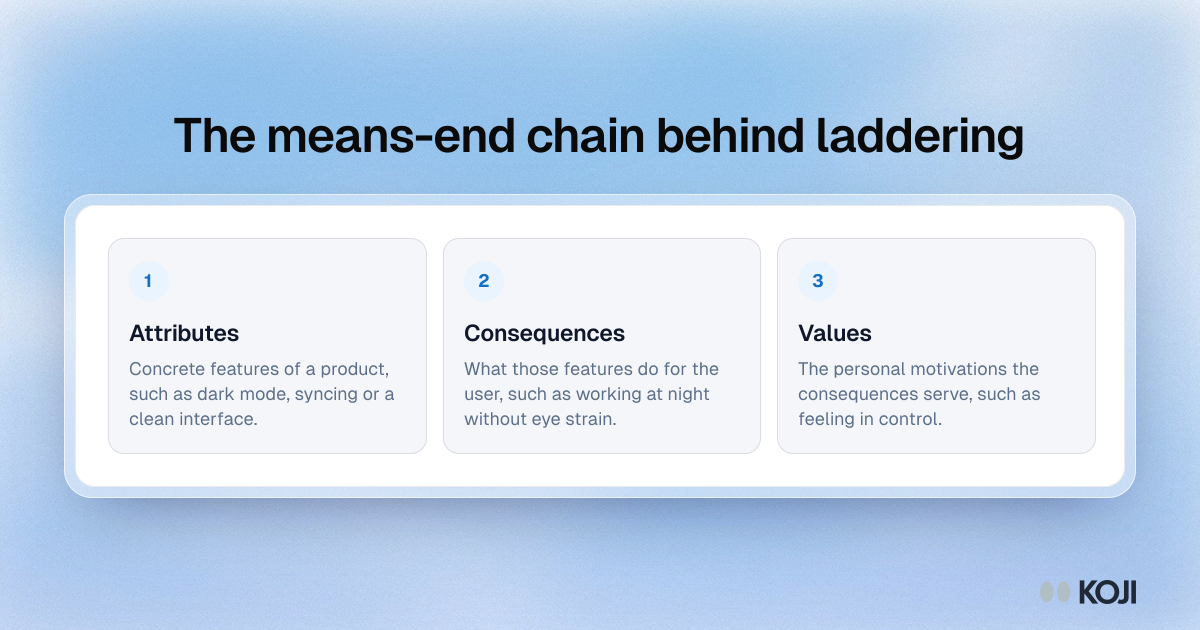
Level 1: Attributes (A)
The concrete, observable features of a product — physical characteristics, functional properties, abstract qualities.
Examples: "It has a dark mode," "It syncs across devices," "It is cheaper than the alternative," "The interface is clean"
Level 2: Consequences (C)
The functional and psychosocial effects that attributes have for the user — what the attribute does for them in practice.
Examples: "Dark mode means I can work at night without eye strain," "Syncing means I never lose my work," "Being cheaper means I do not need budget approval"
Level 3: Values (V)
The fundamental personal values that the consequences serve — abstract, deeply held motivations that transcend any specific product category.
Examples: "I feel in control," "I can be productive anywhere," "I feel like a smart, responsible professional," "I can focus on work I care about"
A landmark analysis of 750 laddering interviews found that only seven basic values are at the core of most brand purchase decisions — meaning beneath all the product variation, a remarkably small set of fundamental human motivations drive the choices users make.
Soft vs. Hard Laddering
Researchers distinguish between two forms of laddering:
Soft laddering allows the natural flow of conversation to guide the interview. The facilitator uses probing questions opportunistically — following threads that emerge from the participant's answers. This produces richer, more naturalistic data but requires an experienced interviewer who can recognize and pursue productive laddering opportunities.
Hard laddering follows a structured protocol, systematically eliciting complete A-C-V chains for each attribute before moving to the next. This produces more consistent data across participants, making cross-interview comparison and coding easier. Better suited to less-experienced interviewers and to AI-moderated research at scale.
Koji's AI interviewer is designed for hard laddering — it systematically probes each open-ended answer with follow-up questions that climb the attribute-consequence-value ladder, ensuring every participant's responses are explored to the same depth.
Step-by-Step: How to Run a Laddering Interview
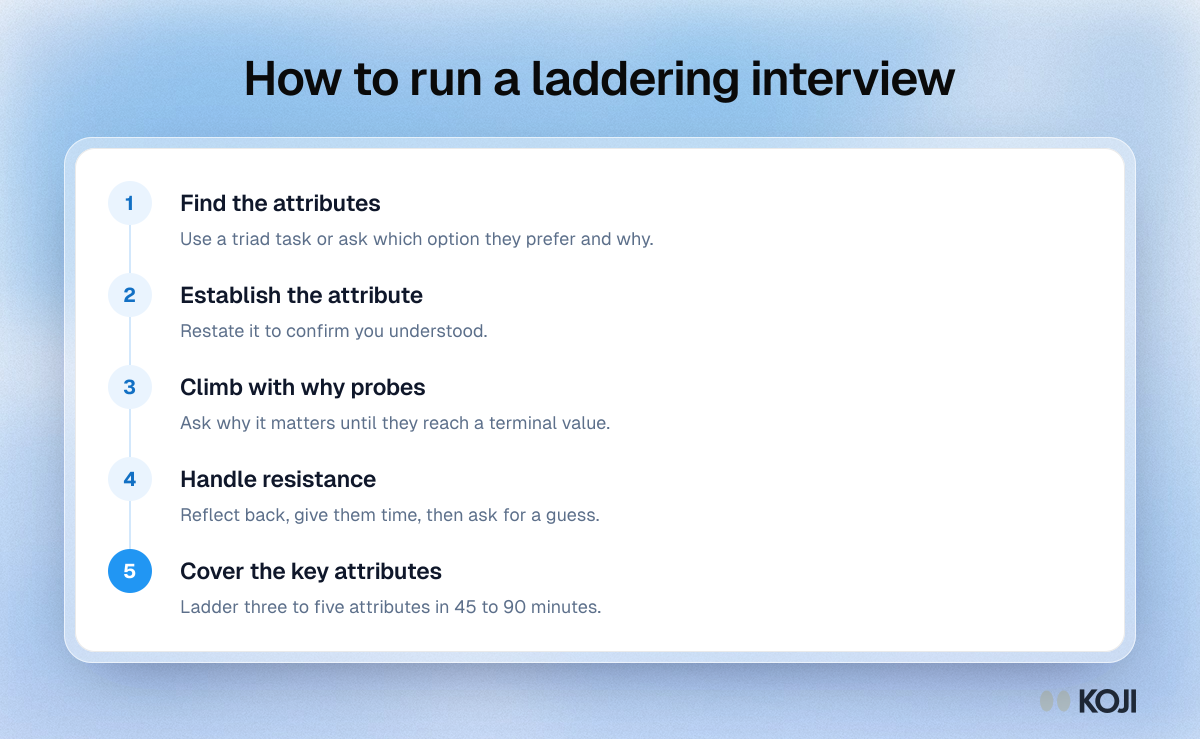
Step 1: Identify Differentiating Attributes (Before the Interview)
Before you can ladder up from attributes, you need to know which attributes are worth exploring. The standard approach:
- Triad task: Show the participant three products (or options) and ask them to identify how two are similar and one is different
- Preference elicitation: Ask which product or option they prefer and why
Attributes that emerge naturally from preference elicitation are the most motivationally relevant starting points — they represent what the user actually uses to distinguish between options.
Step 2: Establish the Attribute
Once you have a differentiating attribute, restate it to confirm understanding:
"You mentioned that you prefer [Product X] because [attribute]. Is that right?"
Step 3: Climb the Ladder with Why-Based Probes
The core of laddering is the systematic use of "Why is that important to you?" variations:
- "Why does that matter to you?"
- "What does that give you or allow you to do?"
- "How does that benefit you in practice?"
- "And why is that important?"
Continue probing until you reach a terminal value — a response where the participant says "it just is" or cannot articulate a deeper reason. That is the value level.
Step 4: Handle Resistance Gracefully
Participants often find it unusual to be probed beyond the obvious. Common deflections and responses:
- "I just like it" → Reflect back: "What specifically do you like about it?"
- "I do not know" → Give time, then try: "If you had to guess, what would you say?"
- "Because it is better" → "Better in what specific way for you?"
A skilled laddering facilitator uses silence effectively — 3–5 seconds of quiet after a probe gives participants time to access deeper motivations they would not otherwise articulate.
Step 5: Explore All Key Attributes
A full laddering session typically covers 3–5 differentiating attributes, climbing complete A-C-V chains for each. A well-run session takes 45–90 minutes.
Example Laddering Session: Research Platform
Here is an abbreviated example showing a laddering chain from attribute to core value:
Researcher: You said you prefer Koji because the interviews happen automatically. Why is that important to you?
Participant: Because I do not have to coordinate scheduling with participants.
Researcher: And why does not having to coordinate scheduling matter to you?
Participant: It saves me hours every week on logistics.
Researcher: What does saving those hours allow you to do?
Participant: I can actually spend time analyzing what people said instead of setting up calls.
Researcher: Why does that matter?
Participant: Because the analysis is where the real value is. That is where I find insights that change the product.
Researcher: And why is finding those insights important to you?
Participant: It is what I am here for. I want to have actual impact — not just run interviews that nobody acts on.
The chain revealed: Automated interviews (A) → no scheduling overhead (C) → more time for analysis (C) → better insights (C) → product impact (V) → sense of meaningful contribution (V)
This chain reveals that the user's core value is not efficiency — it is impact and meaning. Knowing this completely changes how you position the product and what experiences you prioritize building.
Analyzing Laddering Data: Building a Hierarchical Value Map
After conducting laddering interviews (typically 20–50 participants), the analysis process involves:
Step 1: Coding Each response is coded into one of the three levels: Attribute (A), Consequence (C), or Value (V). Two researchers coding independently, then comparing, improves reliability and catches ambiguous elements.
Step 2: Implication Matrix Build a matrix showing how many times each element leads to each other element across all interviews. This quantifies the strength of each link in the motivational chain.
Step 3: Hierarchical Value Map (HVM) Visualize the dominant motivational pathways as a network diagram — with the most common A-C-V chains drawn most prominently. A well-constructed HVM reveals the 2–3 core motivational paths that drive most of your users' decisions.
Reading the HVM: The most connected nodes reveal your most powerful value propositions. Chains that are wide (shared by many users) and deep (reaching values) represent your strongest emotional levers.
When to Use Laddering
Brand positioning: Understand what values your brand is associated with and whether that matches your intended positioning.
Product strategy: Discover what jobs users are really hiring your product to do — and whether new features align with core values or drift away from them.
Messaging and copy: Move from feature-level copy ("12 interview templates") to consequence and value-level messaging ("Build understanding that shapes better products").
Customer segmentation: Group users not by demographics but by shared motivational chains. Users who share values but differ in attributes are natural product evangelists.
Competitive analysis: Run laddering on how users think about competitive products to understand what values competitors win on — and where you can out-position them.
Limitations of the Laddering Technique
Time-intensive: Traditional laddering interviews take 45–90 minutes per participant and require skilled facilitators. Analysis of a 30-person study can take days of researcher time.
Artificial abstraction: Repeatedly probing "why" can feel uncomfortable and sometimes produces socially desirable answers rather than genuine values.
Facilitator bias: The way probes are framed influences which ladders emerge. Less experienced facilitators may push toward pre-existing hypotheses.
Sample size requirements: The rich data from laddering does not aggregate easily. The patterns only become statistically visible with 20 or more interviews.
How Koji Makes Laddering Accessible at Scale
Traditional laddering was expensive enough that only well-resourced market research firms could use it systematically. AI-moderated platforms change this equation.
Koji's AI consultant is designed to conduct the kind of systematic deep probing that laddering requires — asking "why" follow-ups, reformulating the question when a participant deflects, and continuing to climb the abstraction ladder until a terminal value is reached.
Specifically, Koji helps with laddering through:
Structured open-ended questions with probing depth settings: You define the starting attribute-level questions. The AI is configured to probe with up to 3 follow-up questions per answer, systematically climbing the A-C-V chain without researcher intervention.
Scale and choice questions for value validation: After the AI surfaces potential values through open-ended laddering, you can include structured questions — like ranking or single-choice questions — that validate which values are most prevalent across your full participant pool.
Automatic thematic analysis: Koji's AI identifies common themes, codes responses into patterns, and surfaces the most frequently occurring chains — giving you an implication-matrix-like view traditionally done by hand over days.
Voice interview depth: For true laddering depth, Koji's AI voice interviews enable the conversational intimacy that hard laddering requires, while maintaining systematic structure across every participant.
With Koji, a 30-participant laddering study that would have taken 3 weeks of researcher time can be completed in 48 hours — making laddering a practical tool for continuous product research rather than a once-a-year deep dive.
Laddering vs. Other Deep Interview Techniques
| Technique | Goal | Structure | Best for |
|---|---|---|---|
| Laddering | Uncover values hierarchy | Systematic A-C-V | Brand positioning, product strategy |
| 5 Whys | Find root cause | Repeated why probing | Problem diagnosis |
| JTBD interviews | Understand the job being done | Timeline-based | Product discovery |
| Mom Test interviews | Validate without bias | Problem-focused | Early-stage validation |
| Empathy interviews | Build emotional understanding | Free-form | Empathy mapping |
Laddering and JTBD interviews are complementary: JTBD reveals the functional job users are trying to accomplish; laddering reveals the values that make accomplishing that job personally meaningful.
Frequently Asked Questions
What is the laddering technique in qualitative research? Laddering is an in-depth interviewing method based on means-end chain theory that uncovers the hierarchical connections between product attributes (features), functional consequences (what they enable), and personal values (why they matter). Developed by Reynolds and Gutman in 1988, it is widely used in marketing research, UX research, and consumer psychology.
How many "why" questions do you ask in a laddering interview? Typically 3–7 "why" probes per attribute chain, until the participant reaches a terminal value they cannot ladder further. Most complete chains span 4–6 elements across the three levels.
How many participants do you need for a laddering study? Traditional laddering studies use 20–50 participants per segment to build statistically reliable hierarchical value maps. AI-moderated tools like Koji make 50–100 participant studies practical without proportional researcher time increases.
What is the difference between hard and soft laddering? Hard laddering follows a structured protocol, systematically exploring each attribute before moving to the next — better for less-experienced facilitators and consistent cross-participant comparison. Soft laddering follows the natural conversation flow — better for experienced facilitators seeking richer naturalistic data.
Can laddering be done remotely or asynchronously? Yes. Phone and video-based laddering works well and produces comparable data to in-person sessions. AI-moderated voice interviews as in Koji enable fully asynchronous laddering at scale — participants complete the interview on their own time, while the AI maintains systematic structure.
Related Resources
- Structured Questions in AI Interviews
- The Mom Test: How to Talk to Customers Without Being Misled
- Jobs-to-Be-Done Interview Guide
- Probing and Follow-Up Questions: Going Deeper in Research Interviews
- The Definitive Guide to User Interviews
- How to Write Great Interview Questions
Further reading on the blog
- Customer Journey Mapping Guide 2026: How to Build Maps That Actually Drive Decisions — A modern, AI-native playbook for customer journey mapping in 2026 — including the 5-step process, the questions that surface real emotion at
- Best AI Market Research Tools in 2026: The Complete Buyer's Guide — AI has fundamentally changed market research. This guide compares the leading AI market research platforms—from AI-native interview tools li
- B2B Customer Research: The Complete Guide for Product Teams (2026) — B2B customer research is harder than B2C — you are navigating buying groups of 10+ stakeholders, gatekeepers, and enterprise procurement cyc
Related Articles
Jobs-to-Be-Done Interview Guide
Learn the JTBD interview methodology to uncover why customers switch products and what progress they're trying to make.
The Mom Test: How to Talk to Customers Without Being Misled
Learn Rob Fitzpatrick's Mom Test methodology to ask questions that even your mother can't lie to you about.
Probing and Follow-Up Questions: Going Deeper in Research Interviews
Learn the different types of probing questions — clarification, elaboration, and contrast — and when to use each to get richer qualitative data from your participants.
Probing Questions for User Interviews: 40+ Examples to Get Deeper Answers
A practical guide to probing questions in user interviews — the six types of probes, 40+ ready-to-use examples, common mistakes, and how Koji's AI interviewer probes every answer automatically and consistently.
Repertory Grid Technique: A Complete Guide for Customer Research
How to use the repertory grid technique to uncover the hidden constructs customers use to evaluate products — with triadic elicitation, laddering, analysis, and how to run it at scale with AI interviews.
Structured Questions in AI Interviews
Mix quantitative data collection — scales, ratings, multiple choice, ranking — with AI-powered conversational follow-up in a single interview.
The Definitive Guide to User Interviews
Everything you need to plan, conduct, and analyze user interviews that produce actionable research insights.
How to Write Great Interview Questions
Learn to craft open-ended, neutral interview questions that surface genuine user insights instead of confirmation bias.