Critical Incident Technique: The Interview Method That Captures What Really Matters
Learn how to use the Critical Incident Technique (CIT) to uncover the specific moments that shape user experience. Developed by Flanagan (1954), CIT interviews collect real incidents — not generalizations — to reveal actionable patterns in user behaviour.
What Is the Critical Incident Technique?
The Critical Incident Technique (CIT) is a qualitative research method that uncovers the moments that truly shape user experience. Rather than asking people how they generally feel about a product, CIT asks them to recall specific events — the moments where something went remarkably right or frustratingly wrong. This specificity is what makes CIT so powerful for product research.
John Flanagan, a psychologist working with the US Air Force, developed CIT in 1954 to understand what distinguished effective pilots from ineffective ones. Standard surveys couldn't capture the nuance needed. His solution: collect specific, observable incidents and analyze them for patterns. The result was a landmark paper in Psychological Bulletin that defined CIT as "a set of procedures for collecting direct observations of human behaviour in such a way as to facilitate their potential usefulness in solving practical problems and developing broad psychological principles."
Today there are approximately 200 CIT studies in the marketing and consumer research literature alone. The technique has spread across healthcare, education, service quality research, and product UX — anywhere the difference between excellent and poor performance needs to be understood precisely.
The Core Problem CIT Solves
Ask someone "How satisfied are you with our onboarding?" and you get a number shaped by their current mood, social desirability bias, and cognitive distortions. Ask them instead: "Tell me about a specific time when you got completely stuck while setting up our product" — and you unlock something far more actionable.

Photo by Christina @ wocintechchat.com M on Unsplash
The Nielsen Norman Group notes that "memory is fallible, and so details can often be lost, or critical incidents can be forgotten" — which is precisely why CIT interviews should happen soon after the events in question, and why the method's structured prompting matters so much. By anchoring participants to a specific remembered incident, CIT bypasses the generalization problem that plagues most survey research.
The Three-Question Framework
A CIT interview is built around three core questions:
- What happened? — Describe the specific incident
- What led to it? — Context and circumstances
- What was the outcome? — Result and impact
These questions cut through vague opinions and anchor responses in real, memorable events. The first question elicits the incident itself; the second surfaces context that helps you understand why it happened; the third reveals whether the incident actually mattered to the user's behaviour (did they churn? did they tell others? did they find a workaround?).
Origins: From Wartime Aviation to Product Research
During World War II, the US Army Air Force needed to understand what made effective combat pilots. Flanagan's research team collected hundreds of specific incidents observed by supervisors — not ratings of general performance, but accounts of specific effective and ineffective behaviours in specific situations. Categories emerged from the incidents, not from the researchers' assumptions.
This inductive approach — letting the data define the categories — is CIT's most important methodological contribution. You don't ask "was navigation confusing?" You collect incidents, and if 60% of incidents involve users failing to find specific features, you know navigation is the problem. The insight emerges from the pattern, not from the question.
How to Structure a CIT Study
A typical CIT interview lasts 30–60 minutes and covers 3–5 incidents. Here is the framework:
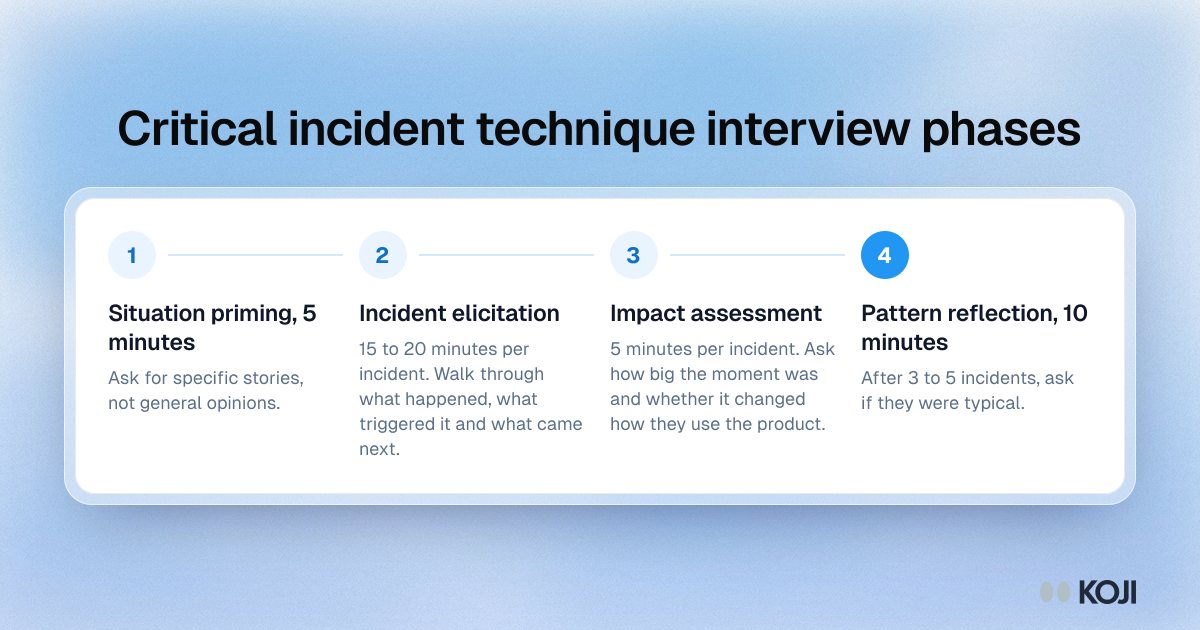
Phase 1: Situation Priming (5 minutes)
Orient the participant. Explain you are looking for specific stories, not general opinions. "I want to hear about actual experiences you have had — specific moments you remember clearly."
Phase 2: Incident Elicitation (15–20 minutes per incident)
Use the core CIT prompt: "Think back to a specific time when using [product] was [very helpful / very frustrating]. Can you walk me through exactly what happened?"
Follow up with:
- "What were you trying to accomplish?"
- "What specifically triggered this moment?"
- "What did you do next?"
- "What was the outcome?"
Phase 3: Impact Assessment (5 minutes per incident)
- "How significant was this moment for your overall experience?"
- "Did this change how you use [product]?"
- "Would you have done anything differently?"
Phase 4: Pattern Reflection (10 minutes)
After collecting 3–5 incidents, ask about patterns: "Were these incidents typical of your experience? What would make these moments less likely to happen?"
Positive vs. Negative Incidents: Collect Both
One of CIT's most underused features is its ability to collect positive critical incidents alongside negative ones. Most research over-indexes on problems. But understanding what delights users is equally important for identifying strengths to double down on, understanding the emotional peaks that drive word-of-mouth, and finding features that are working before inadvertently removing them.
For every "tell me about a time it went wrong" prompt, always ask: "Tell me about a time it went especially well."
Netflix uses a variant of CIT in their content research to understand the specific moments that cause viewers to abandon a show or become deeply engaged — the exact scenes that trigger "just one more episode" versus "I'm done." The technique scales to any domain where understanding the specific moment of a behavioural shift matters more than measuring average sentiment.
Analysing CIT Data
CIT produces rich qualitative data that requires systematic analysis. The standard approach:
- Extract incidents — Pull each distinct event from transcripts
- Categorize by behaviour type — Group incidents that share the same underlying pattern
- Label categories — Give each category a descriptive name ("Failed to find feature", "Unexpectedly delighted by X")
- Quantify frequency — Count how many incidents fall into each category
- Prioritize by frequency and impact — High-frequency, high-impact categories get addressed first
Modern AI analysis tools accelerate this dramatically. Koji's thematic analysis automatically clusters CIT responses by pattern, surfacing the most common incident types without hours of manual coding.
CIT with Koji's Structured Question Types
CIT adapts naturally to Koji's structured question framework. A well-designed CIT study in Koji might combine:
- Open-ended questions for incident elicitation: "Describe a specific time when you got stuck in our product"
- Scale questions for impact measurement: "On a scale of 1–10, how much did this incident affect your likelihood to continue using the product?"
- Single-choice questions for incident classification: "Which area of the product was involved? (Onboarding / Core workflow / Settings / Reporting)"
- Yes/No questions for outcome tracking: "Did this incident cause you to stop using the feature?"
- Multiple-choice questions for contributing factors: "What factors contributed? (Select all that apply)"
- Ranking questions for solution prioritization: "Rank these potential fixes in order of importance to you"
This structured approach lets Koji aggregate CIT data across many respondents, converting qualitative incidents into quantifiable patterns — something traditional CIT could never do at scale.
Running CIT at Scale with AI
Traditional CIT was limited to small samples (10–20 interviews) because each interview required a skilled moderator and hours of analysis. AI changes this fundamentally.
With Koji:
- Create a CIT study with incident-elicitation prompts
- AI interviewer probes naturally when participants give vague answers — "Can you be more specific about what happened next?"
- Automated thematic analysis clusters incidents by category across all respondents
- Structured question widgets capture quantitative ratings alongside qualitative incidents
- Report generation produces incident frequency distributions, not just themes
This makes CIT viable at 50–200 respondent scale — unlocking statistical significance while preserving the depth of incident-based research.
When to Use CIT (and When Not To)
Best for:
- Understanding the specific moments that cause churn
- Identifying onboarding failure points
- Discovering delight moments to amplify
- Post-mortems: what went wrong in specific user journeys
- Service quality research in customer experience teams
Not ideal for:
- Measuring overall satisfaction (use NPS or CSAT)
- Quantifying feature preferences (use choice-based ranking)
- Large-scale quantitative studies where breadth matters more than depth
- Exploratory research without specific behaviours to investigate
CIT vs. Other Interview Methods
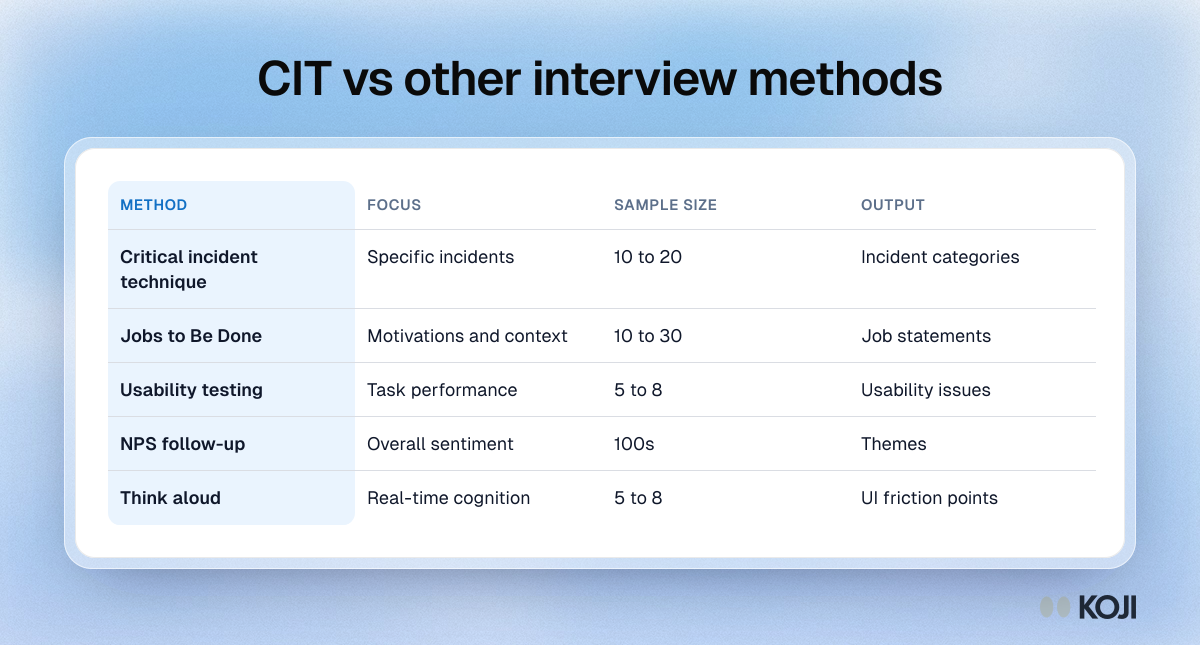
| Method | Focus | Sample Size | Output |
|---|---|---|---|
| CIT | Specific incidents | 10–20 | Incident categories |
| Jobs to Be Done | Motivations & context | 10–30 | Job statements |
| Usability Testing | Task performance | 5–8 | Usability issues |
| NPS Follow-up | Overall sentiment | 100s | Themes |
| Think Aloud | Real-time cognition | 5–8 | UI friction points |
CIT occupies a unique niche: it bridges the gap between real behaviour and retrospective storytelling, giving you incidents you can act on without the artificiality of lab-based testing.
Related Resources
- How to Conduct User Interviews — foundational interview skills and techniques
- Thematic Analysis Guide — how to analyze qualitative data from CIT sessions
- Structured Questions Guide — combining quantitative questions with CIT interviews
- Jobs to Be Done Framework — complementary technique for motivation research
Further reading on the blog
- AI-Moderated vs Human-Moderated Interviews: Which Should You Choose? — AI-moderated and human-moderated interviews each have a time and a place. Here is the honest comparison to help you choose the right approac
- Concept Testing: The Complete Guide for Product Teams (2026) — Concept testing validates whether your idea is worth building before you build it. This guide covers methods, question templates, analysis a
- How to Analyze Customer Interview Data: A Complete Guide — You ran the interviews. Now what? Here is a step-by-step process for turning raw transcripts into clear, actionable insights your team will
Related Articles
AI Over-Reliance and Automation Bias: How to Research Whether Users Trust Your AI Too Much (2026)
Users who accept every AI suggestion are a product risk, not a success metric. How to measure over-reliance and automation bias, why self-report fails, and the study designs that produce honest reliance data.
Algorithm Aversion and Trust Repair: What Happens After Your AI Gets It Wrong (2026)
Users abandon an AI faster than they abandon a human who makes the identical mistake. The research on why, the single design change that raised algorithm adoption from 32% to 76%, and how to research trust repair after an AI failure.
The Five Whys Technique: How to Find Root Causes in User Research (with AI)
The Five Whys is a root-cause analysis technique that turns surface-level user feedback into actionable insight. Learn how to apply it in interviews and run it with AI-powered probing at scale.
How to Conduct User Interviews: The Complete Step-by-Step Guide
A complete step-by-step guide to planning, conducting, and analyzing user interviews—covering discussion guide writing, participant recruitment, facilitation techniques, sample size, and modern AI-powered approaches.
Jobs to Be Done Framework: The Complete Guide
The definitive guide to the Jobs to Be Done (JTBD) framework — its history, two schools of thought, how to write JTBD statements, famous examples, how to conduct JTBD research, and how AI interviews enable JTBD at scale.
Structured Questions in AI Interviews
Mix quantitative data collection — scales, ratings, multiple choice, ranking — with AI-powered conversational follow-up in a single interview.
The Complete Guide to Thematic Analysis
Learn how to systematically analyze qualitative data using Braun and Clarke's six-phase thematic analysis framework.