Framework
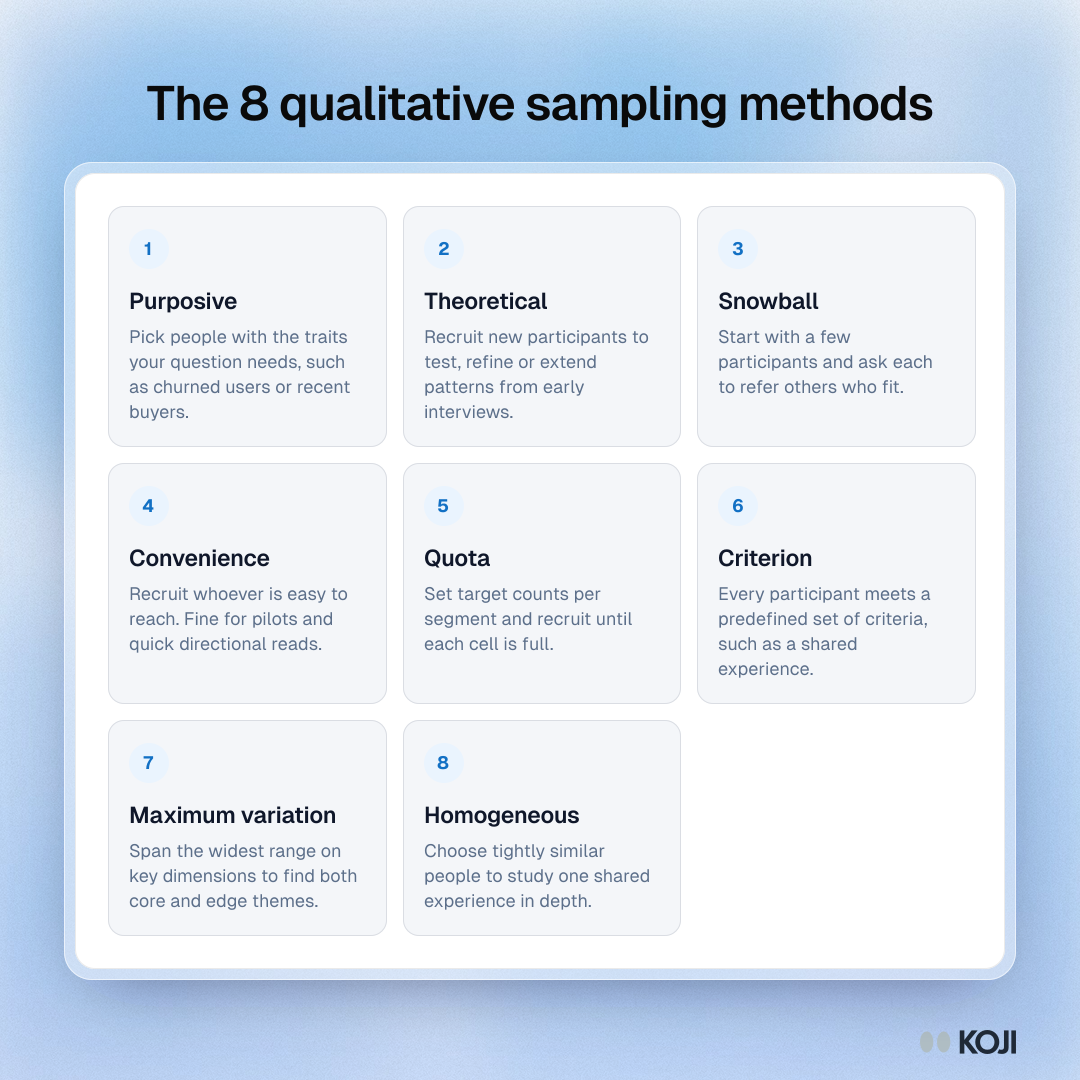
The 8 qualitative sampling methods
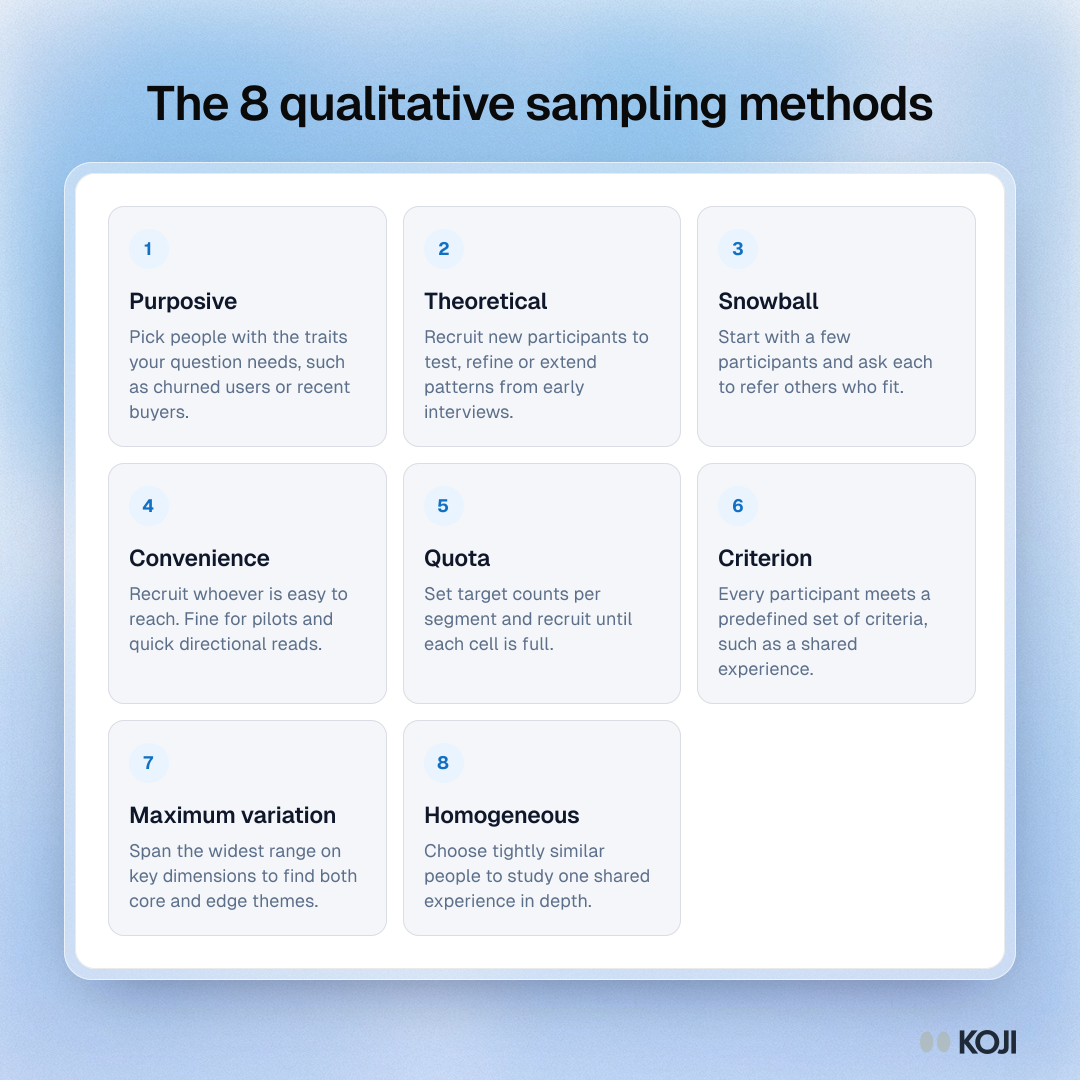
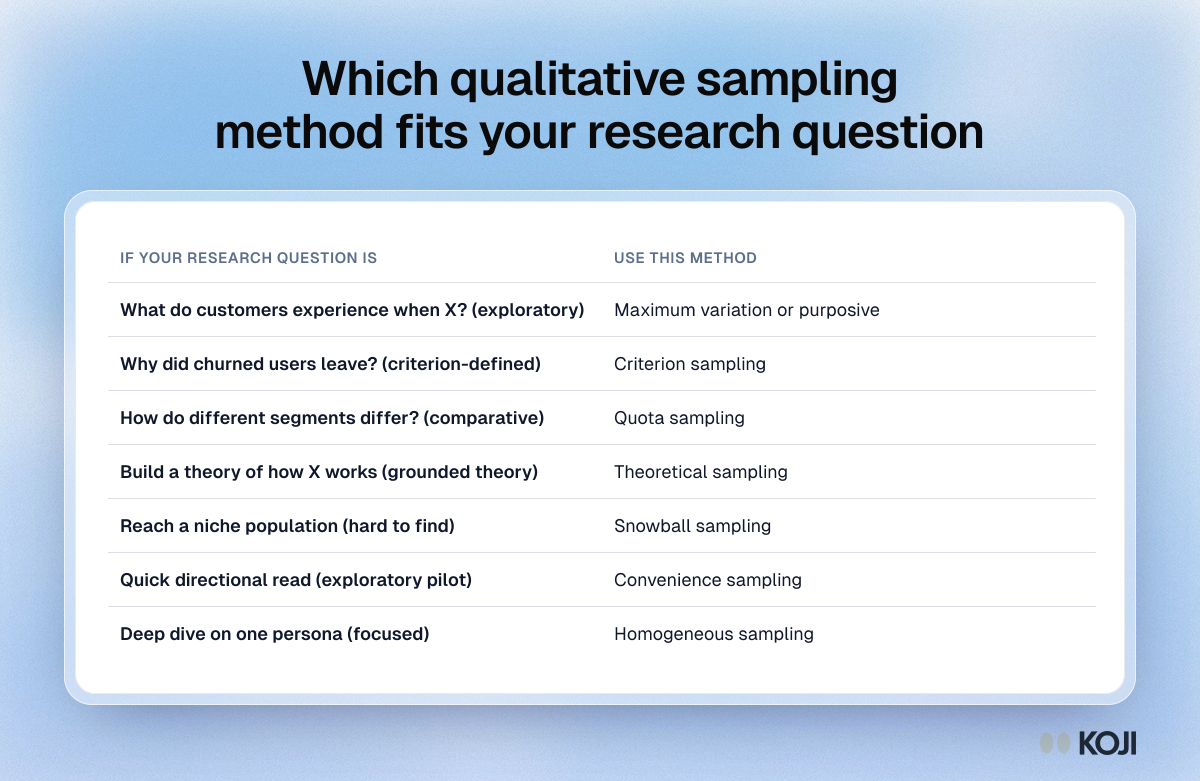
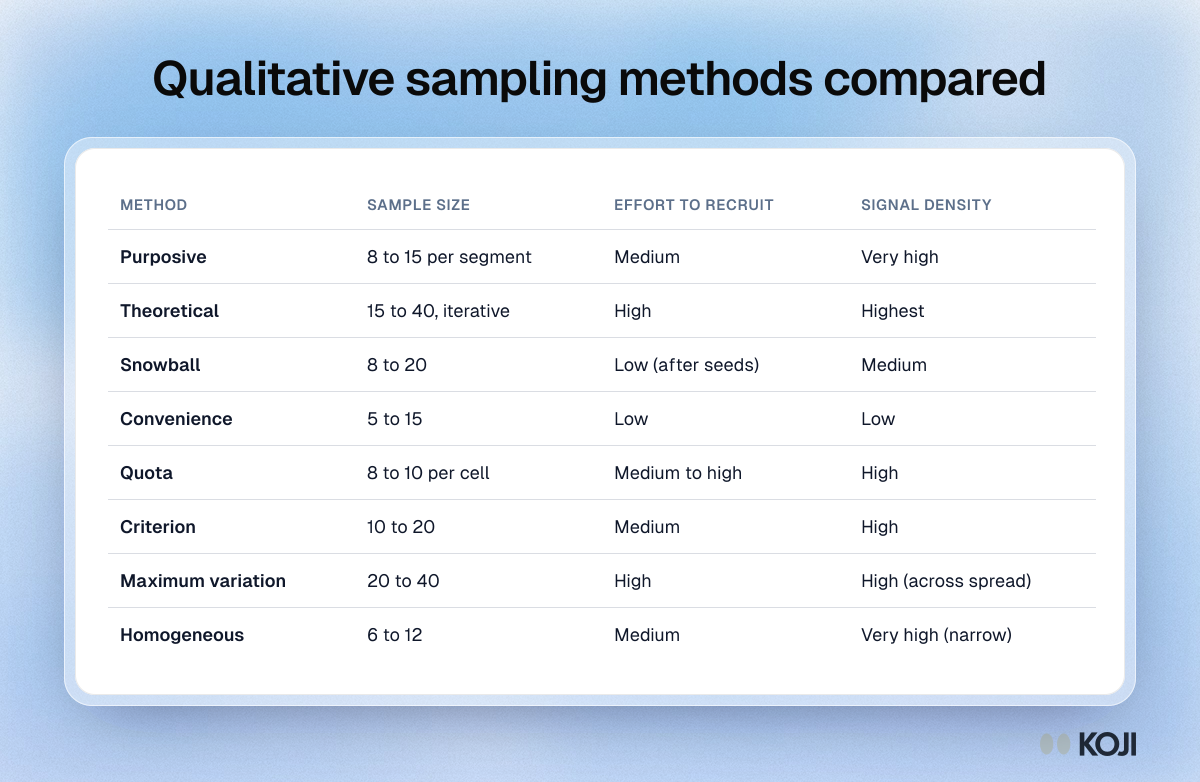
The eight non-probability sampling methods most used in qualitative research, each with a one-line definition: purposive, theoretical, snowball, convenience, quota, criterion, maximum variation and homogeneous sampling. It is for researchers and product teams deciding who to interview. With Koji, larger designs such as maximum variation or quota sampling become practical because AI moderation runs many interviews in parallel.
Where this appears
What's in this framework
- Purposive: Pick people with the traits your question needs, such as churned users or recent buyers.
- Theoretical: Recruit new participants to test, refine or extend patterns from early interviews.
- Snowball: Start with a few participants and ask each to refer others who fit.
- Convenience: Recruit whoever is easy to reach. Fine for pilots and quick directional reads.
- Quota: Set target counts per segment and recruit until each cell is full.
- Criterion: Every participant meets a predefined set of criteria, such as a shared experience.
- Maximum variation: Span the widest range on key dimensions to find both core and edge themes.
- Homogeneous: Choose tightly similar people to study one shared experience in depth.
Use this image
Free to use in your docs, decks and posts under CC BY 4.0, as long as you credit Koji with a link to this page. To embed it, paste this into your page:
html
<a href="https://www.koji.so/visuals/eight-qualitative-sampling-methods"><img src="https://www.koji.so/visuals/eight-qualitative-sampling-methods/eight-qualitative-sampling-methods.png" alt="Framework of eight qualitative sampling methods: purposive, theoretical, snowball, convenience, quota, criterion, maximum variation and homogeneous." width="1080" height="1080" /></a>
<p>Source: <a href="https://www.koji.so/visuals/eight-qualitative-sampling-methods">The 8 qualitative sampling methods</a>, Koji</p>