Framework
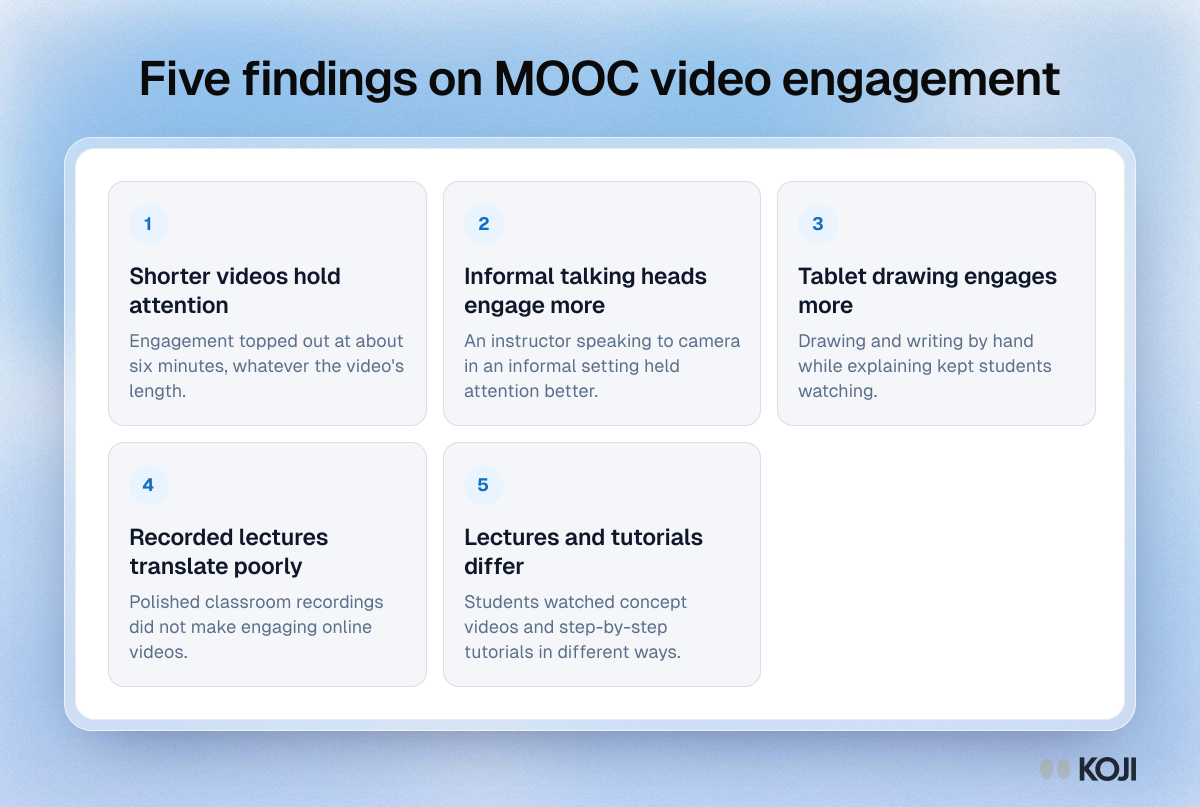
Five findings on MOOC video engagement
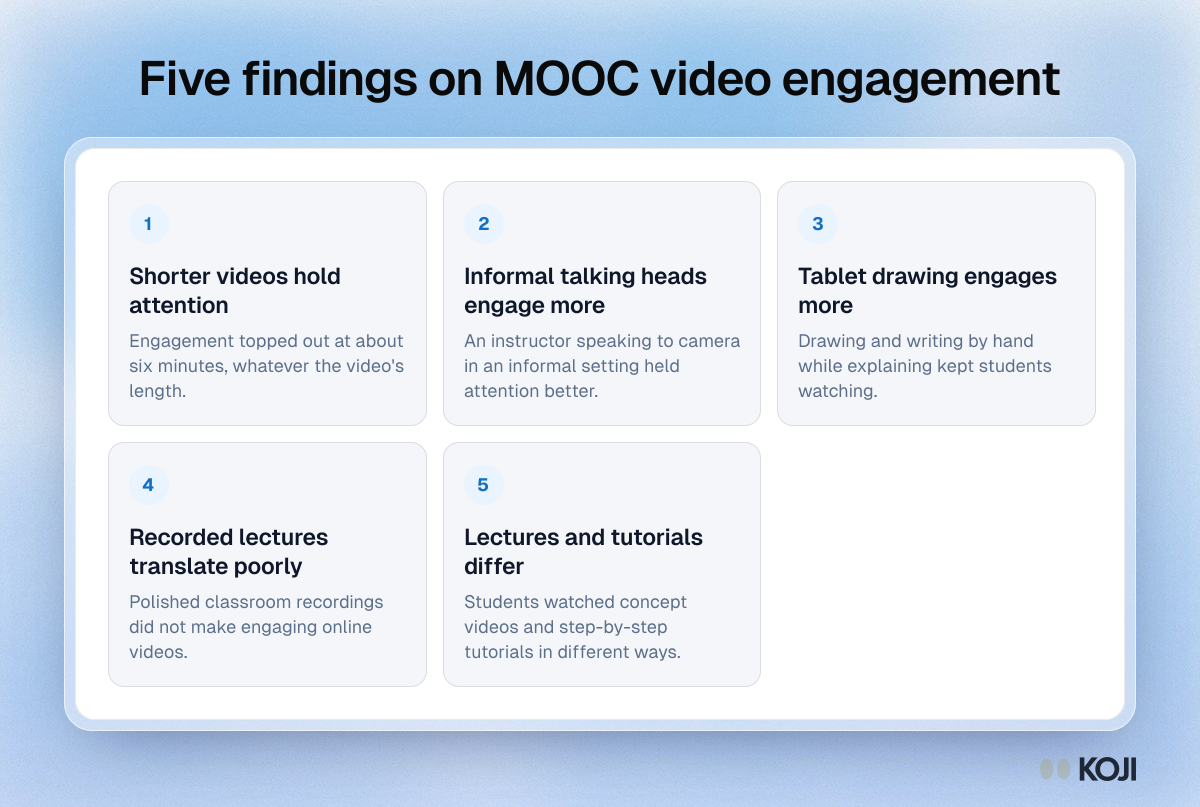
Five findings from Guo, Kim and Rubin's 2014 study of 6.9 million video sessions on edX, the source of the six-minute rule for educational video. It covers video length, talking-head and tablet-drawing styles, recorded classroom lectures, and how lecture and tutorial videos are watched. Engagement was measured by watching time and problem attempts, not learning. Koji interviews help programme teams ask students why a video worked or did not.
What's in this framework
- Shorter videos hold attention: Engagement topped out at about six minutes, whatever the video's length.
- Informal talking heads engage more: An instructor speaking to camera in an informal setting held attention better.
- Tablet drawing engages more: Drawing and writing by hand while explaining kept students watching.
- Recorded lectures translate poorly: Polished classroom recordings did not make engaging online videos.
- Lectures and tutorials differ: Students watched concept videos and step-by-step tutorials in different ways.
Use this image
Free to use in your docs, decks and posts under CC BY 4.0, as long as you credit Koji with a link to this page. To embed it, paste this into your page:
html
<a href="https://www.koji.so/visuals/mooc-video-engagement-findings-guo-kim-rubin-2014"><img src="https://www.koji.so/visuals/mooc-video-engagement-findings-guo-kim-rubin-2014/mooc-video-engagement-findings-guo-kim-rubin-2014.png" alt="Framework of five findings from a 2014 study of 6.9 million edX video sessions: short videos, talking heads, tablet drawing, lectures and video type." width="1200" height="807" /></a>
<p>Source: <a href="https://www.koji.so/visuals/mooc-video-engagement-findings-guo-kim-rubin-2014">Five findings on MOOC video engagement</a>, Koji</p>