Framework
The six NASA-TLX subscales
What participants rate, from 0 to 100, right after a task
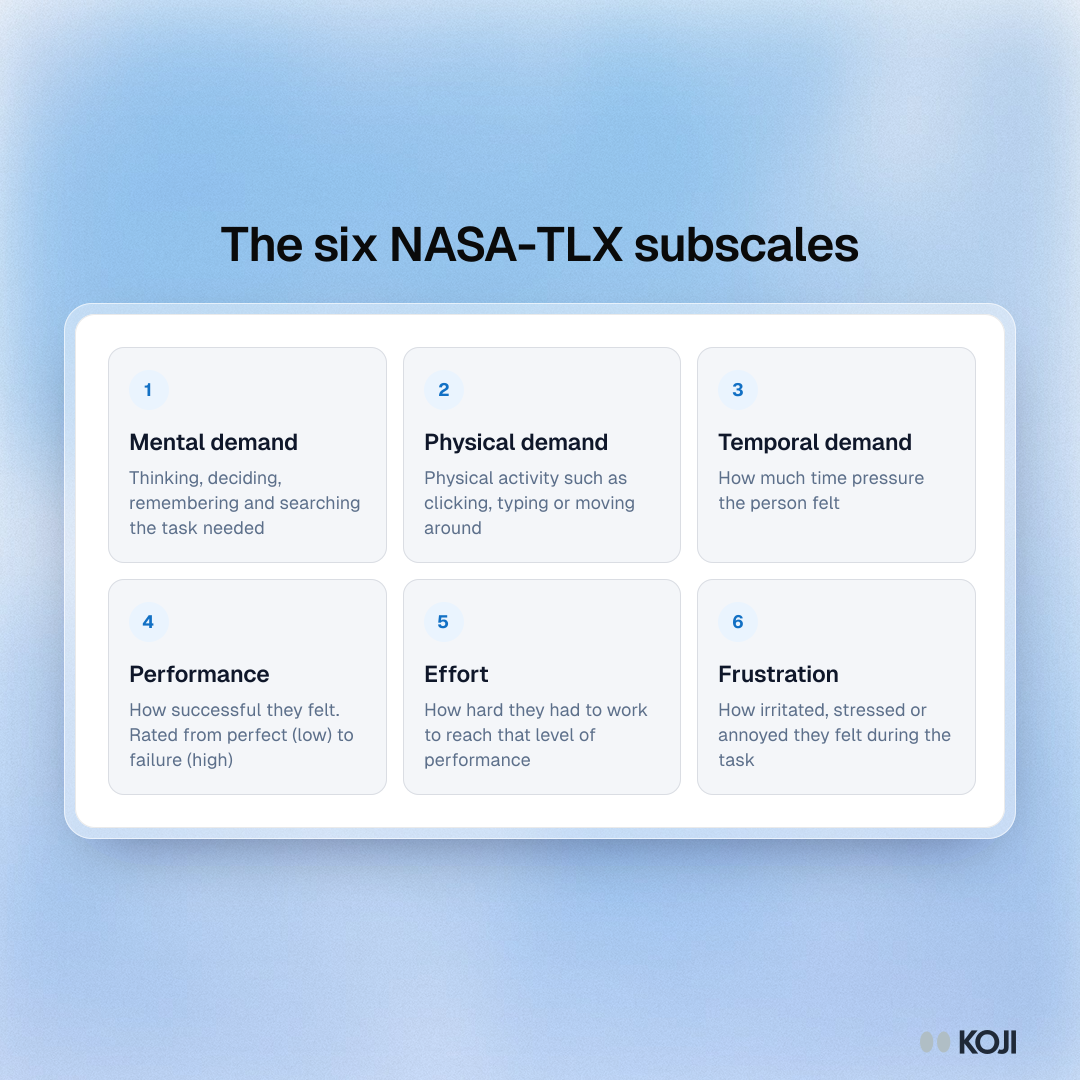
The six dimensions of the NASA Task Load Index, each with a plain definition. Participants rate every one from 0 to 100 right after a task, and the ratings are averaged (Raw TLX) or weighted into one workload score. Note that performance runs from perfect to failure, so a higher number always means more workload. Koji can collect the ratings as scale questions and ask people why they rated a dimension high.
Where this appears
What's in this framework
- Mental demand: Thinking, deciding, remembering and searching the task needed
- Physical demand: Physical activity such as clicking, typing or moving around
- Temporal demand: How much time pressure the person felt
- Performance: How successful they felt. Rated from perfect (low) to failure (high)
- Effort: How hard they had to work to reach that level of performance
- Frustration: How irritated, stressed or annoyed they felt during the task
Use this image
Free to use in your docs, decks and posts under CC BY 4.0, as long as you credit Koji with a link to this page. To embed it, paste this into your page:
html
<a href="https://www.koji.so/visuals/nasa-tlx-six-subscales"><img src="https://www.koji.so/visuals/nasa-tlx-six-subscales/nasa-tlx-six-subscales.png" alt="Framework showing the six NASA-TLX subscales: mental, physical and temporal demand, performance, effort and frustration" width="1080" height="1080" /></a>
<p>Source: <a href="https://www.koji.so/visuals/nasa-tlx-six-subscales">The six NASA-TLX subscales</a>, Koji</p>