Bar chart
How often larger packs cost more per unit: retail vs wholesale
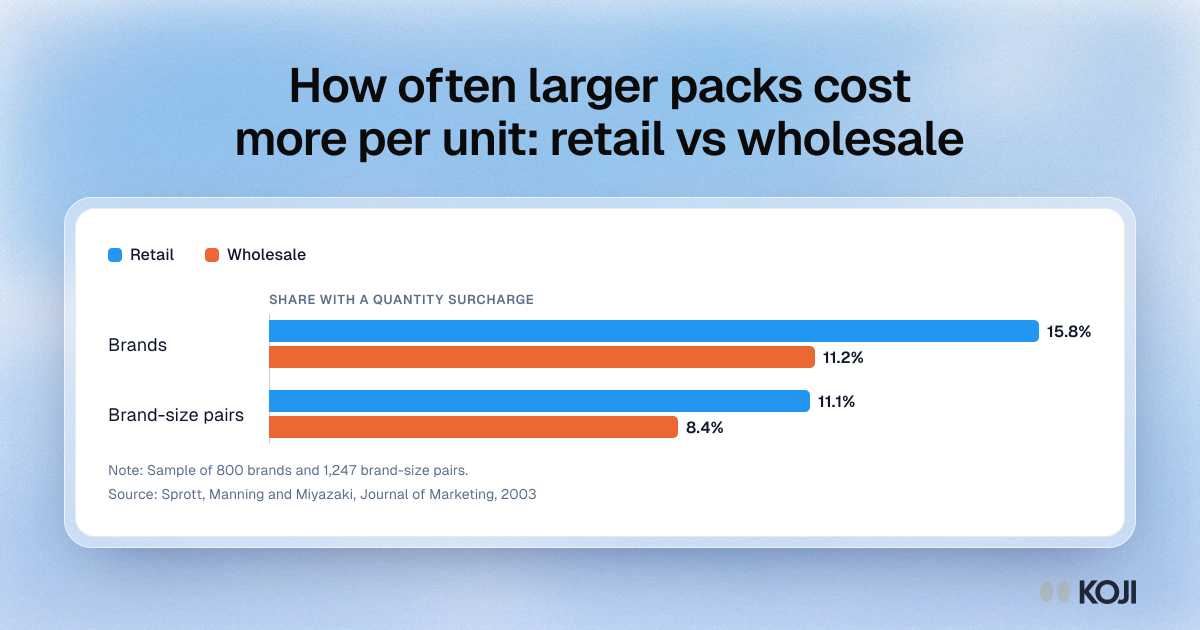
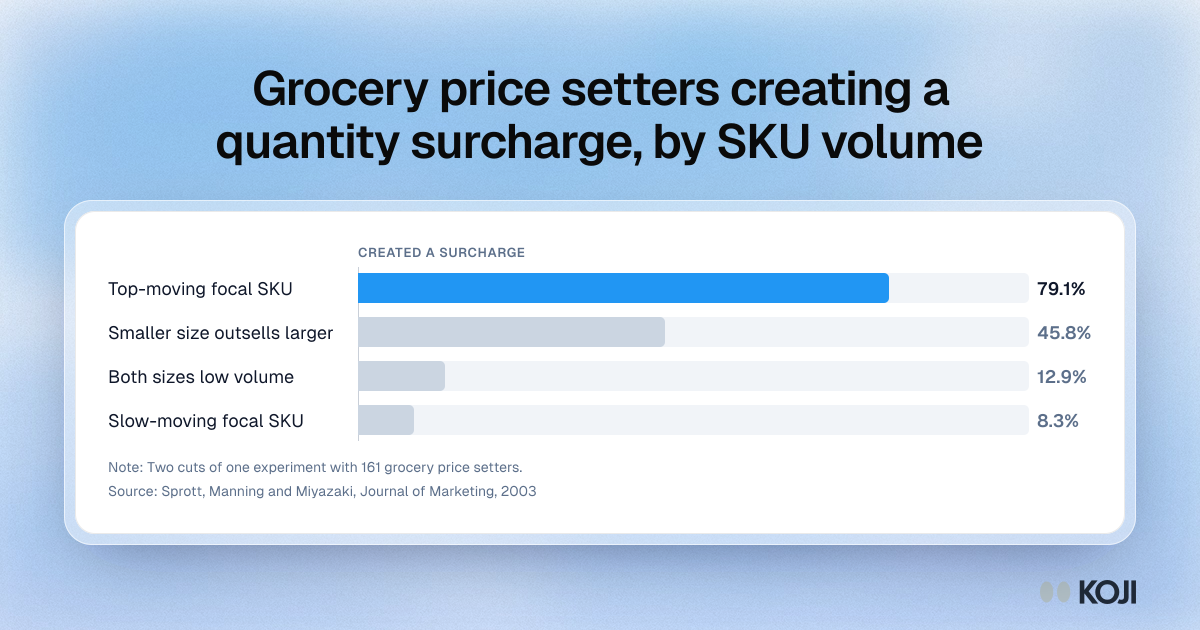
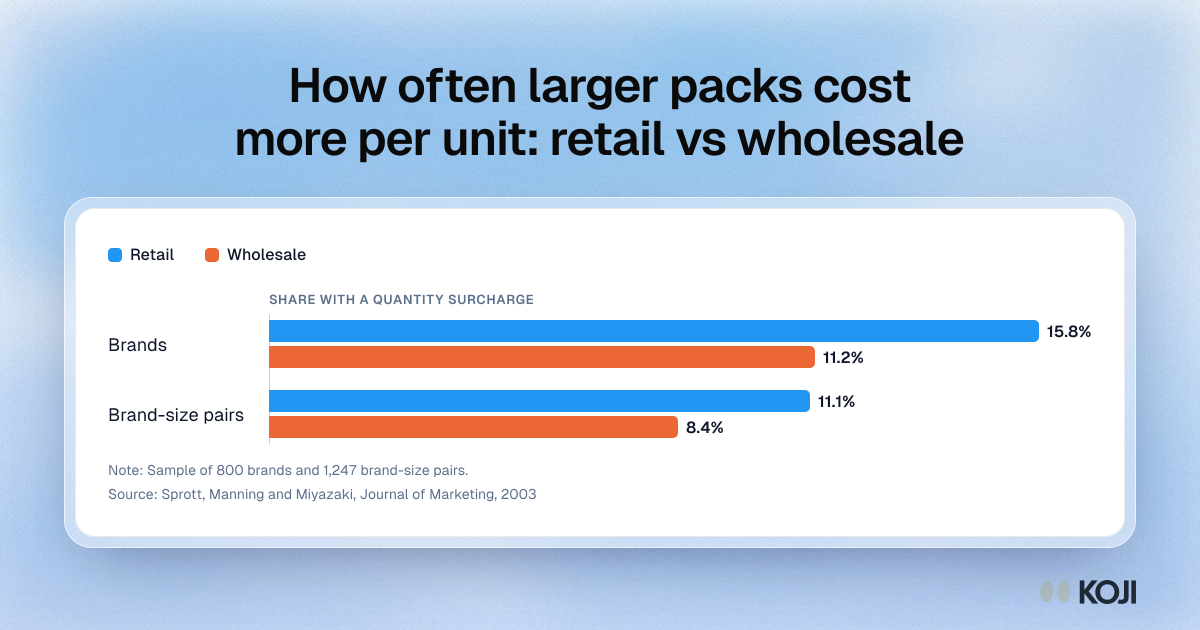
Quantity surcharges happen when a brand's larger pack has a higher unit price than its smaller pack. In Sprott, Manning and Miyazaki's 2003 study of 800 brands and 1,247 brand-size pairs, 15.8% of brands had at least one surcharge at retail and 11.2% at wholesale. For brand-size pairs the figures were 11.1% and 8.4%. The gap suggests most inversions are created on the shelf, not by the manufacturer.
Where this appears
What's in this bar chart
| Retail | Wholesale | |
|---|---|---|
| Brands | 15.8% | 11.2% |
| Brand-size pairs | 11.1% | 8.4% |
Sample of 800 brands and 1,247 brand-size pairs.
Use this image
Free to use in your docs, decks and posts under CC BY 4.0, as long as you credit Koji with a link to this page. To embed it, paste this into your page:
html
<a href="https://www.koji.so/visuals/quantity-surcharge-incidence-retail-vs-wholesale"><img src="https://www.koji.so/visuals/quantity-surcharge-incidence-retail-vs-wholesale/quantity-surcharge-incidence-retail-vs-wholesale.png" alt="Bar chart of quantity surcharge incidence: 15.8% of brands at retail vs 11.2% at wholesale, and 11.1% vs 8.4% of brand-size pairs." width="1200" height="630" /></a>
<p>Source: <a href="https://www.koji.so/visuals/quantity-surcharge-incidence-retail-vs-wholesale">How often larger packs cost more per unit: retail vs wholesale</a>, Koji</p>