Framework
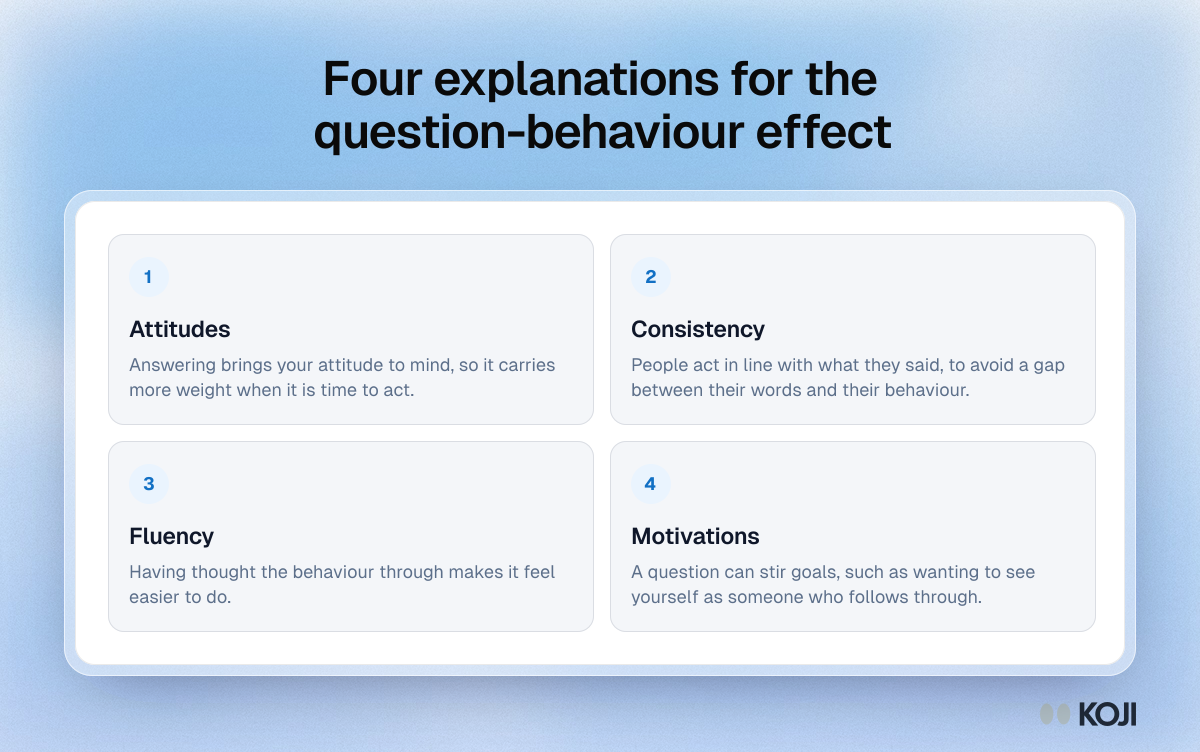
Four explanations for the question-behaviour effect
Why asking people about their plans can change what they do
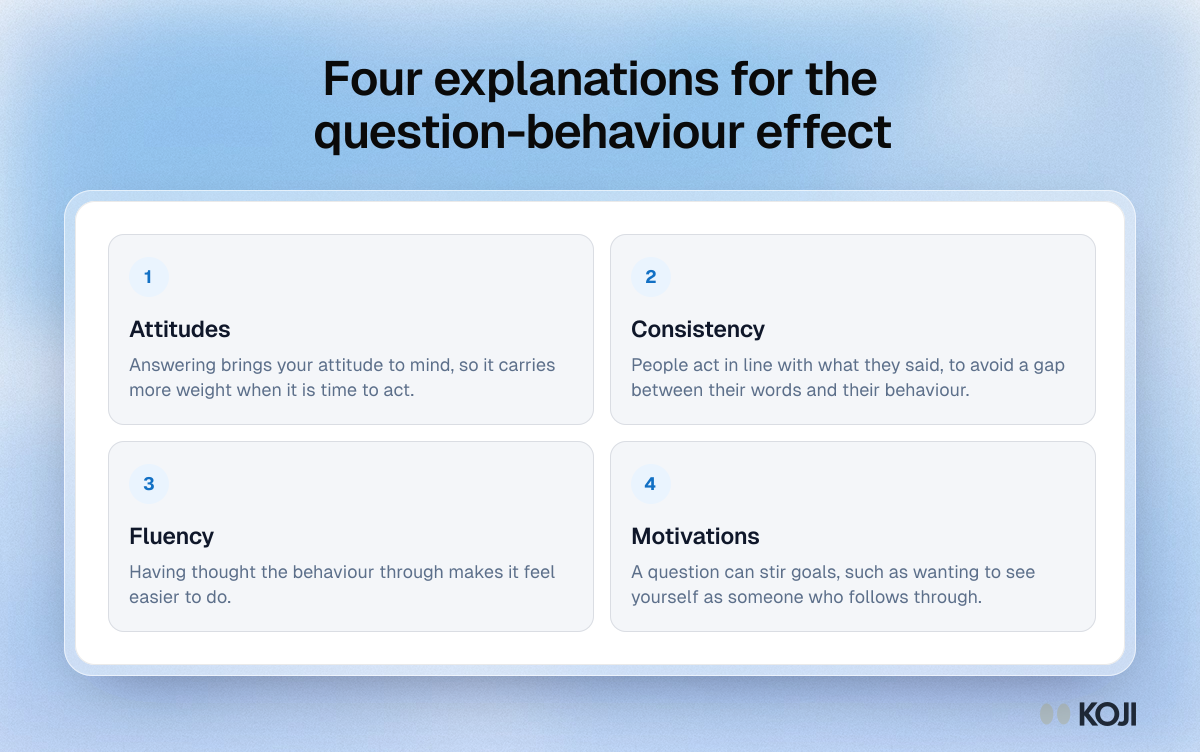
The four families of explanation that Spangenberg, Kareklas, Devezer and Sprott (2016) used to organise research on the question-behaviour effect, the finding that asking people about their intentions changes their later behaviour. It is for anyone designing mid-course check-ins that ask students about their plans. Support for each explanation varies and none is settled. Koji lets teams run check-ins with and without forward-looking questions on separate links to test the effect.
What's in this framework
- Attitudes: Answering brings your attitude to mind, so it carries more weight when it is time to act.
- Consistency: People act in line with what they said, to avoid a gap between their words and their behaviour.
- Fluency: Having thought the behaviour through makes it feel easier to do.
- Motivations: A question can stir goals, such as wanting to see yourself as someone who follows through.
Use this image
Free to use in your docs, decks and posts under CC BY 4.0, as long as you credit Koji with a link to this page. To embed it, paste this into your page:
html
<a href="https://www.koji.so/visuals/question-behaviour-effect-four-explanations"><img src="https://www.koji.so/visuals/question-behaviour-effect-four-explanations/question-behaviour-effect-four-explanations.png" alt="Framework of four explanations for the question-behaviour effect: attitudes, consistency, fluency and motivations, after Spangenberg et al. 2016." width="1200" height="752" /></a>
<p>Source: <a href="https://www.koji.so/visuals/question-behaviour-effect-four-explanations">Four explanations for the question-behaviour effect</a>, Koji</p>