Flowchart
Translate, adapt or wait: a new country decision
Read each country's interviews against this path
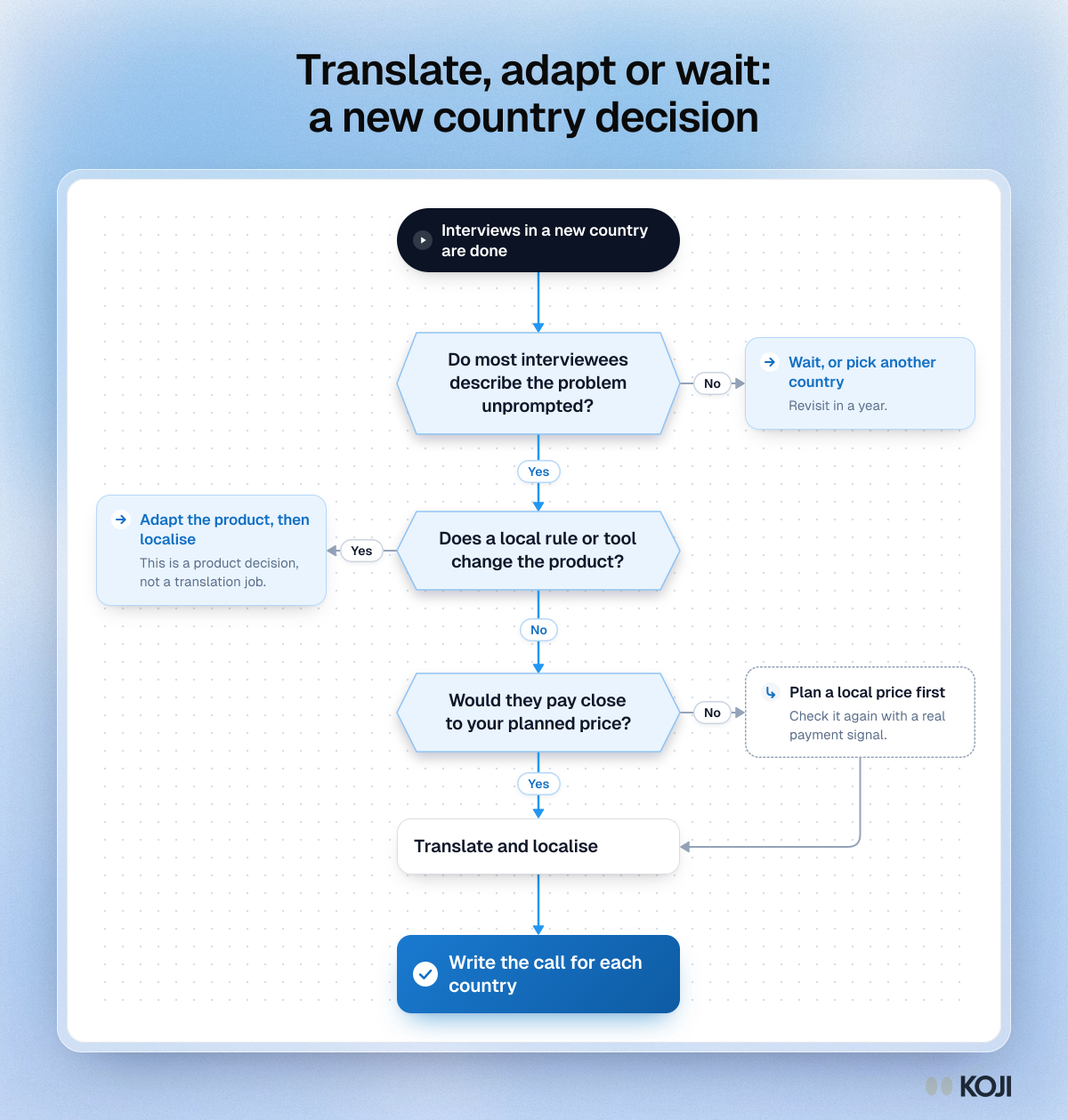
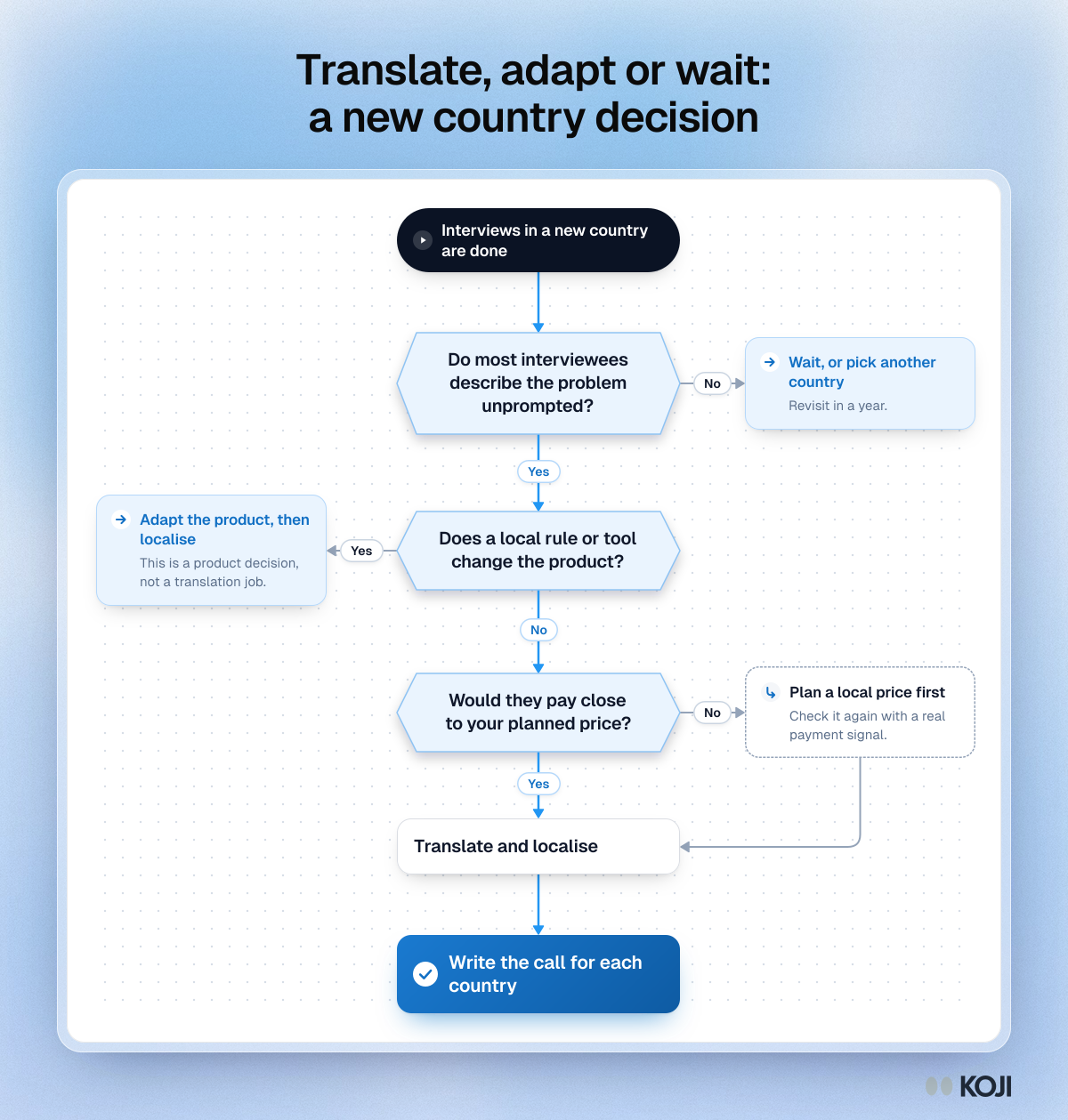
A decision flowchart for founders who have interviewed buyers in a new country. It asks whether most describe the problem unprompted, whether a local rule or tool changes the product, and whether they would pay close to the planned price, and ends in translating and localising, adapting the product first, planning a local price or waiting. Thresholds in the Koji playbook are rules of thumb, not published standards.
Where this appears
What's in this flowchart
Start: Interviews in a new country are done
- Do most interviewees describe the problem unprompted?
- Yes: go to 2.
- No: Wait, or pick another country. Revisit in a year.
- Does a local rule or tool change the product?
- No: go to 3.
- Yes: Adapt the product, then localise. This is a product decision, not a translation job.
- Would they pay close to your planned price?
- Yes: go to 4.
- No: Plan a local price first. Check it again with a real payment signal. Then go to 4.
- Translate and localise.
- Finish: Write the call for each country.
Use this image
Free to use in your docs, decks and posts under CC BY 4.0, as long as you credit Koji with a link to this page. To embed it, paste this into your page:
html
<a href="https://www.koji.so/visuals/translate-or-research-first-new-country-flowchart"><img src="https://www.koji.so/visuals/translate-or-research-first-new-country-flowchart/translate-or-research-first-new-country-flowchart.png" alt="Flowchart for the decision after interviews in a new country: wait, adapt the product, plan a local price or translate." width="1200" height="1259" /></a>
<p>Source: <a href="https://www.koji.so/visuals/translate-or-research-first-new-country-flowchart">Translate, adapt or wait: a new country decision</a>, Koji</p>