Should you translate your product for a new country, or find out first whether buyers there have the problem? Research first. Twelve conversations per country, run in the buyers' own language over about three weeks, will tell you whether the problem exists, how they solve it today and whether your price makes sense, before you spend a quarter on translation, local payments and a hire. This playbook shows who to talk to, what to ask, how to read the answers and what you should decide at the end.
When you need this
You are probably past product-market fit at home. Inbound has started to arrive from Germany or Brazil, a board member keeps saying "Europe is the obvious next step", or a competitor just opened an office in the market you had in mind. The cheap-looking move is to translate the site, switch on a local currency and see what happens.
That move can be expensive. A Gartner survey of software providers, reported in March 2025, found that 30% of first-time geographic expansions were still unprofitable two years after launch [1]. Gartner's analyst called a startup's first expansion its riskiest, and warned that resource-poor providers are tempted to copy the marketing that worked at home [1]. Translation is the part of expansion you can see. What decides the outcome is whether the buyer there has the problem, buys the way your home buyers buy and will pay what you plan to charge.
The signs it is time to research, not translate:
- Three or more inbound leads from one country, but none of them closed.
- You are about to hire a local salesperson or agency on the strength of a hunch.
- Your best customers at home share a trait (a regulation, a seasonal pattern, a tool) you have not checked exists elsewhere.
- Someone has said "we just need to localise" and nobody can say what that means.
If you are entering a new customer segment in your home country, read Research a new customer segment before you build for it instead. This one is about a new country, where language, buying habits and price expectations can all differ at once.
The method in brief
Run short qualitative interviews with people who match your best home-market customer, in the country you are considering, in their language, and compare what you hear with your home-market customers. That is a narrow, comparable study, which is what makes a small sample useful. A systematic review of empirical tests found that interview studies with a fairly homogeneous group often reach saturation, the point where new interviews stop producing new themes, within roughly 9 to 17 interviews [2]. Our working number is 12 per country for a first read.
Pair it with the right companion for each question:
| Question | Method | Reference |
|---|---|---|
| Does the problem exist, and how do they cope today? | Interviews built on past behaviour | The Mom Test, customer discovery interviews |
| Would they pay roughly what we plan to charge? | A price test inside the interview, then a real payment signal | Price your first product with 30 customer conversations |
| Does the page we would launch make sense to them? | A first-impression test with the localised page | Test your landing page before you launch |
| Is the language right? | A native reader, then a few interviews that probe wording | Cross-cultural user research |
Why not a survey? A survey can size a market once you know what to ask. It is a poor first step because response styles differ by country. Harzing's study of 26 countries found major differences in how people use rating scales, and that English-language questionnaires drew more middle answers than questionnaires in respondents' own language [3]. Comparing a 4 out of 5 from Munich with a 4 out of 5 from Madrid is a risky comparison. Open interview answers about what someone did last month travel better.
Step by step
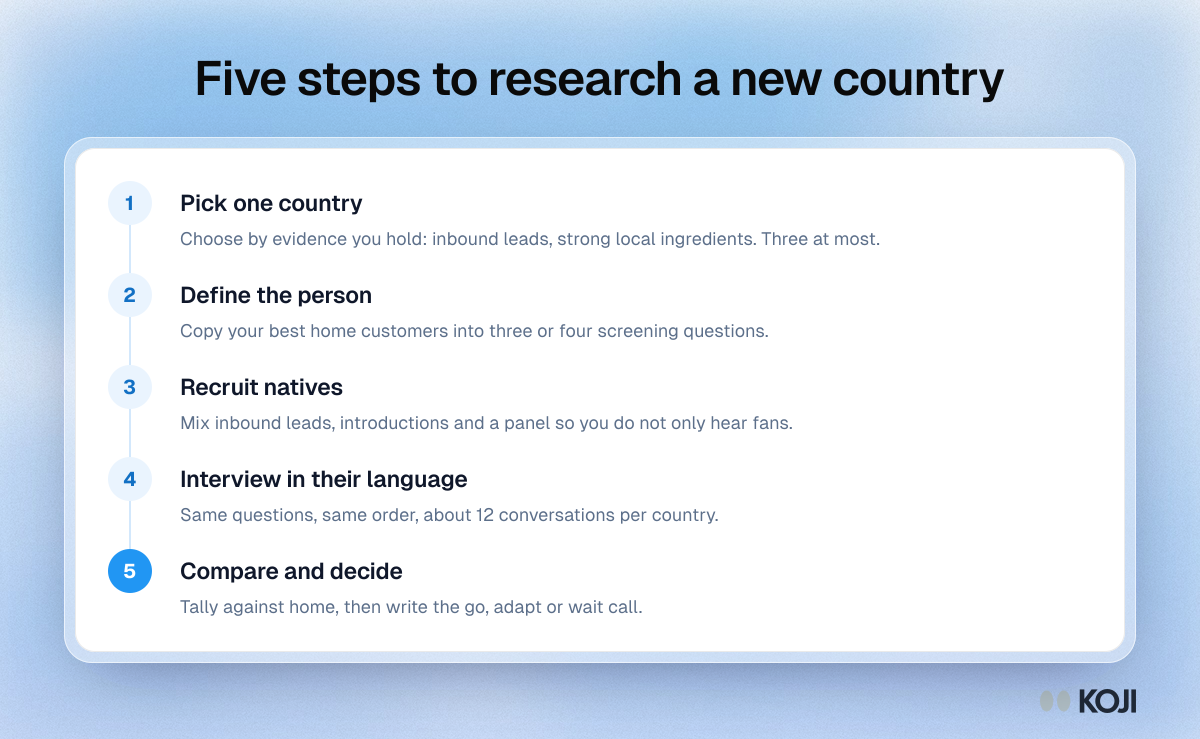
1. Pick one country, or at most three. Choose by evidence you already hold: where inbound leads come from, where your product's ingredients (a regulation, a platform, a trade) are strong. Do not run all three at once on your first try. Each country is its own study.
2. Define the person. Copy your best home customers: role, company size, the trigger that made them look for a solution. Write that as three or four screening questions. If your home buyers are ops managers at 20 to 200 person firms who just changed their process, find that person abroad.
3. Find them with no local network. Use four routes, cheapest first:
- Your own inbound leads and past signups from that country. They already raised a hand, though they are biased toward people who found you.
- Your customers' contacts and partners there. Ask for introductions, not for sales.
- A recruitment panel filtered to the country, language and role. Slower to set up for niche B2B roles, but it reaches strangers.
- Local communities, trade bodies and LinkedIn, with a short honest ask. The no-audience playbook covers the invite wording, and recruiting B2B participants covers channels.
Mix at least two routes. If every interviewee came from your inbound list, you have measured your fans.
4. Interview in their language. Not in English with a translator, and not in English because "everyone speaks it". People describe a problem most precisely in the language they think in. A review of the question wording by a native speaker before you launch costs an hour and saves you from an awkward or accidentally formal question.
5. Keep the interview identical across countries. Same questions, same order, same length. Otherwise you cannot tell whether Germany differs from the UK or whether your two interview scripts do.
The question bank
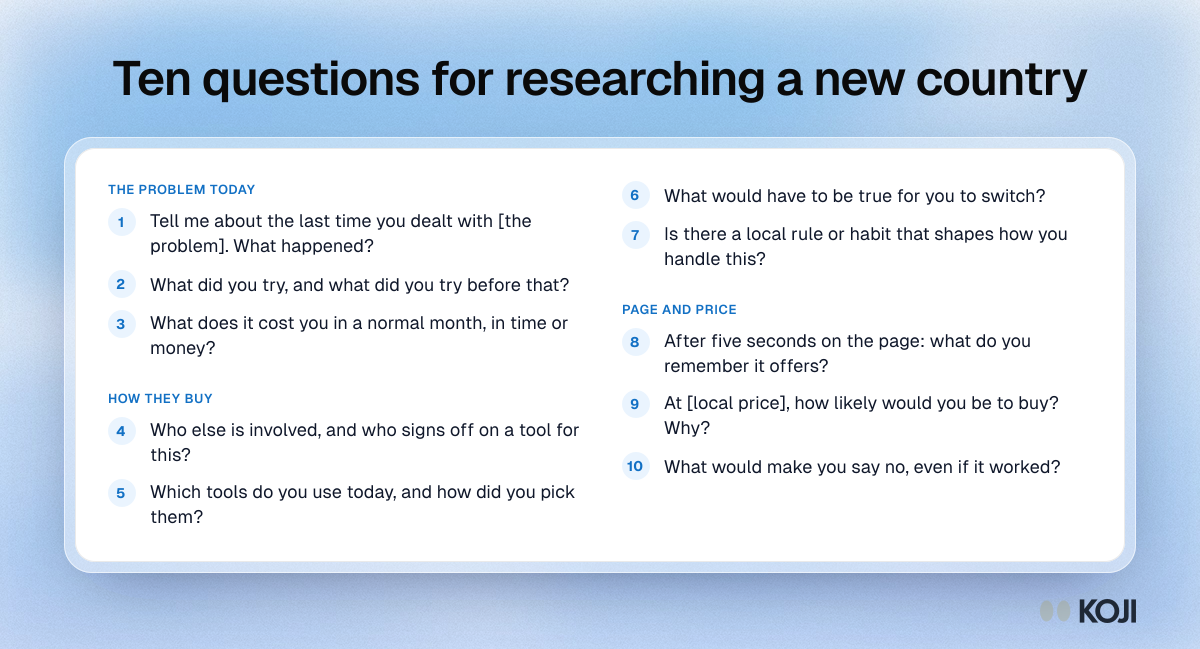
Open with the last time, not an opinion:
- Tell me about the last time you had to deal with [the problem]. What happened?
- What did you do about it? What did you try before that?
- What does that cost you, in time, money or stress, in a normal month?
- Who else is involved when this comes up? Who signs off on a tool for it?
- Which tools or services do you use for this today, and how did you pick them?
- What would have to be true for you to switch?
- Is there a rule, a standard or a habit in your industry here that shapes how you handle this?
- (After showing the localised page for five seconds) What do you remember it offers? What did you expect to see?
- At [price in local currency], how likely would you be to buy? Why?
- What would make you say no to a product like this, even if it worked?
Question 7 is the one home-market scripts miss. It surfaces the local rule or tool that changes the product, and it is why a translated product fails quietly.
A worked example
Say you run a three-person product team at a company that sells job-scheduling software to HVAC contractors. You have 260 customers in the UK. Three German firms have emailed asking for a demo and a board member wants "a German launch" next quarter.

Photo by Compagnons on Unsplash
You decide to test Germany and the Netherlands against your UK customers. You write the screener: owner or office manager, 5 to 40 technicians, books jobs by phone today. You recruit 12 in Germany and 12 in the Netherlands, mixing the inbound list, two customer introductions and a panel filter, and you interview eight UK customers for comparison.
What you hear: in the UK, the problem is double-booked engineers. In Germany, 9 of 12 describe a different pain: documenting maintenance work to satisfy a regulator, with scheduling handled by a dispatcher in a spreadsheet that works fine. Question 5 reveals most already use a local tool that bundles scheduling and documentation. In the Netherlands, 10 of 12 recognise the scheduling problem in almost the UK's words, and few have a tool. At question 9, willingness to buy at the UK price is similar to the UK.
You decide: the Netherlands first, with Dutch translation and a Dutch-language landing page. Germany waits until you know whether you can add maintenance documentation, which is a product decision and not a translation job. You saved a quarter of German work that would have produced demos and no deals. These numbers are invented for the example, but this is the shape of a real result.
Reading the results and deciding
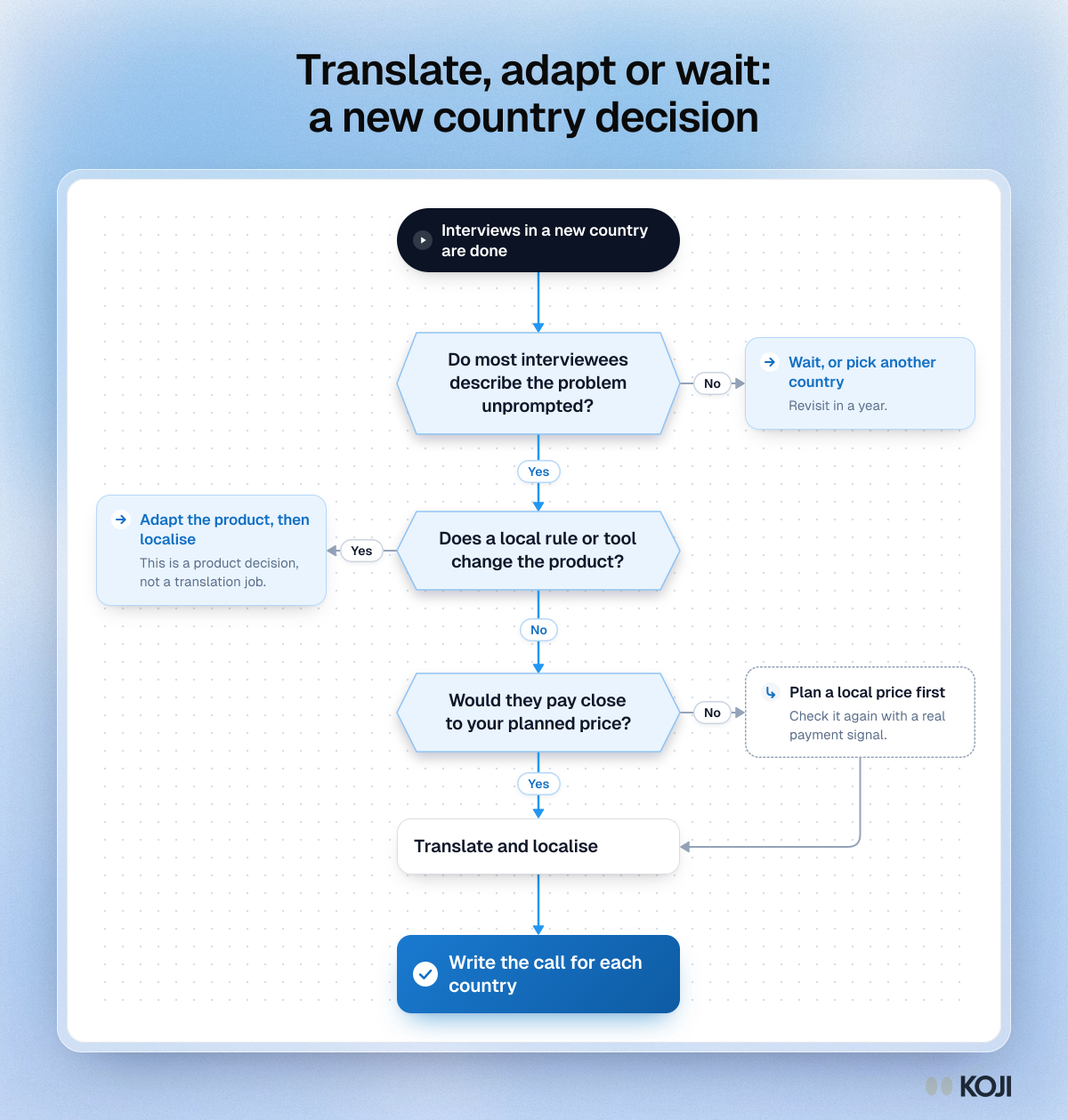
Read all 12 transcripts for each country, then tally. These thresholds are our rules of thumb, not published standards, so adjust them to your stakes:
- Go (translate and localise): at least 8 of 12 describe the problem unprompted, in terms close to your home customers, and name a workaround you can beat.
- Adapt first: the problem exists but a local rule, tool or buying habit changes the product or the buyer. Fix the product, then localise. Germany in the example above.
- Wait: fewer than 5 of 12 have the problem, or a strong local incumbent satisfies it. Revisit in a year, or choose another country.
- Price: if willingness to buy at your planned price in local currency is clearly lower than at home, or buyers expect a different packaging, plan a local price before launch.
Then check the tally against the cautions in the next section before you act on it.
Run it this week with Koji
You can do all of this by hand with a spreadsheet, a video-call tool and a translator, and for one country that is a reasonable choice. Koji shortens the parts that scale badly: running the same interview in several languages and reading the results side by side.
- Build one study per country. Start from the research brief assistant and describe the decision. Paste the ten questions above. Add the screening questions (role, company size, current tool) so the wrong people are turned away before the interview starts. Then duplicate the study for each country, so every country gets its own report and the questions stay identical.
- Turn on the languages. In the study's Context tab, enable each language, for example Dutch and German. When you publish, Koji translates every question, including answer options and scale labels. Use the "Viewing in" toggle to read and edit each translation, and ask a native speaker to check them. Koji offers 30+ interview languages in text and voice. See the multilingual research guide.
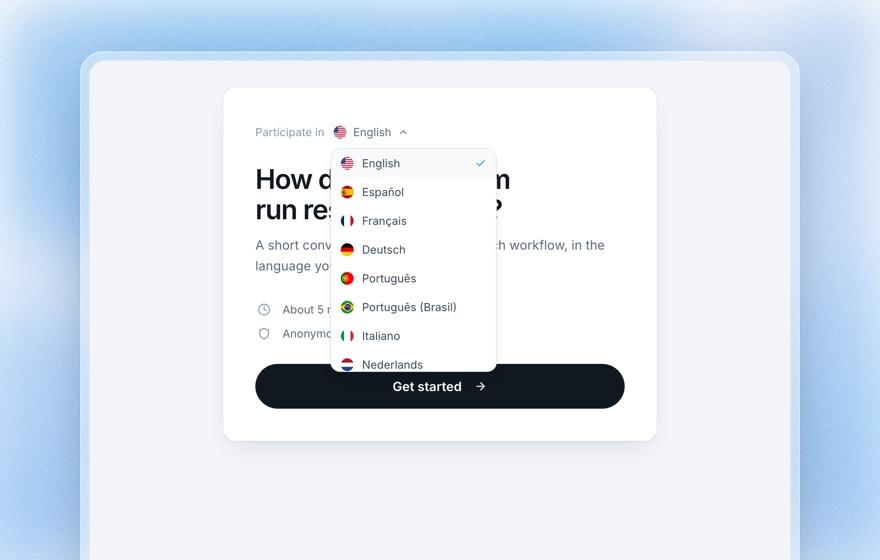
- Send each country its own link. Add
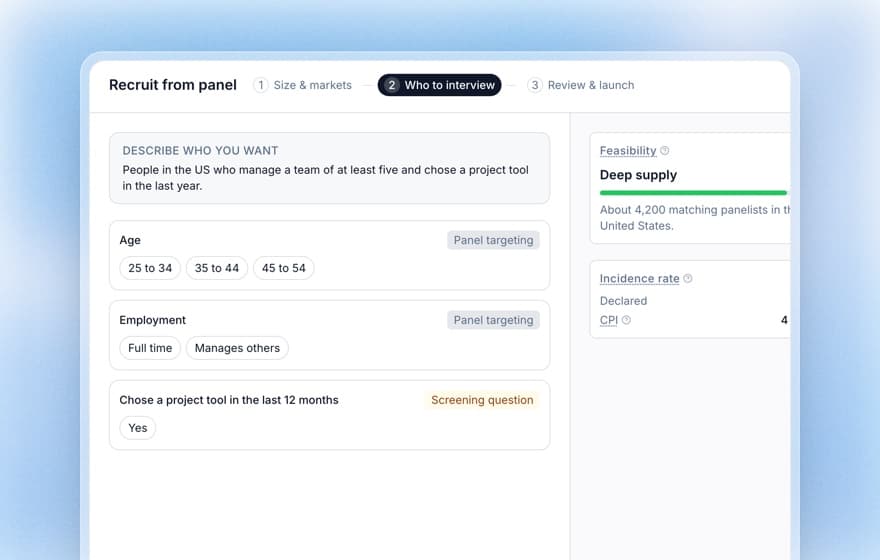
?lang=nlor?lang=deto the interview link so the page opens in the right language. Without it, Koji picks from the participant's browser language, then their country, then your default. It never picks a language you did not turn on. - Recruit. For people you already know, email your own list or use a personal link for each person (the link route is on Interviews and Enterprise plans, the email route on paid plans). For strangers, the panel recruitment tab lets you choose a country and language market, add an audience description and a screening question, and see the cost and feasibility before you launch. Building the audience works on any plan, and launching needs a paid plan.
- Show the local page for five seconds. Attach your localised landing page to question 8 and set it to show once, full screen, for 5 seconds. Koji then asks what they remember and what they expected, so the follow-ups are about what they actually saw. This works in text and voice interviews, not phone calls.
- Test the local price. Add a price test question with a ladder of 5 to 7 prices in the local currency. Each person is asked about one price at a time and moves up or down until Koji finds the highest they would still buy at, then asks why. The report shows the share who would buy at each price. It is directional, and it reads best from about 30 interviews, so with 12 per country treat it as a prompt for the reasons you read, and pool it with the interview comments.
- Read and share. Set the report language to English. Quotes stay in the participant's own words, so you read the analysis in English and still see the original wording. Put the country reports side by side, and download the report as slides or a PDF for the board.
Where research will mislead you
- Politeness differs by culture. A "yes, interesting" means different things in different places. Harzing's cross-national work is a reminder that scale answers are not comparable across countries without care [3]. Ask for past behaviour and money, not opinions.
- Your recruits are not the market. Inbound leads and customer introductions skew friendly. Balance them with strangers from a panel or community.
- Stated price is not paid price. A meta-analysis of 77 studies found people state prices about a fifth higher than they pay [4]. Confirm with a real payment signal: a pre-order, a deposit or a signed pilot.
- Native-language fieldwork beats a simulated respondent. AI personas look like a shortcut. A 2026 study that ran World Values Survey items in 11 languages found that an explicit cultural framing aligned a model with human answers better than just switching the prompt language [5]. A March 2026 practitioner write-up from an insight agency found models matched real UK and French results closely, but missed the spread of opinion among Malaysian respondents on a sensitive topic [6]. The agency sells research, so read it as a view and not a trial. Use synthetic respondents to draft questions at most, and talk to real people before you decide.
- Language is not the whole case. One widely quoted consumer study of 8,709 people in 29 countries found 76% preferred buying where product information is in their own language and 40% would never buy from sites in other languages, but it was a 2020 consumer survey and the share varied by country (Japan was the least won over, at 50%) [7]. B2B buyers behave differently, and that is the reason to ask.
Common mistakes
- Running the study in English because the team does.
- Changing the script between countries, then comparing the answers.
- Asking about the market ("is there demand for this in France?") and not about the person's last experience.
- Treating translation as the project. It is the last 10% of the work.
- Interviewing 40 people in one country and none in the comparison group.
- Ending with a slide of agreement and no decision. Write the go, adapt or wait call for each country at the top of the report.
Where this fits
This is a scaleup decision on the founder's research playbook. Before it, research a new customer segment and find out why you lose bigger deals. After it, test the price you will publish: contact us or a published price. If you are still at an earlier stage, start at Koji for founders.
FAQ
How many interviews do I need in each country? Twelve is a sound first read for a narrow, homogeneous group, in line with the 9 to 17 range found for saturation [2]. If the first six all say the same thing, you can stop early. If themes keep appearing, add six more.
Can I interview in English to save time? For some audiences, such as developers who work in English every day, yes. For most business buyers, people describe a problem more precisely in the language they work in, so interview in that language, and add a few English interviews only if you must compare.
Do I need to speak the language? No. You need a native reader to check the question wording, and analysis that keeps quotes in the original language beside a translation you can read.
Is a survey better for sizing a market? Later, yes. First learn what to ask, because scale answers are not directly comparable across countries [3].
How do I handle a country where most of my panel is consumers? Screen hard on role and company size, accept that niche B2B roles take longer, and mix in your own contacts.
What should I do next? Pick one country and write the go, adapt or wait rule you will apply before you see any answers.
References
- Gartner. "Gartner Survey Finds 30% of Software Providers' First-Time Geographic Expansions Remain Unprofitable After Two Years." Gartner newsroom, 10 March 2025. https://www.gartner.com/en/newsroom/press-releases/2025-03-10-gartner-survey-finds-30-percent-of-software-providers-first-time-geographic-expansions-remain-unprofitable-after-two-years
- Hennink, M. and Kaiser, B. N. "Sample sizes for saturation in qualitative research: A systematic review of empirical tests." Social Science & Medicine, 2022. https://doi.org/10.1016/j.socscimed.2021.114523
- Harzing, A.-W. "Response styles in marketing research: a cross-national investigation." International Marketing Review, 23(3), 2006. https://www.emerald.com/imr/article/18/3/301/178112
- Schmidt, J. and Bijmolt, T. H. A. "Accurately measuring willingness to pay for consumer goods: a meta-analysis of the hypothetical bias." Journal of the Academy of Marketing Science, 2020.
- Bulté, B. and Rigouts Terryn, A. Study of World Values Survey items prompted in 11 languages. Computational Linguistics, 2026. https://aclanthology.org/2026.cl-2.2.pdf
- Strat7. "What insight teams need to know about LLMs." Strat7 blog, March 2026. https://strat7.com/blogs/what-insight-teams-need-to-know-about-llms/
- CSA Research. "Can't Read, Won't Buy: B2C." CSA Research, July 2020. https://csa-research.com/Blogs-Events/CSA-in-the-Media/Press-Releases/Consumers-Prefer-their-Own-Language
Further reading:
- Cross-cultural user research: Koji's guide to running the same study across cultures.
- Multi-language user research: the setup for interviewing in 30+ languages.
- How many user interviews do you need?: the sample-size reasoning behind the 12 per country.
- Hennink and Kaiser (2022): the systematic review on saturation, for anyone who wants the evidence behind the number.