You need to talk to 20 people who have the problem you want to solve, and you have no audience, no customer list and no budget. The short answer: start with introductions from people you already know, add the two or three communities where your customer posts, and treat cold messages as the top-up, not the plan. By the end of this guide you can work out how many people to contact, run a 14-day outreach plan, and decide on day 14 whether you heard enough to keep going.
When you need this
You are at the stage where the idea is clear enough to say out loud but nobody has paid, signed up or even agreed it's a problem. You have probably already tried the obvious thing. Founders on Indie Hackers ask it in plain words: how do you actually get people to do customer discovery interviews [7]. The replies that come back are practical and a little deflating: pull interviewees from your own users if you can build something in a month, hang out in the communities where your people already are, offer a skill swap, and ask each person for a referral.

Photo by Corinne Kutz on Unsplash
The cost of skipping this is concrete. Camuffo and colleagues ran four randomised trials with 759 firms and found that entrepreneurs taught to test their ideas as hypotheses, instead of following intuition, made different decisions about which ideas to pursue and which to drop [6]. Talking to the right people early is the cheapest hypothesis test there is. Talking to the wrong people, usually friends and family, gives you politeness instead of information.
Which route fits at this stage
There are four ways to get in front of people, and they are not equal. Warm introductions convert best and cost nothing, but they run out quickly. Communities (forums, Slack and Discord groups, subreddits, LinkedIn groups) take a week of reading before you write anything, then give you a steady trickle. Cold email and LinkedIn messages scale but reply rarely. A paid panel gets you strangers on demand and costs money per interview.
For a first-time founder with no audience, use them in that order. The mix matters more than any one channel. Your warm network will probably give you five or six conversations, the communities another six to ten, and cold messages fill whatever gap is left. If you can reach people you could build for in under a month, a fourth route is to build the smallest thing first and interview the people who try it. Koji's guides on finding early adopters and recruiting from communities and events go deeper on those two routes.
The outreach math
Why 20? Qualitative research on saturation, the point where new interviews stop turning up new themes, gives a consistent answer for a narrow group. Guest, Bunce and Johnson found that 100 of the 109 codes in their data (92%) had appeared by the twelfth interview [1]. A later review of empirical saturation studies by Hennink and Kaiser found that saturation arrived within about 9 to 17 interviews when the group was fairly uniform and the questions narrow [2]. So 12 interviews with one tightly defined type of person will tell you most of what you can learn. Twenty gives you room for no-shows and for a second segment. Our guide to how many interviews are enough covers the exceptions.
Now the part nobody posts: how many messages it takes. There is no clean public dataset of reply rates for research invitations, so the figures below come from sales and recruiting outreach. Hunter's analysis of 31 million cold emails sent in 2025 found an average sequence reply rate of 4.5%, with single-message campaigns at 3.3% and three-message sequences at 6.8% [3]. Pin's 2026 benchmarks, from more than four million recruiting messages, put cold email at 4.96% and LinkedIn messages at 17.08% [4]. Belkins, counting 7.5 million B2B cold emails in 2025 more strictly, reports 0.45% [5].
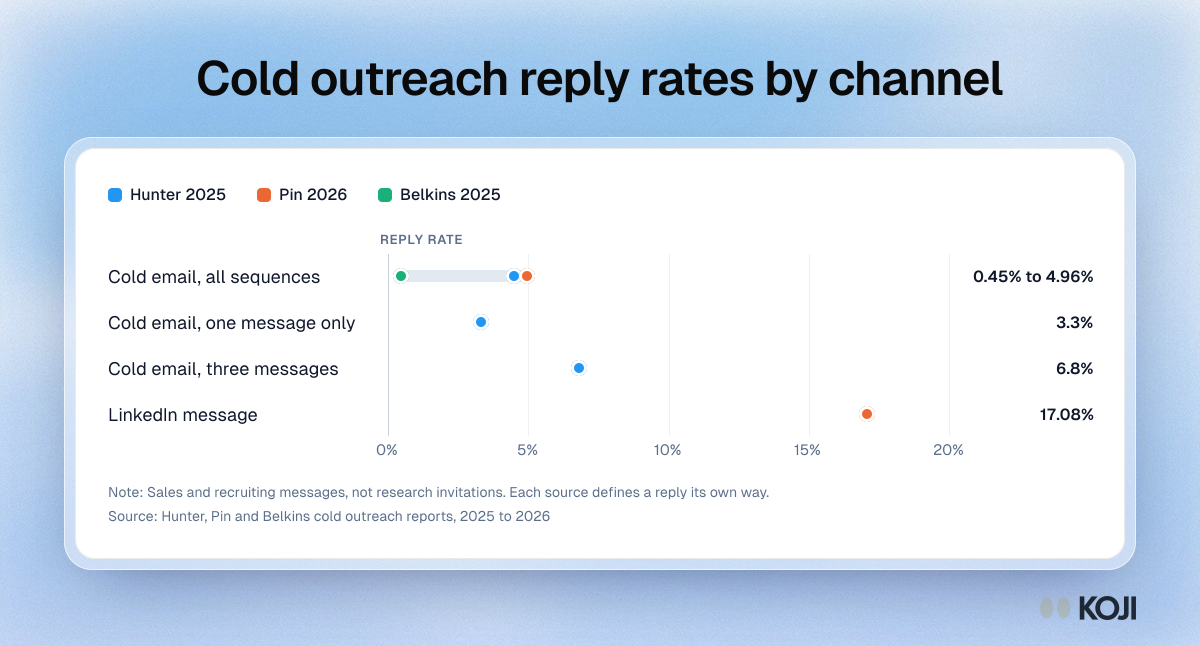
Here is a planning calculation. The assumption is mine, not a published figure: about half of the people who reply end up completing a conversation. To finish 20, you need around 40 replies. At Hunter's 4.5% that is roughly 890 emails. At Pin's LinkedIn rate of 17.08% it is about 235 messages. At Belkins' 0.45% it is close to 8,900. The spread is the point. Cold email alone is a bad plan for a founder with no brand, and three messages beat one by roughly double, so follow up. A message that names the person and says exactly what you want to learn should do better than a generic blast, but check that against your own first 20 sends before you commit to a volume.
Step by step: the first 14 days
The plan below runs for two weeks. It is built around one rule: never send a cold message to a place you have not read first.
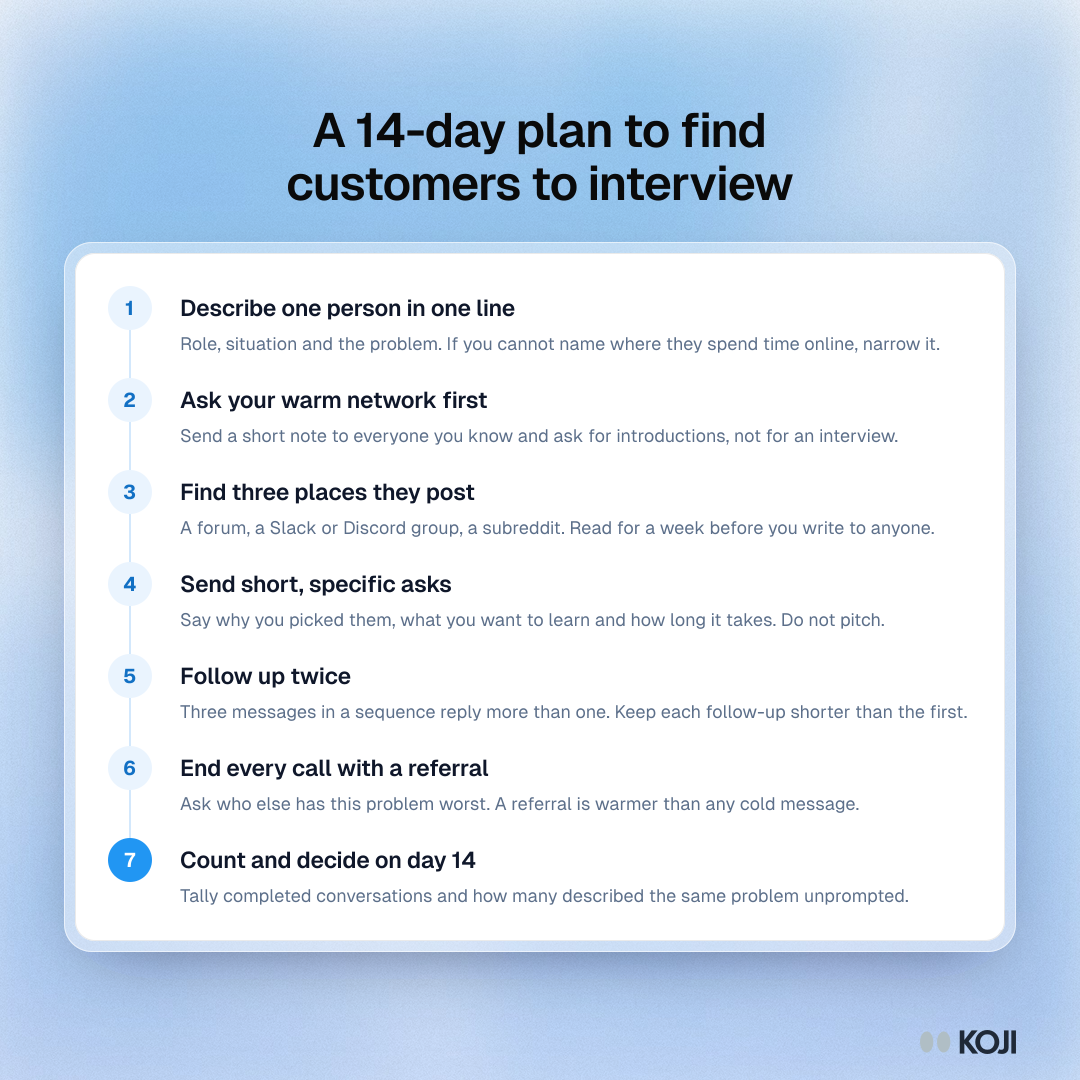
Day 1: describe one person. Write one sentence: their role, their situation and the problem. "Office managers at dental clinics with three to ten staff who still book recalls by phone" is a person. "Healthcare businesses" is not. If you can't say where this person spends time online, the sentence is too wide.
Days 1 to 2: warm network. Message everyone you know with a short note: what you are working on, who you are looking for, and a request for an introduction, not an interview. People say yes to introducing you far more readily than to being interviewed. Do not interview friends about whether your idea is good. They will be kind.
Days 2 to 5: communities. Pick two or three places your person posts: a subreddit, a Slack or Discord group, a LinkedIn group, an industry forum. Read for a few days. Learn how they describe the problem and what they complain about. Then write a post or a direct message that says who you are, what you are trying to understand and how long it takes. Give something back where you can: a summary of what you learn, a skill swap, a small thank-you. Check each community's rules first, since some ban outreach.
Days 4 to 10: direct messages. Send short, specific asks to people who match your sentence. Say why you picked them, in a clause. Say what you want to learn and that you are not selling anything. Ask for 20 minutes, or offer a written conversation they can finish whenever they like. Follow up twice, a few days apart. Our collection of recruitment email templates has wording you can adapt.
Days 5 to 13: run the conversations. End every one by asking who else struggles with this most, and whether they would introduce you. Referrals are your best source after week one.
Day 14: count. How many completed? How many described the same problem without being led? Decide using the rules in the section on reading results below.
What to ask
Keep the first conversation to the past. Ask what happened the last time, not whether they would use something. This is the core of Rob Fitzpatrick's Mom Test approach, summarised in Koji's Mom Test guide. The bank below is designed to be pasted into an interview guide.
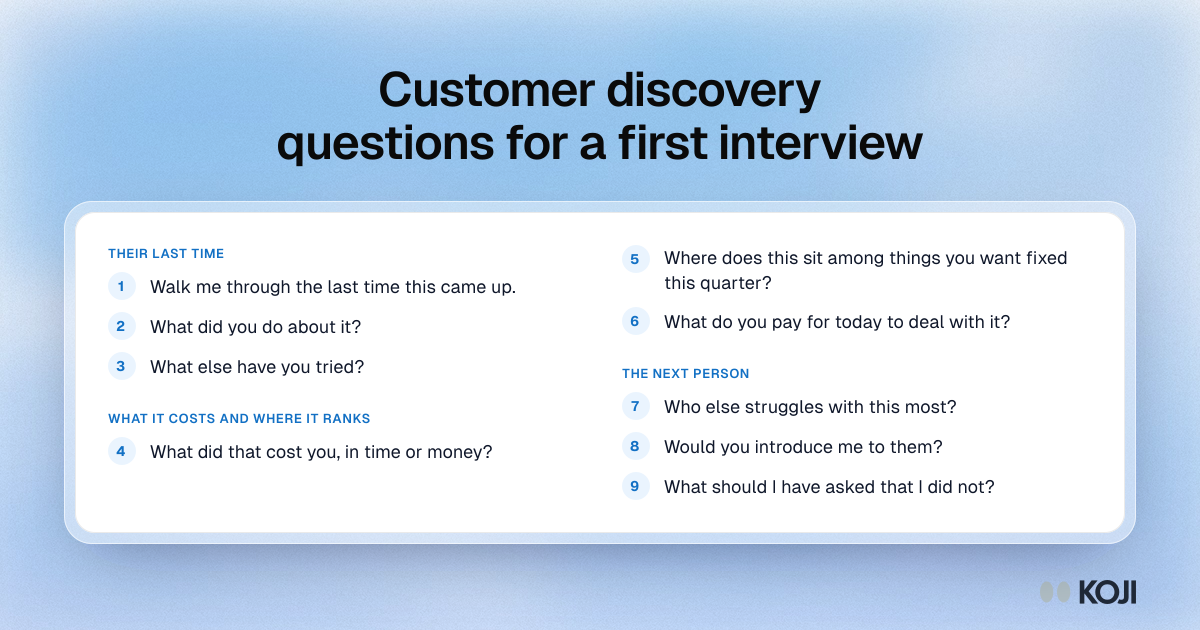
Do not describe your idea until the end, if at all. When you do, ask what they would do next, not what they think.
A worked example
Say you are two people building inventory software for independent coffee roasters. Your sentence is: "Owners of roasteries with one to five staff who sell wholesale and online and track green coffee in a spreadsheet." You message eleven people you know and get two introductions to roasters. Over four days of reading a roasters' Slack group and a subreddit, you spot the same complaint three times: running out of a green coffee lot you thought you had. You post once, asking to hear about the last time that happened. Six people reply. You send 60 direct messages to roastery owners found through their websites, and two follow-ups. Say nine reply and six talk to you.
By day 12 you have 14 conversations. Nine describe a stock-out in the last three months, and five tell you what it cost, in lost orders or a rushed expensive purchase. Three have already tried a paid tool and abandoned it, and two built their own spreadsheet formulas. Four others say inventory is fine but pricing wholesale accounts is the pain. You decide the problem is real for roughly two thirds of the group, you have a competitor to study in the abandoned tools, and the pricing thread is a second research question for the next round. You also now have four warm introductions from the end of calls, which cost you nothing.
Reading the results and deciding
A rule of thumb, not a published threshold: treat the problem as real enough to keep going when most people in one segment describe the same problem unprompted, and at least a few of them have already done something about it. "Done something" means a workaround, a tool they tried, money or hours they spent. Opinions don't count.
- Most describe it and several acted on it: continue. Narrow the segment, then test a concept. Your next question is what to charge, covered in Price your first product with 30 customer conversations.
- Many describe it but nobody acted: the pain may be mild. Ask what else is higher on their list before building.
- The problem is real but for a different person than you thought: change the sentence in step one and run another 10 conversations. That is a good result, not a failure.
- Mixed, no pattern: your segment is probably too wide. Split it by one attribute (size, tool used, how they sell) and compare.
- Fewer than 8 people completed: you don't have a result yet. Change the channel before you change your mind about the idea.
Run it this week with Koji
If you'd rather not schedule 20 calls, Koji runs the conversation for you, in text or voice, on the person's own time. That removes the scheduling step, which is where many yeses stall. It does not find the people. You still decide who to ask, and for the first handful of conversations I'd talk to people yourself, since you learn most from the early ones.
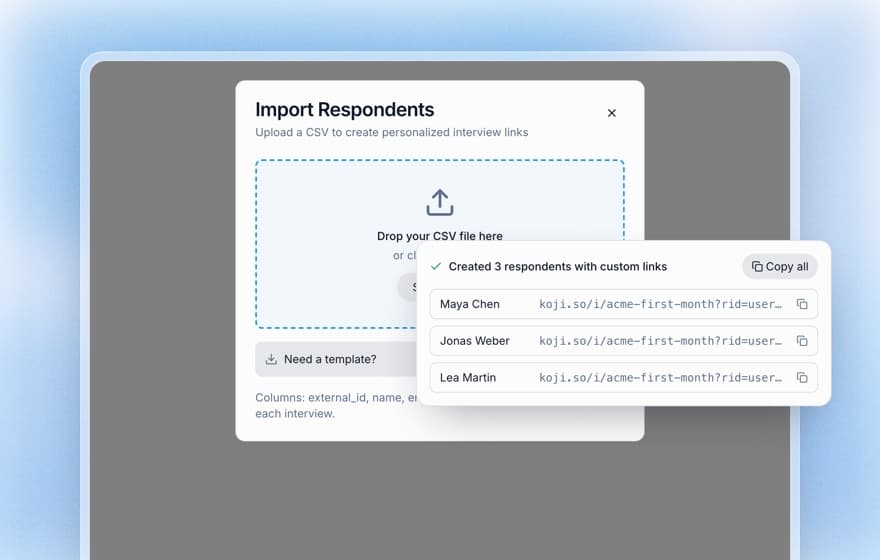
The setup for a founder with no audience:
- Create a study from your question. Describe what you want to learn and the research brief assistant drafts the questions. Paste in the question bank above or edit the draft. Preview the interview yourself before you send anyone to it.
- Add screening questions. Screening questions go in the brief, and you mark which answers qualify. Anyone who doesn't match is turned away before the interview starts, whichever way they arrived. This is how you keep a community post from filling your study with the wrong people. They are available on every plan for studies created since 5 September 2026.
- Pick a route. The shared interview link works on every plan: post it in a community or send it in a message. On the paid plans (Insights, Interviews and Enterprise), the Participants area lets you import a CSV, group people into audiences and email an invitation or reminder from the study's Self-recruit tab. Each person gets their own link, and you can see who received the email, who opened it and who took part. Send a test to yourself first.
- Set a response limit so the study closes at the number you chose, such as 20.
- Say thank you. On the paid plans you can offer an incentive per participant (a gift card, a prepaid Visa card or a charity donation). You approve each reward, with the interview's quality score beside it. See participant incentives for how much to offer.
- Need strangers? Paid plans can recruit from Koji's research panel and target by audience description and screening questions. It costs credits per interview, so use it for a segment you can't reach otherwise, not as your first move.
Read the results in the report: themes, each with the interviews behind it, and the quotes. Count how many interviews describe the problem in their own words before you read any summary. The checks in the previous section still apply.
Common mistakes
- Starting with the cold message. Skipping the reading and warm-intro steps is how you end up at the bottom of the reply-rate range.
- Interviewing friends and family. They want you to succeed. That's a nice quality in a friend and a bad one in a source.
- Pitching in the first message. People reply to curiosity and ignore a sales message.
- A segment that's too wide. "Small businesses" will give you 20 different answers.
- Stopping after one email. Three-message sequences replied at 6.8% against 3.3% for a single message in Hunter's data [3].
- Not asking for referrals. The cheapest next conversation is the one the last person introduces.
When this will mislead you
Interviews measure what people say. What they say is polite. The Mom Test separates compliments from commitments, and the table below is the filter to run your notes through.
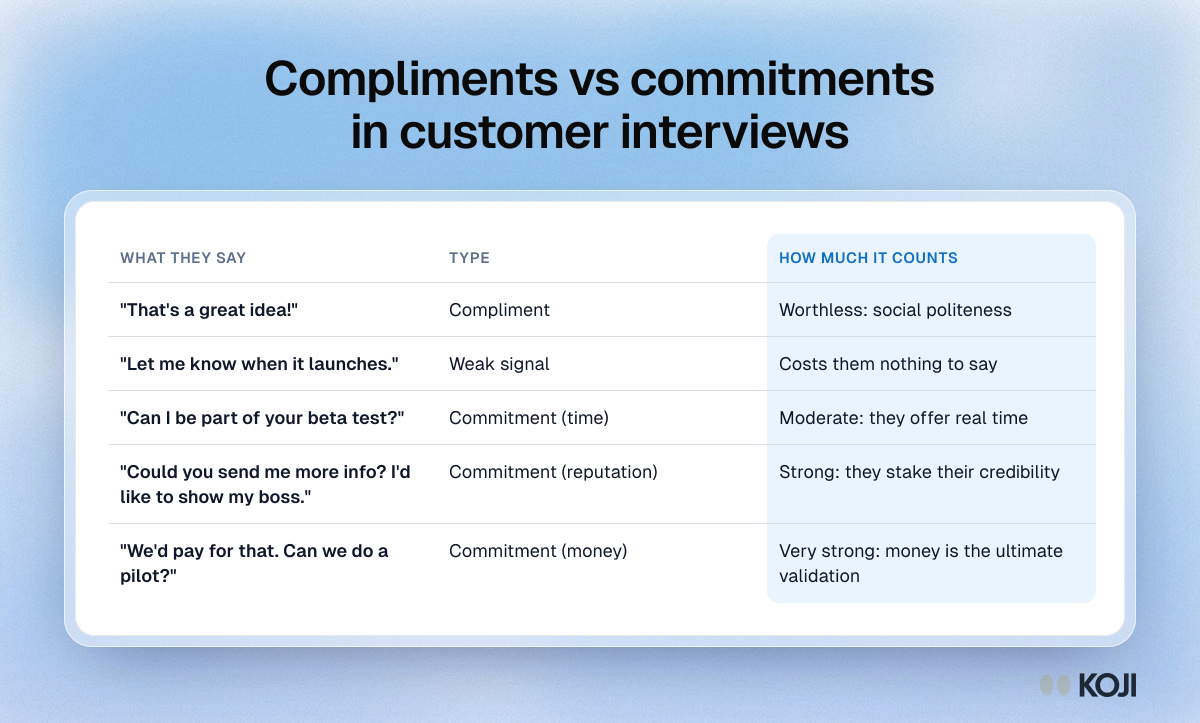
A compliment ("great idea") is worthless. "Let me know when it launches" costs them nothing. Offering to join a beta is a commitment of time, asking for more information to show their boss stakes their reputation, and "we'd pay for that, can we do a pilot?" commits money. Pair the interviews with something a person has to pay for: a pre-order, a deposit, a signed letter of intent or usage of a rough prototype. A small, tightly defined group also tells you little about a different group, so don't assume the roasters speak for every food business. And the people who agree to talk to a stranger are not typical. They tend to be more helpful, more talkative and more interested in the topic than the ones who ignore you.
Where this fits
This is the first step on the idea-stage path in the founder's research playbook, which follows the decisions from "is this problem real?" through pricing and onward. Once you have a segment and a clear problem, the next decision is what to charge: Price your first product with 30 customer conversations. For the full method on running the conversations, read the customer discovery guide. More on how Koji supports founders is on the founders page.
FAQ
How many people do I need to interview as a founder? Around 12 for one tightly defined type of person, which is where Guest, Bunce and Johnson found 92% of codes had already appeared [1]. Plan for 20 so you have a cushion for no-shows and a second segment.
What if nobody replies? Check the segment sentence first, then the channel. If you only used cold email, move to introductions and communities. Reply rates for cold email ranged from 0.45% to 4.96% across three large datasets [3][4][5], so a low rate on your first 50 messages is normal, not a verdict on the idea.
Should I pay people to talk to me? Not at the start, with people who care about the problem and you reaching them personally. A small thank-you is polite and may help with strangers or busy professionals. For panel recruits an incentive is part of the cost. Research participant incentives has ranges.
Can I interview friends and family? Use them for introductions and to rehearse your questions. Don't count their opinions as evidence about your market.
Can an AI interview my customers instead? An AI interviewer can run the conversation with people you have found, in text or voice, and ask follow-ups. It doesn't remove the need to decide who to ask. For your first handful, talk to people yourself.
Your next step
Write your one-sentence description of the person today, then message five people you know and ask who they would introduce you to. Set up the study in Koji while you wait for answers, so the first person who says yes has somewhere to go.
References
- Greg Guest, Arwen Bunce and Laura Johnson, "How Many Interviews Are Enough? An Experiment with Data Saturation and Variability," Field Methods 18(1), 2006, pp. 59-82. doi.org/10.1177/1525822X05279903
- Monique Hennink and Bonnie Kaiser, "Sample sizes for saturation in qualitative research: A systematic review of empirical tests," Social Science and Medicine 292, 2022. pubmed.ncbi.nlm.nih.gov/34785096
- Hunter, "The State of Cold Email," Hunter, 2025 (31 million emails sent in 2025). hunter.io/the-state-of-cold-email
- Pin, "Recruiting Outreach Benchmarks 2026: The Full Data Report," Pin, 2026. pin.com/blog/recruiting-outreach-benchmark-report
- Belkins, "Cold Email Response Rates," Belkins, 2025 (7.5 million B2B emails). belkins.io/blog/cold-email-response-rates
- Arnaldo Camuffo, Alessandro Cordova, Alfonso Gambardella and Chiara Spina, "A scientific approach to entrepreneurial decision-making: Large-scale replication and extension," Strategic Management Journal 45(6), 2024, pp. 1209-1237. repositorio.ie.edu
- "How do you actually get people to do customer discovery interviews?", Indie Hackers community thread, 2026. indiehackers.com
Further reading
- The Mom Test guide: the interview rules behind the question bank, and how to tell a commitment from a compliment.
- How many interviews are enough?: when 12 is plenty and when you need more.
- How to find early adopters: the build-first route to your first conversations.
- Recruitment email templates: wording for the first message and the follow-ups.