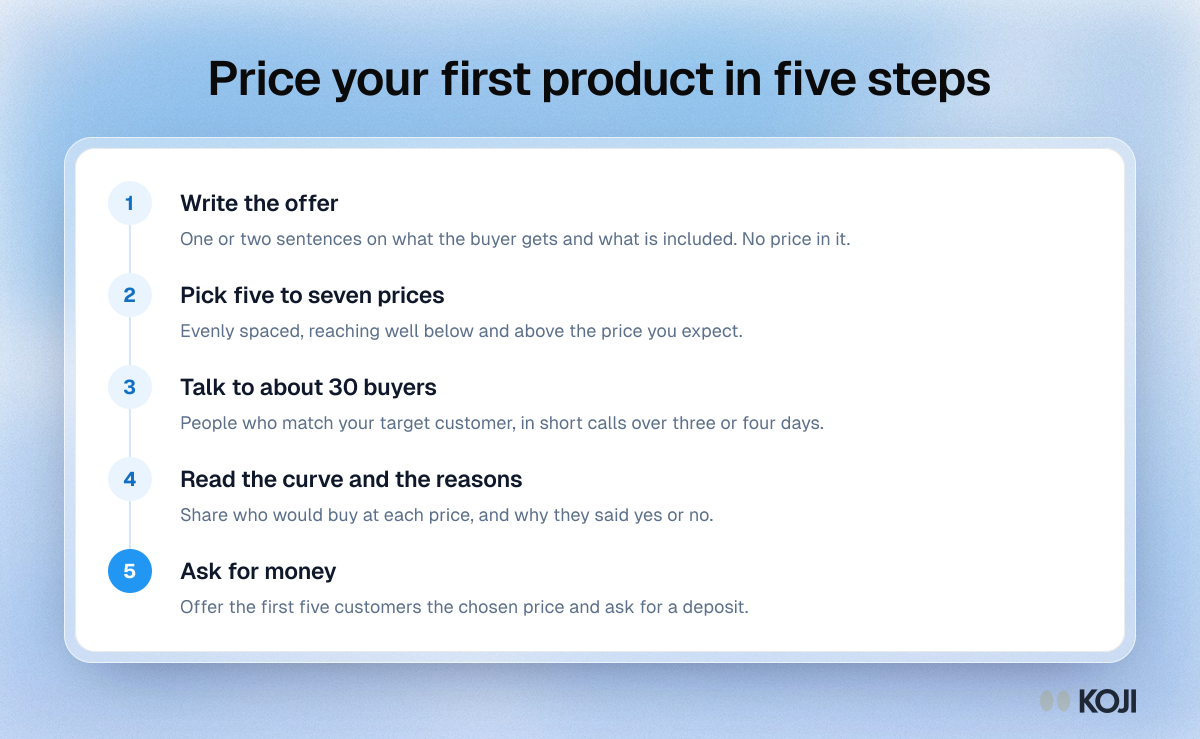
You have a product people use, maybe a handful of customers, and no idea what to charge. The short answer: talk to about 30 of the people you want as customers, show each one what the price buys, test five to seven prices, and read the reasons behind every answer. That gives you a directional price curve and a shortlist of two prices to try with real money. By the end of this guide you can run the whole thing this week.
When you need this
You are in one of these moments:
- You are launching and the price field is empty, so you copied a competitor.
- You gave early customers a discount "for now" and now have to say what "later" means.
- A big prospect asked for a quote and you made a number up on the call.
- Your price has not changed since day one and you suspect it is too low.
Guessing is expensive in both directions. Price too low and you attract people who churn at the first bump while you starve the business. Price too high and you never hear why people left, because they never signed up. Software prices also move more than founders expect: PricingSaaS counted more than 1,800 pricing and packaging changes across about 500 SaaS and AI companies in 2025, roughly 3.6 per company [1]. Nobody gets it right once and leaves it. The aim is a defensible first number and a habit of checking it.
Founders who treat their strategy as a set of hypotheses to test tend to do better. In a randomised trial of 116 Italian startups, the ones trained to form and test hypotheses performed better than those who got only general training [2], and a later set of four trials covering 759 firms found a similar pattern [3]. Pricing is one of the easiest places to apply that.
The method in brief
There are four honest ways to find a price this early. They answer different questions.
- Founder-led conversations. The Mom Test way: ask about their current spend, the cost of the problem and who signs off. Cheap and rich, but people are polite about prices you say out loud.
- A price test (Gabor-Granger). Each person says how likely they are to buy at one price at a time, and you get the share who would buy at each price. How the method works.
- Price ranges (Van Westendorp). Four questions about too cheap, cheap, expensive and too expensive. Good for finding the acceptable range when you have no price at all. How it works. The two methods are compared in Gabor-Granger vs Van Westendorp.
- Real money. A deposit, a pre-order, a paid pilot. The only method that measures what people do.
Use the first two together. Conversations tell you why, the price test tells you how much, and real money tells you whether either was true.
Step by step: find 30 people and ask
Who. Thirty people who match the customer you want, not thirty people who are easy to reach. If you serve two different buyers, such as owners and office managers, decide which one pays and talk to that one. Qualitative work reaches diminishing returns faster than most founders fear: in a well-known study of 30 interviews with a fairly similar group, 100 of the 109 themes had already appeared by the 12th interview [4]. A price curve is different, because you are counting people, and that is why the floor is nearer 30 than 12.

Photo by KOBU Agency on Unsplash
Where to find them with no audience. Email your own users and waitlist first; they are the warmest. Then ask each person you speak to for two introductions. Post in the communities where your buyers already talk, and say plainly that you are researching, not selling. A small thank-you, such as a gift card, shows you value their 15 minutes.
What to ask. Keep it under 15 minutes. Start with their world before you show anything.
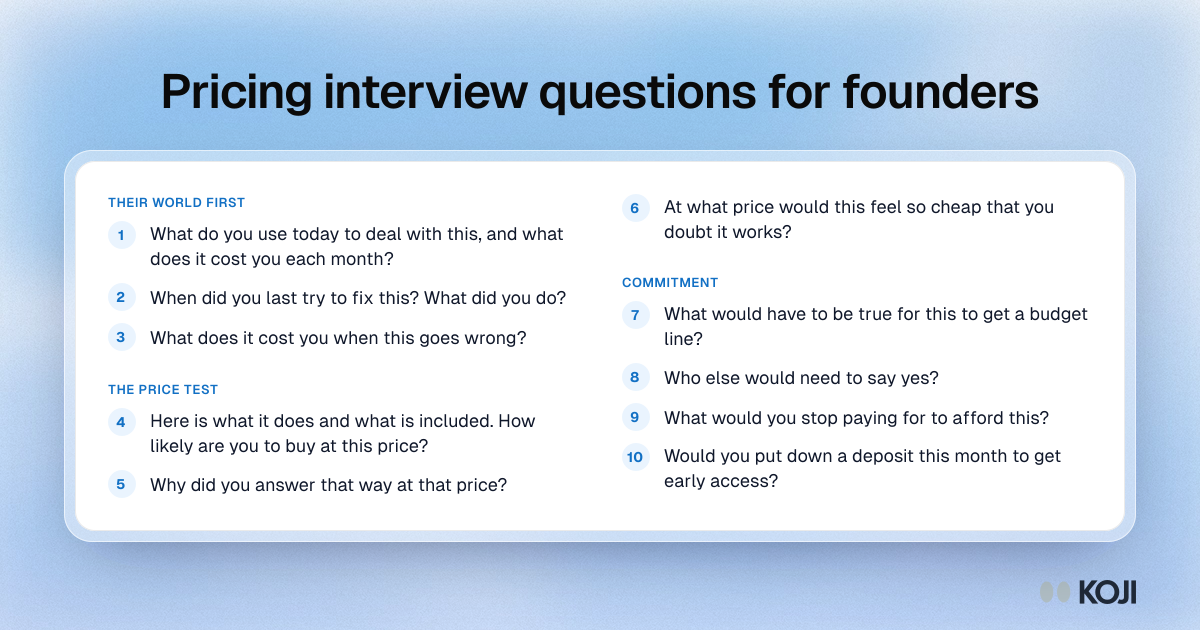
How to run it. Describe what the price buys in a sentence or two, with no number in it. Then show the prices one at a time, never a menu, because a menu invites people to pick the middle. Start different people at different prices so no one is anchored on the cheapest. After each answer, ask why.
How long it takes. A week is realistic: two days to write the offer and pick prices, three to four days of conversations, one day to read.
A worked example
Say you are a two-person team selling scheduling software to dental clinics. Your guess is somewhere between $29 and $199 a month. You pick seven prices: $29, $49, $69, $89, $119, $149 and $199 per month.
You email 60 clinic managers from your waitlist and the people you have met at events, and 31 take a 12-minute call. The numbers below are made up to show you how to read a result, not data from a real study.
You ask what they use now. Most use a shared calendar and a receptionist, and say no-shows cost them a few hundred dollars a week. That is the anchor: against a few hundred dollars of lost chair time, $89 is small.
Then the price test. The share who would buy at each price might look like this:
| Price per month | Would buy | Revenue per person asked |
|---|---|---|
| $29 | 90% | $26 |
| $49 | 81% | $40 |
| $69 | 65% | $45 |
| $89 | 48% | $43 |
| $119 | 26% | $31 |
| $149 | 13% | $19 |
| $199 | 6% | $12 |
Revenue per person asked is just the price times the share. The peak is $69, and $89 is within a few percent of it. The reasons separate the two: people who stop at $69 say "I would need to see it save a no-show first", and people who go to $89 are the ones with several chairs. So the decision is not "$69". It is "$69 for a single-chair clinic, and test $89 for multi-chair practices with a real payment".
Notice what the example does not say: that 48% of clinics will pay $89. It says that, among people who said so out loud, the drop-off is steepest between $69 and $119.
Reading the results and deciding
Treat the curve as an upper bound. A meta-analysis of 77 studies found that people state a willingness to pay about 21% higher, on average, than they pay when it is real [5]. Use these rules:
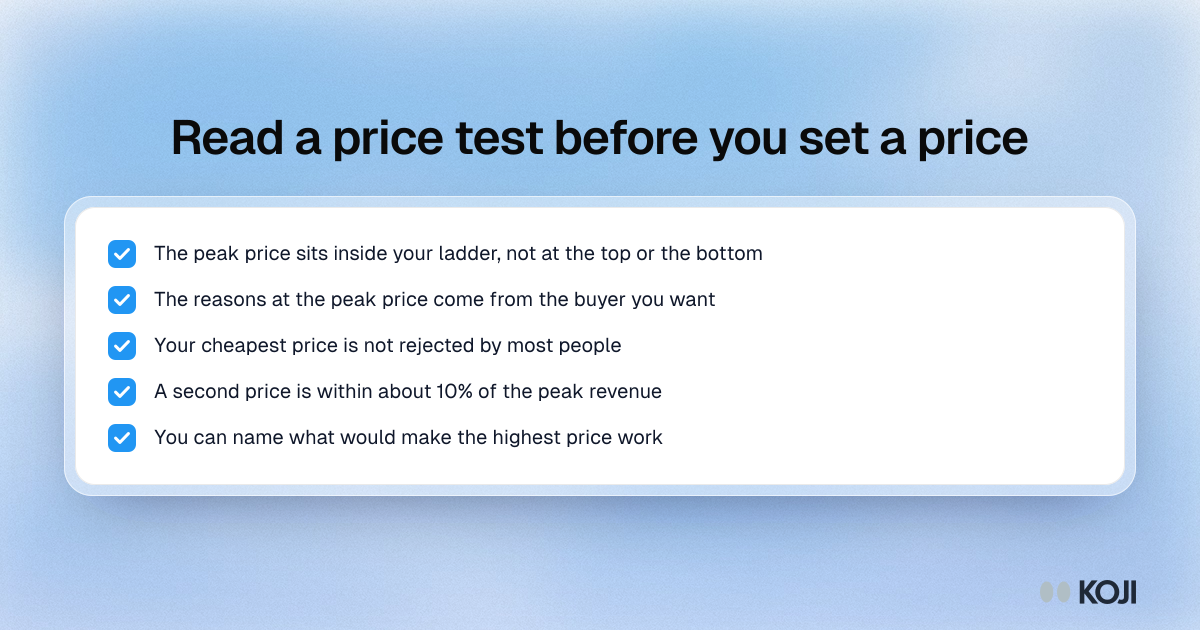
- The peak price sits inside your ladder, not at the top or the bottom.
- The reasons at the peak price come from the buyer you want, not from tire-kickers.
- Your cheapest price is not rejected by most people.
- You have a second price within about 10% of the peak revenue to test against it.
- You can name what would make the most expensive price work.
What to do next, by outcome:
- Peak in the middle, reasons clear. Pick it, or the next price down if you want volume. Then ask the first five customers for money at that price.
- Peak at the top of the ladder. The ladder stopped too low. Add higher prices and run another 10 to 15 conversations.
- Most people reject even the cheapest price. This is rarely a pricing problem. They do not see the value, so go back to the problem and the offer.
- Two peaks with different reasons. You have two customers. Price them separately, or pick one.
Run it this week with Koji
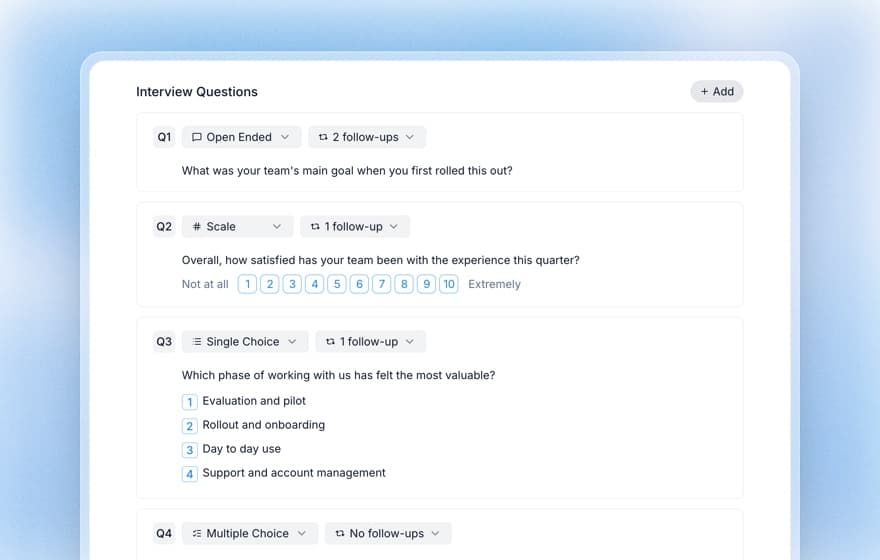
You can do all of the above by hand with a spreadsheet and a calendar. Koji removes the scheduling, the walk up and down the prices and the maths. The price test is a question type you can set up yourself from a free account, next to every other kind of question.
- Start a study and describe the goal ("what should we charge for our scheduling software?"). The research assistant can build the study, or you can add questions yourself.
- Add a Price Test question. The question text names the product and what the price buys, not a price. Enter 3 to 10 prices (five to seven, evenly spaced, works best), the currency, and a unit such as "per month".
- Choose what counts as buying. The default is "Probably would buy" or higher.
- Put the context questions around it: current spend, the cost of the problem, who signs off, then the price test.
- Share the link with your own users by email or a personal link, or recruit from a panel.
- Read the report. It shows the share who would buy at each price, the revenue each implies and the price that earns the most, with the quotes behind every point.
Each person starts at a random price in the middle of your list, and Koji moves up or down until it finds the highest price they would still buy at, usually in about three steps. Then it asks why, in their words. The test works in text and voice interviews, but not on phone calls, and prices are locked once responses come in, so check them first.
The report is labelled directional on purpose: people overstate what they would buy, and the best price is always one of the prices you tested. It reads best from about 30 interviews. If you have a concept or landing page to show, you can attach an image to the question first, and you can download the finished report as slides or a PDF to take to your co-founder or investors.
Common mistakes
- Asking "what would you pay?" People anchor on round numbers and lowball. Show prices instead.
- Testing a feature list, not a price for something. Describe the outcome and what is included.
- Asking friends. They want to be nice.
- Reading the curve as a forecast. It is a ceiling.
- Ignoring the reasons. Two identical curves can come from opposite reasons.
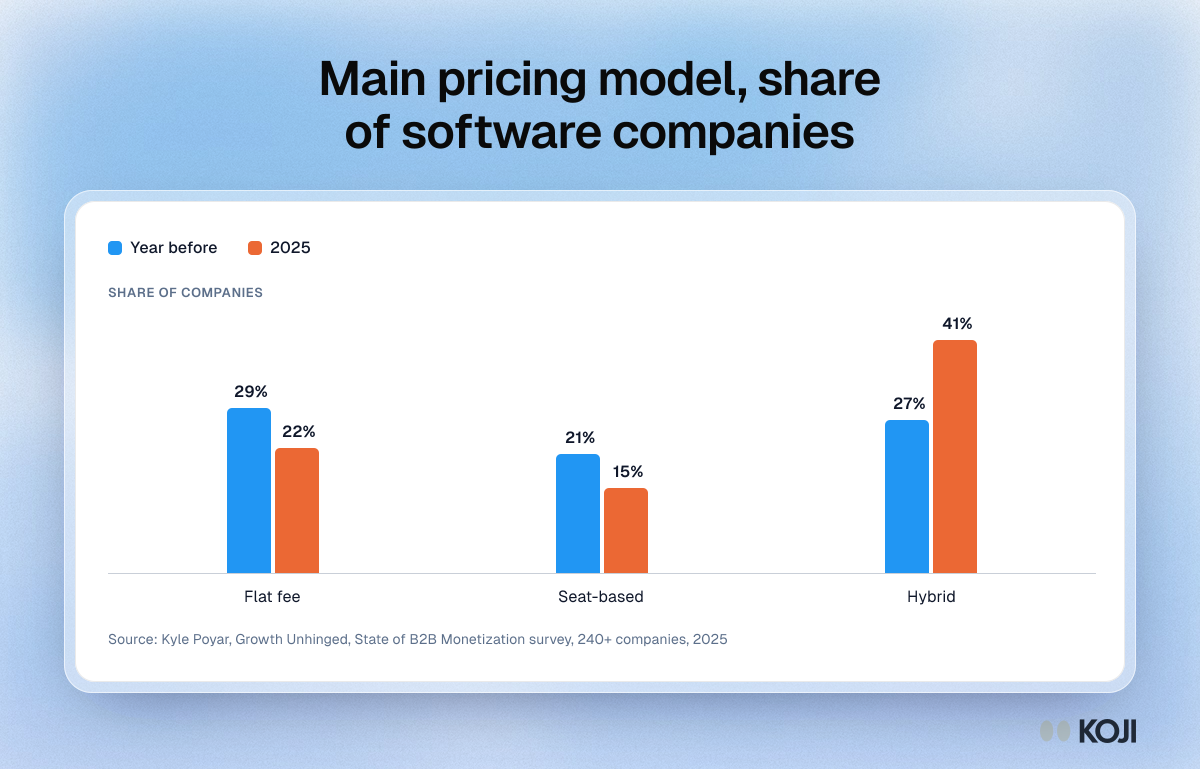
- Setting a price once. Revisit it. Pricing models are shifting fast: in a survey of more than 240 software companies, hybrid pricing rose from 27% to 41% as the main model in a year, while seat-based fell from 21% to 15% [6].
When research will mislead you
Interviews and price tests measure what people say. Three things bend it:
- Stated prices run about a fifth high [5], and more for expensive or specialist products.
- Thirty people is a directional sample. Survey guidance, such as SurveyMonkey's, asks for at least 100 completes per segment you want to analyse separately [7]. If you need to compare two customer groups, 30 will not settle it.
- Politeness and context. Someone who says "probably would buy" has not opened a budget line.
So pair the test with a commitment: a deposit, a pre-order, a signed letter of intent or a paid pilot. If five of the ten people who said yes at your chosen price will not put down a deposit, the curve was too kind.
Where this fits
Pricing comes after you know who the customer is and before you scale acquisition. Before it, find your ideal customer. After it, test whether you have fit and why people leave. The whole sequence is in the founder's research playbook, and Koji for founders shows how founders run it. Related reading: Pricing research without the consultant, Pricing survey questions and Why "price" is never the real reason customers churn.
FAQ
How many customers do I need to talk to before I set a price? About 30 people from the group you want to sell to gives a directional curve. For firm numbers or to compare segments, aim for 100 or more per segment.
Should I ask "how much would you pay?" No. People anchor on round numbers and round down. Show a series of specific prices and ask how likely they are to buy at each.
Is Gabor-Granger or Van Westendorp better for a first price? Gabor-Granger gives a demand curve at prices you pick. Van Westendorp finds the acceptable range when you have no idea where to start. If you can name a range, use Gabor-Granger.
Can I trust what people say they would pay? Only partly. A meta-analysis found stated willingness to pay about 21% above real payment on average [5]. Confirm with a deposit or a paid pilot.
What if my customers are on the other side of the world? You can interview in many languages and set the currency on the price question, so test the prices in the currency they would pay in.
Next step: write your one-line offer and seven prices, then start a free study and run 30 conversations this week.
References
- Kyle Poyar, "The good, bad and ugly of SaaS pricing changes" (analysis of PricingSaaS tracking of 2025 pricing and packaging changes), Growth Unhinged. growthunhinged.com
- Camuffo, Cordova, Gambardella and Spina, "A Scientific Approach to Entrepreneurial Decision Making: Evidence from a Randomized Control Trial", Management Science, 2020. City Research Online
- Camuffo et al., "A scientific approach to entrepreneurial decision-making: Large-scale replication and extension", Strategic Management Journal, 2024. IE repository
- Guest, Bunce and Johnson, "How Many Interviews Are Enough? An Experiment with Data Saturation and Variability", Field Methods 18(1), 2006. ALNAP library
- Schmidt and Bijmolt, "Accurately measuring willingness to pay for consumer goods: a meta-analysis of the hypothetical bias", Journal of the Academy of Marketing Science 48(3), 2020. marketingcenter.de
- Kyle Poyar, "The state of B2B monetization in 2025", Growth Unhinged, 2025. growthunhinged.com
- SurveyMonkey, "The Gabor-Granger method: how to build the survey and calculate the demand curve". surveymonkey.com
Further reading
- Gabor-Granger pricing method: the method behind the price test, with the maths.
- Van Westendorp price sensitivity meter: for finding a range when you have no starting number.
- The Mom Test: how to ask about money without being flattered.
- Dear SaaStr: How do I price my SaaS product in the early days, before product-market fit?: a founder-facing take on the same question.