You are selling to bigger companies now, and some deals you expected to win are going to someone else. Your CRM says "price" or "no decision". The short answer: ask the buyers, within a few weeks of the decision, about how they decided rather than about your product, and stop treating the CRM reason as the reason. By the end of this page you can pull your lost and won deals, invite the right people, run about a dozen conversations in two weeks, and read them against a clear rule for when a pattern is real.
This is the decision playbook. Koji already has the method pages: win-loss analysis and the question list. Here we deal with the situation founders actually face: a handful of big deals, a buying group instead of one person, and nobody whose job is research.
When you need this
You are probably here because of one of these:
- Win rate dropped after you started selling to larger accounts, and the team disagrees about why.
- Sales says "they chose a cheaper tool". Product says "they wanted a feature". Nobody has heard it from the buyer.
- You are about to change pricing, packaging or positioning for the next segment, and you only have your own deal notes.
- A board member asked why you lost the last three enterprise deals.
The cost of guessing is concrete. If you build the feature the rep named and the real reason was that the buying group never agreed, you spend a quarter on the wrong thing. That is not rare. One analysis of 10,247 post-decision buyer interviews, run by the vendor User Intuition between January 2024 and December 2025, found price cited in 62.3% of lost deals but named as the primary driver in only 18.1% [1]. It is a vendor study with its own coding, so read it as a strong hint rather than a law. It matches what most founders find in their first round: the stated reason and the deciding reason are different things.
The method in brief
For this decision the right method is short interviews with the buyers themselves, not a survey and not a CRM field. Surveys give you a pick-list answer ("price"), and a pick-list is exactly what hides the story. Interviews let you follow the timeline: what started the search, who got involved, what nearly changed their mind.
Two features of bigger deals change how you run it.
Buyers decide as a group, and they often disagree. Gartner's 2025 survey of 632 B2B buyers found that 74% of buying teams showed unhealthy conflict during the decision, and that teams that reached consensus were 2.5 times more likely to describe the deal as high quality [2]. So one champion's view of why you lost is one view. Where you can, speak to two people per deal.
Many buyers have formed a view before they talk to you. Gartner's 2026 survey of roughly 650 buyers found 67% prefer a rep-free experience for at least part of the purchase [3]. Some of your losses happened before your first call, which is why the first section of the interview is about how they looked, not about your demo.
If you want the underlying method choice, the three realistic options sit like this: interviews with lost and won buyers (best for "why"), a short structured question to add a count (best for "how many"), and your own deal data (best for "where in the funnel"). Use the first two together and the third as a check. For multi-person buyers, the buying committee interviews guide goes deeper.
Step by step
1. Pull the list (day 1)
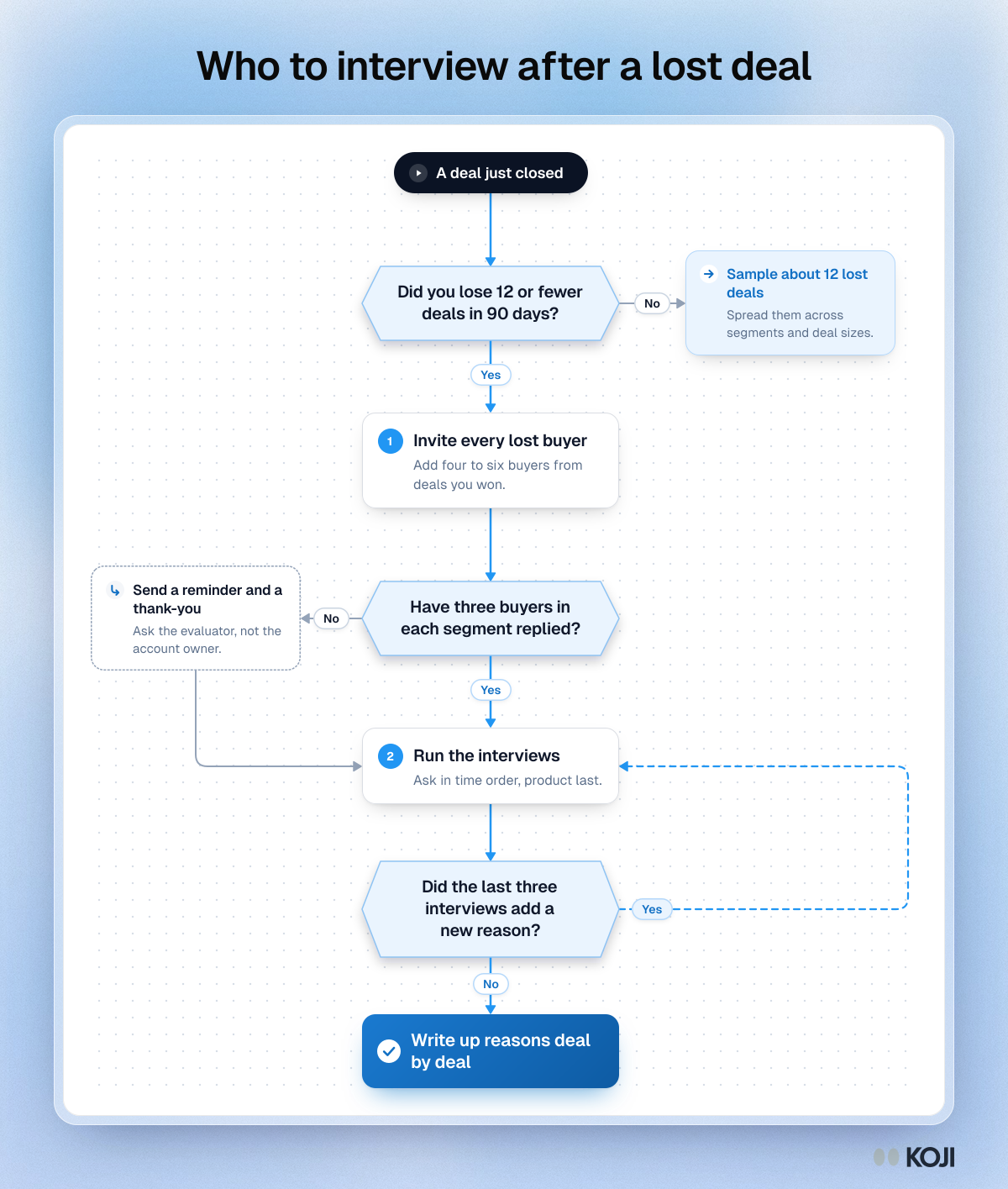
Take every closed deal from the last 90 days in the segment you are asking about: lost, won, and "no decision". Write down for each: deal size, segment, who the contact was, the date it closed, and the reason your team recorded. Do not read the recorded reason again until you have heard from buyers. It will anchor you.
If you closed fewer than about a dozen lost deals, plan to ask all of them. If you have more, sample across segments and deal sizes so one big account type does not fill the list.
2. Decide how many (day 1)
Research on interview saturation gives a useful floor. Guest, Bunce and Johnson reported that in their 60 interviews, saturation arrived within the first twelve [4]. A later systematic review by Hennink and Kaiser, covering empirical tests of saturation, found studies converge on a fairly consistent size for narrow questions and fairly similar participants [5]. The practical reading: about twelve conversations answers a narrow question about one kind of buyer. It does not cover three different segments at once.
My rule for this job:
- Aim for 8 to 12 lost-deal buyers, 4 to 6 won-deal buyers, and 2 or 3 "no decision" buyers if you have them.
- Wait for at least three replies in each segment before reading anything into a pattern.
- Stop when the last three interviews add no new reason.
3. Ask the right person, in the right way (days 1 to 3)
The seller should not ask. Buyers soften what they say to a rep who might call back. Have a founder who was not on the deal, a PM, or an interviewer that is not your salesperson send the invite.
Keep the invite short and honest: you lost or won a deal, you are not trying to sell again, it is fifteen minutes, and you will share what you change. Offer a small thank-you where company policy allows it. Ask for the person who evaluated, and, if the champion is willing, for one colleague who was more doubtful. That second person is where the disagreement lives.
Interview within about two to six weeks of the decision. This is practitioner advice, not a studied cut-off: the later you wait, the more the story becomes tidy.
4. Ask about the decision, not the product (weeks 1 to 2)
Ask in time order. Start with what was happening before they looked, move to who was involved and what they considered, then ask what nearly changed their minds. Product feedback comes last.
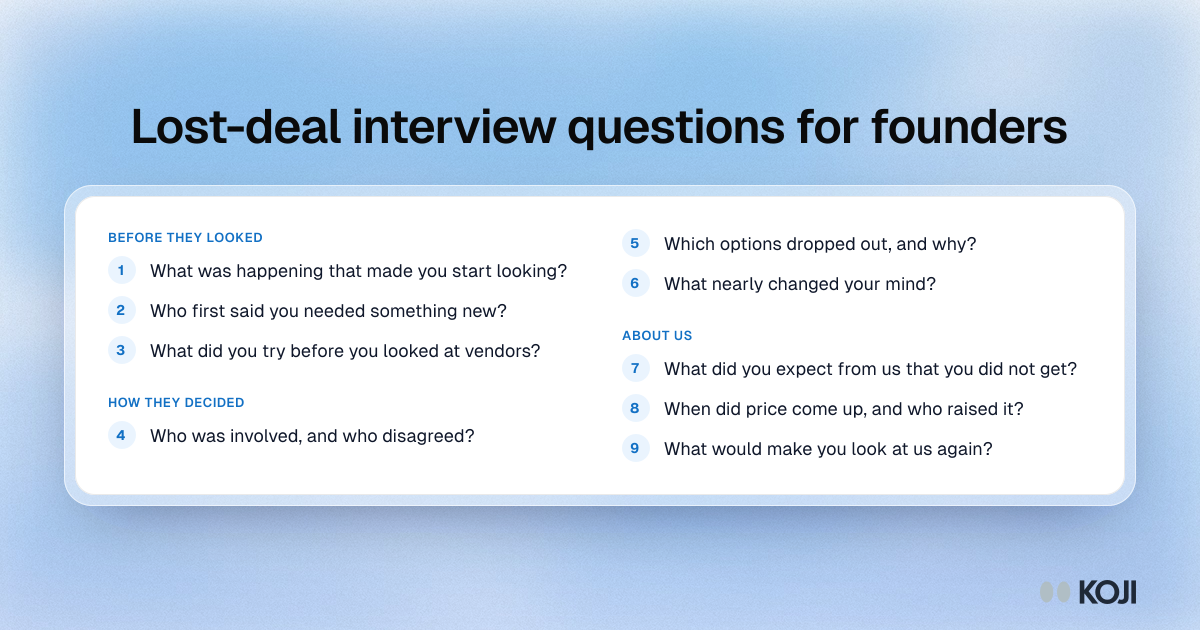
Three habits help. Ask for a specific moment ("walk me through the day you decided"). When they say "price", ask what they compared it to, and who raised it. And ask what nearly changed their mind: it surfaces the case you almost won.
A worked example
Say you are a four-person company selling scheduling software. You used to sell to single dental clinics, and in the last quarter you started pitching clinic groups of ten to thirty sites. Your CRM shows eleven lost group deals in 90 days. Seven are marked "price", three "missing feature", one "no decision".
You invite all eleven buyers and four people from groups you won. Nine lost buyers and three won buyers say yes. You run twelve conversations in ten days.
What you hear: in seven of the nine lost deals, the person who talked to you liked the product. Their finance or operations lead then asked how you handled consolidated reporting across sites, and nobody could answer it on the spot. Two of those buyers describe price coming up only after that question stalled things. One says outright, "We would have paid more if I had a one-page answer for my finance director." Two lost buyers did leave over cost. Both were single-owner groups under ten sites.
What you decide: price is a real reason for a small group, but the main pattern is a missing answer for the second buyer. You write one page for the finance lead and add a consolidated reporting view to the next quarter, and you stop discounting. You also route sub-ten-site groups to the plan you already have. All of that came from twelve conversations and no price change.
Reading the results and deciding
Code each conversation by deal, not by quote. For every deal write: the trigger, who was involved, the one or two things that decided it, and the "nearly changed my mind" moment. Then count.
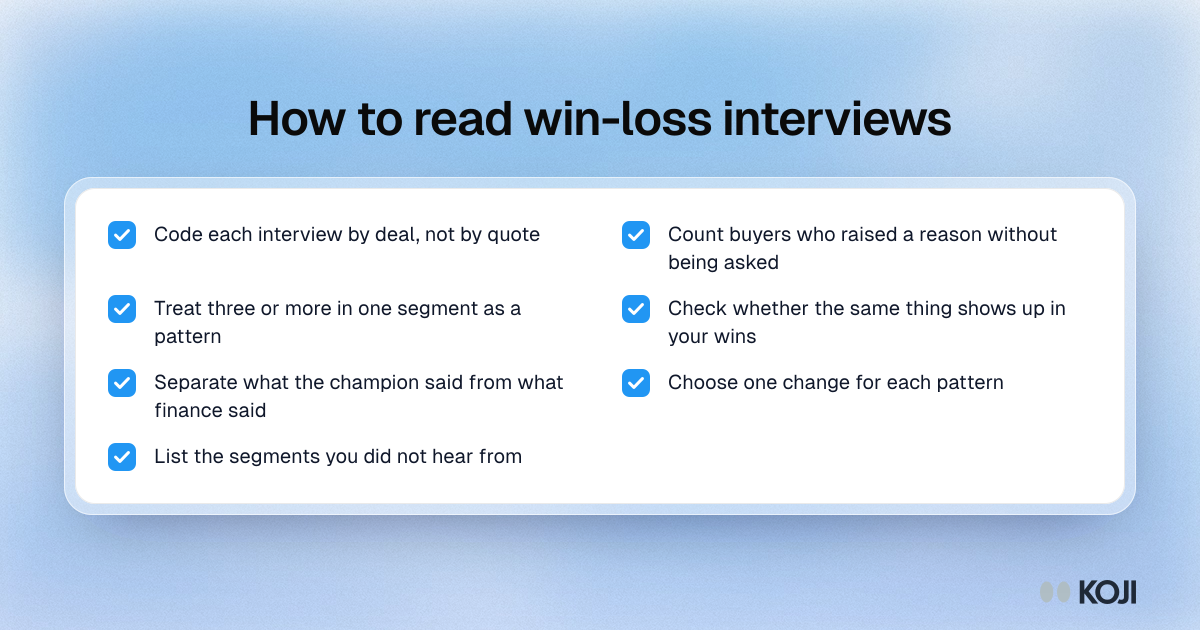
My decision rules:
- A pattern is three or more buyers in a segment who raise it without being asked. One buyer is a story.
- Check the wins. If the reason you lose is also what the winners praised in the competitor, you have a real gap. If winners did not care about it, it is noise.
- Separate who said it. A rep-style champion saying "price" and a finance lead saying "I could not defend this" are different findings.
- Act on one thing per pattern. A fix, a message change, or a segment you stop chasing.
- Say what you do not know. Name the segments you did not hear from.
If the main reason is a missing answer or a message gap, fix that first, because it is cheap. If it is a real feature gap, add it to your roadmap with the number of deals behind it. If it is price in a segment, test price before you cut it: see how to test a published price.
Run it this week with Koji
You can do all of this by hand with a calendar and a spreadsheet, and for a first round of six interviews that is a fine choice. Koji helps when you want a dozen conversations in the same week without anyone scheduling.
- Make the study. Describe the goal to the research brief assistant ("why we lose and win group deals") and paste the question bank above. Add one single-choice question near the end: "Which of these mattered most in your decision?", with your own list of options, followed by an open "Why?". That gives you a count and the reasons behind it.
- Choose voice or text. Buyers can answer by voice or text, in their own time. A 15-minute window suits most busy buyers better than a diary slot.
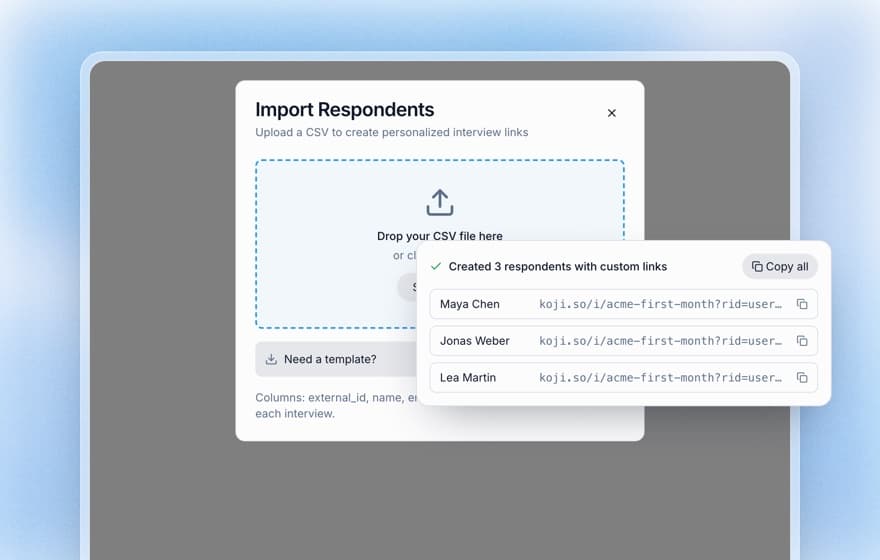
- Invite by name. Import your list of lost and won buyers from a CSV. Each person gets their own interview link, and you can email the audience from Koji with reminders after two, three, five or seven days. You see who got the email, who opened it and who finished. Importing contacts needs the Interviews or Enterprise plan.
- Thank them. You can set an incentive for completed interviews (a gift card, a prepaid Visa or a donation) and approve each one after you see the interview quality.
- Protect names. A per-study setting takes names, emails, phone numbers and employers out of transcripts when interviews finish, so a report can circulate more widely. It can miss details, so check before you share.
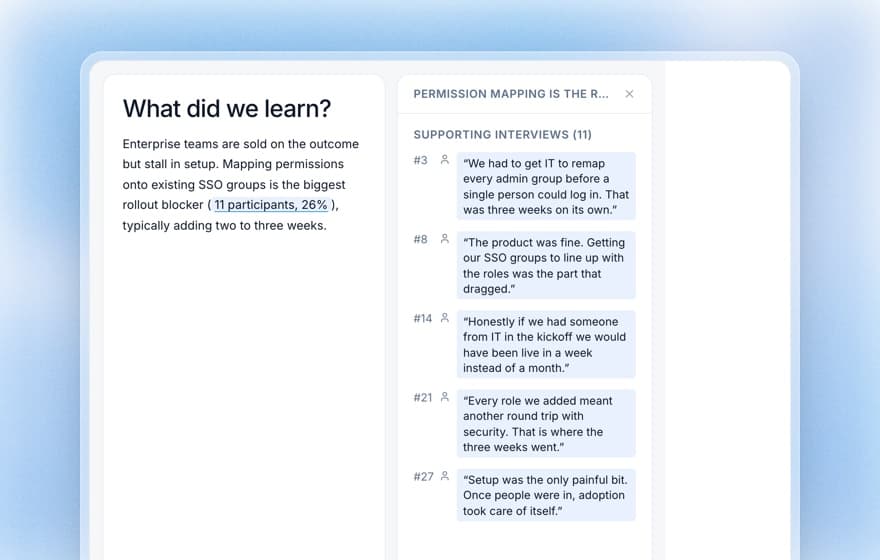
- Read the report. Koji groups themes and shows the quotes behind each claim, so you can open a finding and see which buyers said it. Check this against your own coding of deals rather than taking it whole.
- Share it. Download the report as slides or a PDF for the sales and product meeting or the board. For how to cut it down to a short readout, see a 7-slide customer research readout.
Two honest notes. First, an AI interviewer is not the same as a human with a long relationship. Some buyers speak more freely to someone who is not selling to them, but for your three biggest accounts you may want to call yourself. Second, Koji will not fix a small list: if you lost four deals, call all four.
Common mistakes
- Having the salesperson ask. The answers change.
- Starting with the product. You get a feature list instead of a decision.
- Talking only to the champion.
- Only talking to losses, so you cannot tell what is a real gap and what is just what everyone dislikes.
- Reading the CRM reason first.
- Treating a stated price as the price. People tend to state higher prices than they pay: a meta-analysis by Schmidt and Bijmolt found stated willingness to pay about 21% above real [6].
- Changing three things at once, so you cannot tell what worked.
When research will mislead you
Buyers rationalise after the fact, and a polite person will give a reason that closes the call. Interviews cannot tell you how many deals you lose for each reason: that needs your deal data. A dozen buyers of one kind tell you nothing about another. The buyer who answers is often the one who liked you; the angriest do not reply. So pair interviews with real signals: stage-by-stage drop-off in your CRM, trial or demo usage, and what happens when you try the fix on the next five deals.
Where this fits
Before this, decide what you charge as you move up: Contact us or a published price. If your buyers are small and leave later rather than not buying, see the churn interviews angle. The full path for this stage is in the founder's research playbook, and there is more for founders. If you want the intro to enterprise-style pilots, read enterprise pilot user interviews.
FAQ
How many lost deals do I need to interview? About 8 to 12 lost buyers for one segment, plus a few won ones. Twelve is a floor from saturation research for a narrow question, not a guarantee. If you lost fewer, ask all of them.
Will buyers who chose a competitor actually talk? Some will. Expect a minority to reply to a first invite, so plan for reminders and a small thank-you. Do not have the account owner ask.
Is price really never the reason? It sometimes is. The point of the vendor study cited above is that price is often named without being the deciding factor. Ask what they compared it to and who raised it.
Can I do this without a tool? Yes. A spreadsheet, a short script and calendar slots work. A tool helps with volume, reminders and reading dozens of transcripts.
When should I hire someone to run this? When you run these every month and nobody owns them.
What do I do with one loud reason from one buyer? Write it down and watch for a second. One buyer is a story, three independent mentions are a pattern.
Your next step: pull the last 90 days of closed deals today and invite the first five buyers by Friday.
References
- User Intuition. "Why price is almost never the real reason you lost the deal: evidence from 10,000 AI-moderated win-loss conversations." User Intuition blog, 2026 (interviews January 2024 to December 2025). https://www.userintuition.ai/posts/why-price-is-almost-never-the-real-reason-you-lost-the-deal-evidence-from-10000-ai-moderated-win-loss-conversations/
- Gartner. "Gartner Sales Survey Finds 74% of B2B Buyer Teams Demonstrate 'Unhealthy Conflict' During the Decision Process." Gartner newsroom, May 7, 2025. https://www.gartner.com/en/newsroom/press-releases/2025-05-07-gartner-sales-survey-finds-74-percent-of-b2b-buyer-teams-demonstrate-unhealthy-conflict-during-the-decision-process
- Gartner. "Gartner Sales Survey Finds 67% of B2B Buyers Prefer a Rep-Free Experience." Gartner newsroom, March 9, 2026. https://www.gartner.com/en/newsroom/press-releases/2026-03-09-gartner-sales-survey-finds-67-percent-of-b2b-buyers-prefer-a-rep-free-experience
- Guest, G., Bunce, A., and Johnson, L. "How Many Interviews Are Enough? An Experiment with Data Saturation and Variability." Field Methods 18(1), 2006. https://doi.org/10.1177/1525822X05279903
- Hennink, M., and Kaiser, B. N. "Sample sizes for saturation in qualitative research: a systematic review of empirical tests." Social Science & Medicine 292, 2022. https://pubmed.ncbi.nlm.nih.gov/34785096/
- Schmidt, J., and Bijmolt, T. H. A. "Accurately measuring willingness to pay for consumer goods: a meta-analysis of the hypothetical bias." Journal of the Academy of Marketing Science 48, 2020. https://doi.org/10.1007/s11747-019-00666-6
Further reading
- Win/loss analysis guide: Koji's reference on the method this playbook builds on.
- Win-loss interview questions: a longer bank to pull extra questions from.
- Buying committee interviews: how to speak to several people on one deal.
- How many interviews are enough: the reasoning behind the sample sizes here.