Short answer: before you build for a new customer segment, interview about 25 qualified people in it, using the same questions you would use with your best customers, and write down what result would make you stop before the first call. Then ask for a small commitment, not an opinion. By the end of this guide you can run that in four weeks and decide whether to build, pilot or stay put.
When you need this
You are past the first fit. Customers pay you and some renew. Now someone says the next stage of growth is bigger accounts, a second industry, or a new country, and your roadmap starts bending toward people you have never talked to.
The signs are familiar:
- Sales keeps getting asked for features your current customers never mention (SSO, audit logs, a different integration, a local language).
- Your best customers cannot say what the new segment needs, because they are not in it.
- A big prospect or an investor is pulling you there, and you cannot tell the pull from demand.
- You are about to hire a salesperson, translate the product, or rebuild pricing for a group you have only met on calls with a sales rep in the room.
Guessing is expensive in a specific way: you ship for the segment, then find out its buyers want something your current product shape cannot give them. Meanwhile the customers who pay today wait.
Your best customers are a poor guide here. They chose you for reasons that worked for them. The new segment may have a different problem, a different budget holder and a different way of buying.
Buying itself changes as you move. Gartner's 2025 survey of 632 B2B buyers found buying groups ranging from five to 16 people across as many as four functions, and that 74% of buyer teams showed unhealthy conflict during the decision [1]. Its 2026 survey of 646 buyers found 67% prefer a rep-free experience [2]. So the people you will sell to are deciding as a group, and a lot of that happens before you are in the room. If you only hear from one champion, you hear one voice of several.
The method in brief
This is customer discovery run again on a new group. You are not validating your product in the abstract. You are testing three things in the new segment: do they have the problem, do they handle it badly today, and will they take a step toward you.
Which method fits depends on what you need to know:
| You need to know | Method | Koji reference |
|---|---|---|
| What their world is like and whether the problem is real | Problem interviews, past behaviour only | The Mom Test |
| Why they would switch from what they use now | Switch or timeline interviews | Jobs-to-be-done interviews |
| How big the group is | Sizing from real counts | TAM, SAM and SOM with customer data |
| Whether findings hold per segment | Sample size per segment | How much data a segment needs |
| What they would pay | A price test, later | Gabor-Granger pricing |
Interviews come first. A survey cannot tell you what you do not know to ask about, and a new segment is exactly that case. Sizing and price come after you know the problem exists.
One more piece of evidence on method: in a randomised trial of 116 Italian startups, founders trained to form hypotheses and test them with a stated decision rule performed better than a control group, and pivoted more [3]. You do not need the training. You need the habit of writing the test down before you run it.
Step by step
1. Write your kill criteria before call one
Write three sentences:
- Who exactly is in this segment (role, company size, situation).
- What you believe about them ("They run a weekly job that takes a day and they hate it").
- What result would make you stop ("Fewer than 8 of 25 describe it unprompted, or no one will take a pilot").
The numbers are yours to pick. The point is that you pick them while you still do not care about the answer.
2. Define the segment with a screener
Do not interview "enterprise". Interview a role in a type of company with a real recent example of the problem. A screener turns a loose idea into a list of people who qualify: job title, company size, whether they handled the task in the last six months, what tool they use.
A tight screener can hurt you too. If you screen only for people who already fit your story, you miss the ones who would have taught you something. Keep the criteria to what defines the segment, nothing more. See screener questions.
3. Find 25 people
Aim for about 25 completed interviews in the segment. Where does 25 come from?

Photo by LinkedIn Sales Solutions on Unsplash
- Studies of saturation find that in a fairly uniform group, 9 to 17 interviews usually surface the main themes [4]. One classic study of 60 interviews found the core themes appeared within the first 12 [5].
- The same line of work warns that groups spread across several sites or contexts need more: a replication across sites found 20 to 40 interviews were needed to see the cross-site themes [6].
A new segment is uncertain by definition, and you will want to compare it to your current customers. Twenty-five is a working floor I use, not a law. It gives you room for no-shows and a few weak interviews, and it is about the size where one odd answer stops moving the picture. If your segment has two clearly different roles, count 25 for each, or pick one for now.
Finding them with no audience in that group is its own problem. The tactics are in How to find 20 people to interview when you have no audience. For a new segment, the quickest sources are:
- Your own prospects and lost deals that fit the segment (they already told a rep something).
- Warm introductions from customers who work next to the new segment.
- Communities and events for that role (recruiting from communities).
- A research panel when your segment is describable in a sentence.
4. Ask about the past, and about money
Use the same bank for every interview so you can compare. The questions below move from their world to their buying to a commitment.
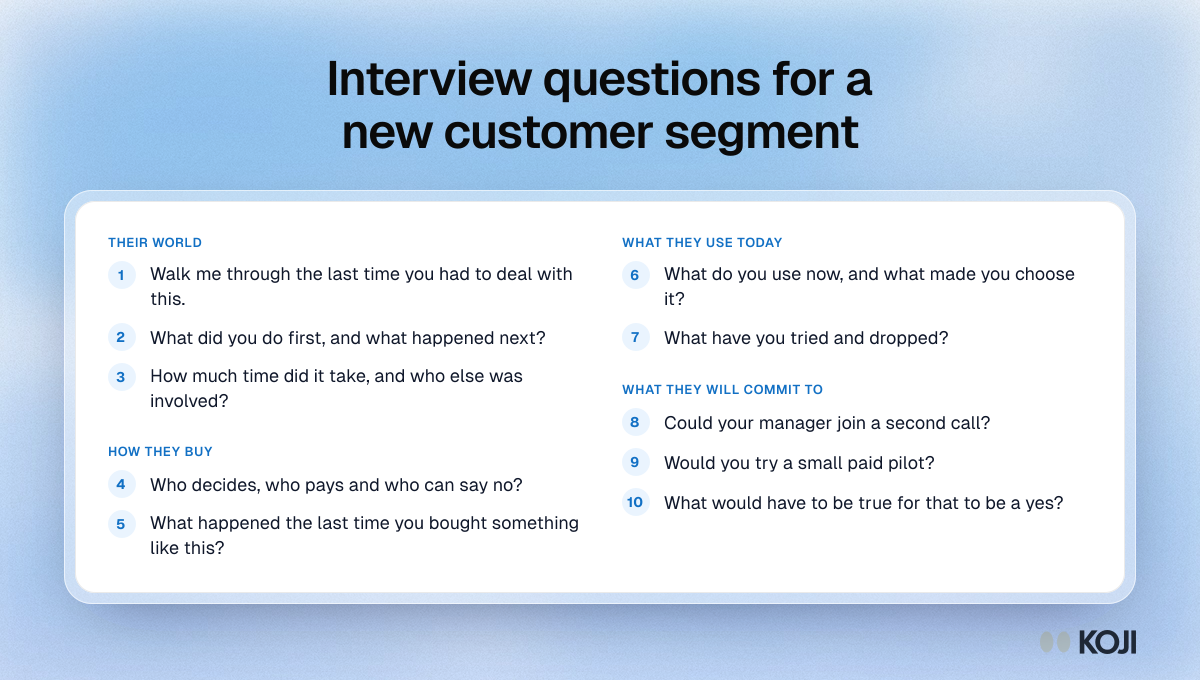
Three habits keep the answers honest:
- Ask for the last time it happened, not what they would do.
- Ask who else is involved. In a group of five to 16 [1], one person's view is a fraction.
- End with a request that costs them something: a second call with their manager, a data sample, a pilot, or a deposit on a paid trial.
5. Run it in four weeks
| Week | What happens |
|---|---|
| 1 | Write kill criteria, build the screener, list sources, send the first invitations |
| 2 | Run the first 10 interviews and read them as they arrive. Fix the questions that did not work |
| 3 | Run the next 15, adding the second role if you chose both |
| 4 | Read everything together, compare to your current customers, and decide |
A worked example
Say you are a 14-person team selling scheduling software to single-location dental clinics. A few multi-site dental groups have asked for a demo, and an investor has asked why you are not "going upmarket".
Your kill criteria: the segment is practice managers and operations leads at groups with five to 30 clinics. You believe they lose hours every week reconciling schedules across sites. You stop if fewer than 8 of 25 describe it without being asked, or if none will join a pilot.
You screen for people who set staff rotas across at least five sites and did it in the last quarter. You find 25 through two customers who know them, a regional dental association, and three lost deals.
What you hear: 17 of 25 describe cross-site reconciliation, and 11 of those bring it up before you ask. Only 4 are the decider. The rest say the group's finance director signs, and three mention that the clinic software they already use must stay the source of truth. Your single-clinic customers never mentioned either.
What you decide: the problem is real, but the buying path and an integration requirement are new. You do not build a multi-site product. You offer 6 of the 17 a paid three-month pilot of a read-only cross-site view, and 3 accept. That is a signal worth building for, with a clear scope. If none had accepted, you would stay with single clinics and say so to the investor with the data.
Reading the results and deciding
Count, then read the quotes behind the count.
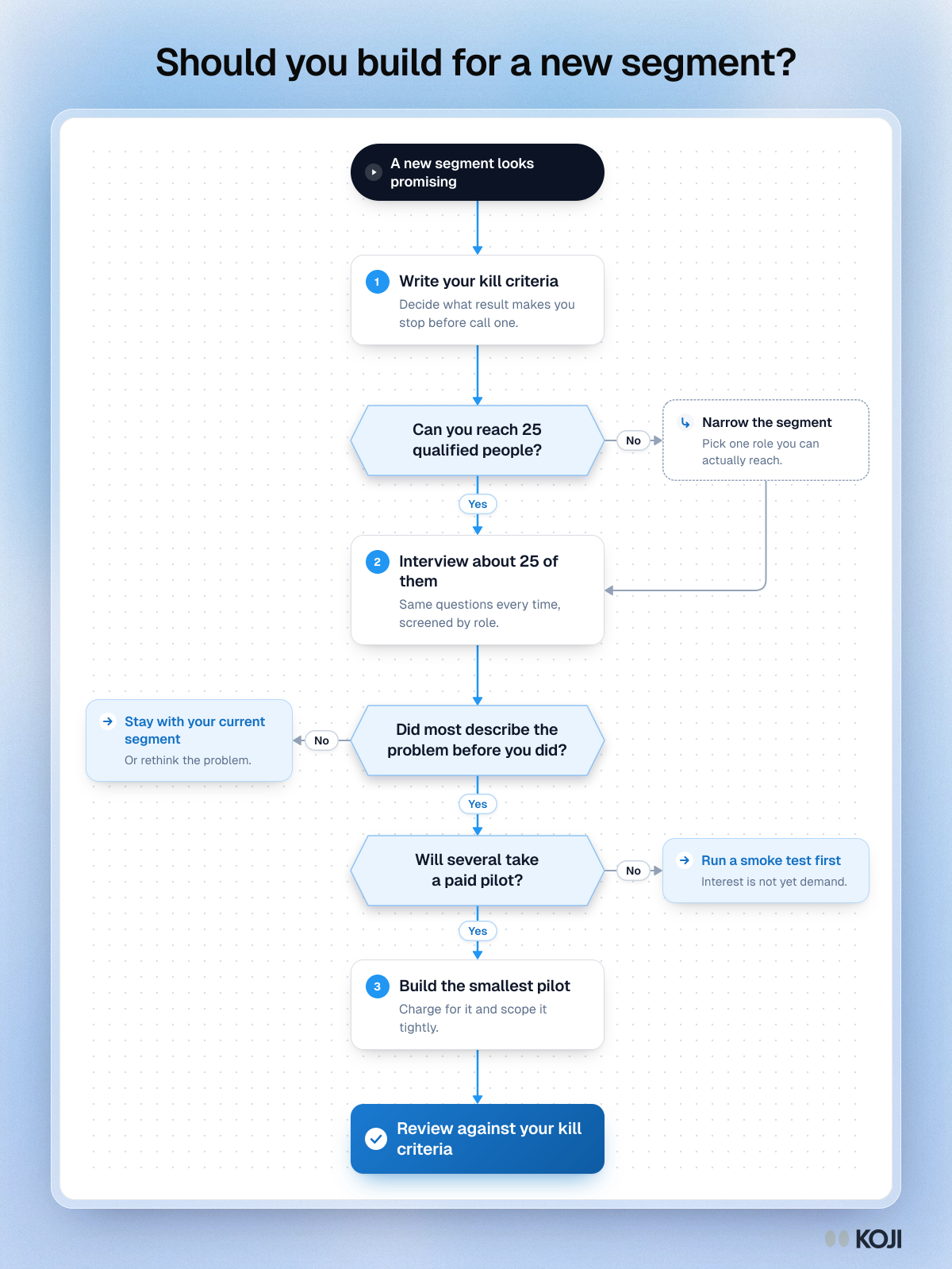
Use rules like these, set in advance:
| What you found | What it suggests | Next step |
|---|---|---|
| Most describe the problem before you do and several take a pilot | Real pull | Build the smallest pilot, charge for it |
| They agree the problem is real but no one commits | Interest, not demand | Run a smoke test or a concierge version first |
| They describe a different problem than your product solves | Wrong fit | Decide whether to adapt or stay |
| You cannot reach 25 qualified people in a month | The segment may be too narrow, or too hard for you to sell to | Narrow it or park it |
Also compare to your current customers. Where the new segment gives the same answer on the problem but a different answer on who buys, you have a go-to-market change, not a product change. That is cheaper than it sounds and worth knowing before you hire.
Pricing comes after this. A price test with about 30 interviews gives a directional curve with reasons behind it, not a final price, and survey guidance usually wants 100 or more per segment. Stated willingness to pay also runs high: a meta-analysis of 77 studies found hypothetical payments about 21% above real ones on average [7]. See Price your first product with 30 customer conversations and Contact us or a published price.
Run it this week with Koji
You can do all of this by hand with a spreadsheet and calendar invites. The reasons to use Koji are speed and being able to hear 25 people without scheduling 25 calls. Here is the setup, checked in the product.
- Start from the brief. Describe your research question to the research assistant ("why multi-site dental groups struggle with scheduling") and it drafts the study. Paste your question bank and your kill criteria into the brief.
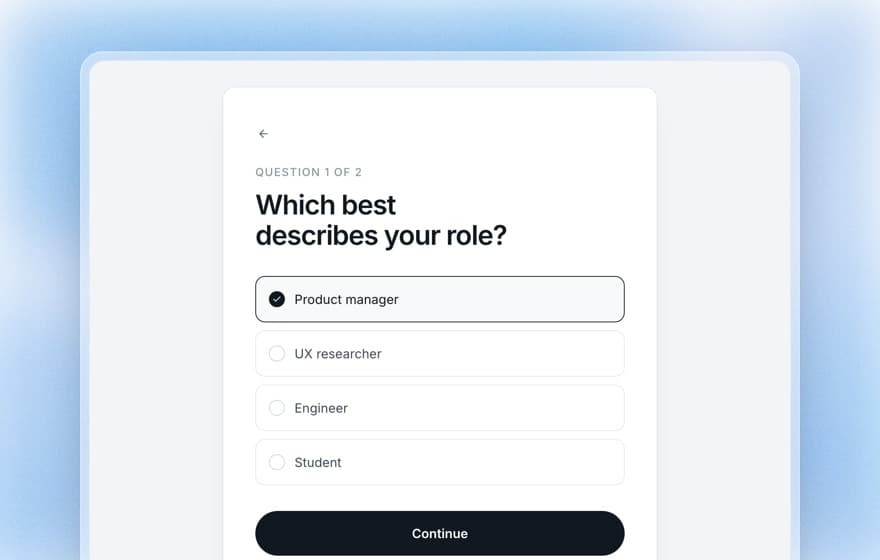
- Add screening questions. In the brief, add a screening question for role, number of sites, and whether they did the task recently, and mark which answers qualify. Everyone answers them before the interview starts, whatever route they arrived by, and anyone who does not qualify is turned away. Screening is available on every plan.
- Bring your people in. Email an audience with an invitation and a reminder from the study's Self-recruit tab (on paid plans), or import a CSV of prospects and lost deals and give each their own invite link (personal links need the Interviews plan or above). If you have no list, recruit from Koji's research panel; building an audience and seeing the cost works on any plan, and launching needs a paid plan.
- Show the concept. If you want a first reaction to a new landing page or a one-page offer for the segment, attach the image to a question. It can be shown once, full screen, for 3, 5, 10 or 15 seconds, then hidden, and Koji asks what they remember and what they think. Works in text and voice interviews.
- Add a structured question for the commitment. Ask a choice question: "Would you join a three-month paid pilot?" with answers from "Yes, send details" to "No", and follow it with an open question asking why.
- Add a price test later. When the problem checks out, a price test question lets each person say how likely they are to buy at one price at a time, starting in the middle of your ladder, then asks why. The report shows the share who would buy at each price and the quotes behind them. It is directional and reads best from about 30 interviews.
- Read the report. Each finding links to the participants behind it. Download the report as an editable PowerPoint deck or a PDF to take to your board or investor.
Run the new segment as its own study, with its own screener, so its report stands alone. Compare it with the report from your current customers side by side. Put anything the interviewer must know in the brief or in the question itself.
Two honest limits. AI interviews give you breadth fast, but they do not replace a conversation with the person who signs. Use them to learn the shape of the problem across 25 people, then talk to the buyers yourself. And Koji cannot tell you how many accounts exist in the segment; that comes from sizing.
Common mistakes
- Starting with the solution. Showing your product first turns the interview into a demo. Ask about the problem, then show.
- Counting enthusiasm as demand. "That would be great" costs nothing. A pilot, a data sample or a deposit does.
- Interviewing only champions. The champion is one person in a group of five to 16 [1]. Ask who else decides, and talk to them.
- Mixing segments in one pile. Ten answers from two different groups tell you nothing about either.
- Changing the questions halfway. Fix bad questions in week 2, then keep them fixed.
- Letting your best customers vote. They are not the new segment.
When research will mislead you
Interviews measure what people say and remember. People overstate what they will pay [7], and a polite buyer will tell you what you hope to hear. Pair interviews with a commitment: a paid pilot, a letter of intent, or a smoke test with a real call to action. Treat 25 interviews as a strong signal, not proof. If the segment's buying process runs months, a pilot signed today may still not become a contract; track what happens, not what was said.
Also remember the survey base: the Gartner figures above describe B2B buyers in general [1][2]. Your own segment may differ, which is the reason to ask.
Where this fits
This sits in the scaling stage of the founder's research playbook, after you know why you win and lose deals (Why you lose bigger deals) and before you change your pricing for the new segment (Contact us or a published price). For the account-expansion side, using the customers you already have, see account expansion and upsell research. More for founders at /for/founders.
FAQ
How many interviews do I need to test a new customer segment?
About 25 qualified people per distinct role is a sensible working target. Saturation studies find 9 to 17 interviews for fairly uniform groups [4], and more when contexts differ [6]. Use more if the segment has two roles.
Should I interview my existing customers about the new segment?
Only the ones who work next to it, as sources for introductions. They are not a substitute, because they are not in the segment.
Is it better to run a survey for a new segment?
Not first. A survey tests what you already know to ask. Interview first, then use a survey once you know the problem and want counts.
How do I find people in a segment I have no network in?
Start with your own lost deals and prospects, ask customers for warm introductions, join the communities and events for that role, or use a research panel when you can describe the segment in a sentence. See the sourcing guide linked above.
When should I test pricing for the new segment?
After the problem checks out. A price test from about 30 conversations is directional. Confirm with a paid pilot.
What if only a few people commit to a pilot?
That may be enough. Three of 25 paying for a scoped pilot is a clearer signal than 20 saying it sounds good. Decide your threshold before you start.
Next step
Write your kill criteria today, then draft the screener. If you want to run it this week, start a study from the research assistant, paste your question bank, and add the screening questions.
References
- Gartner, "Gartner Sales Survey Finds 74% of B2B Buyer Teams Demonstrate 'Unhealthy Conflict' During the Decision Process", press release, 7 May 2025 (survey of 632 B2B buyers). https://www.gartner.com/en/newsroom/press-releases/2025-05-07-gartner-sales-survey-finds-74-percent-of-b2b-buyer-teams-demonstrate-unhealthy-conflict-during-the-decision-process
- Gartner, "Gartner Sales Survey Finds 67% of B2B Buyers Prefer a Rep-Free Experience", press release, 9 March 2026 (646 buyers, surveyed August to September 2025). https://www.gartner.com/en/newsroom/press-releases/2026-03-09-gartner-sales-survey-finds-67-percent-of-b2b-buyers-prefer-a-rep-free-experience
- Arnaldo Camuffo, Alessandro Cordova, Alfonso Gambardella and Chiara Spina, "A Scientific Approach to Entrepreneurial Decision Making: Evidence from a Randomized Control Trial", Management Science 66(2), 2020. https://doi.org/10.1287/mnsc.2018.3249
- Monique Hennink and Bonnie Kaiser, "Sample sizes for saturation in qualitative research: A systematic review of empirical tests", Social Science & Medicine 292, 2022. https://pmc.ncbi.nlm.nih.gov/articles/PMC9359070
- Greg Guest, Arwen Bunce and Laura Johnson, "How Many Interviews Are Enough? An Experiment with Data Saturation and Variability", Field Methods 18(1), 2006. https://doi.org/10.1177/1525822X05279903
- Jessica Hagaman and Amber Wutich, "How Many Interviews Are Enough to Identify Metathemes in Multisited and Cross-Cultural Research?", Field Methods 29(1), 2017. https://metatoc.com/papers/58698-how-many-interviews-are-enough-to-identify-metathemes-in-multisited-and-cross-cultural-research-another-perspective-on-guest-bunce-and-johnsons-2006-landmark-study
- Jonas Schmidt and Tammo Bijmolt, "Accurately measuring willingness to pay for consumer goods: a meta-analysis of the hypothetical bias", Journal of the Academy of Marketing Science 48(3), 2020. https://doi.org/10.1007/s11747-019-00666-6
Further reading
- The Mom Test: how to ask about the past so people cannot flatter you.
- Data saturation in qualitative research: how to know when more interviews stop adding anything.
- How much data a segment needs: when a segment's own numbers are enough to trust.
- Jobs-to-be-done interviews: the timeline interview, useful for asking why someone switched.